E-Paper



Is monsoon performance in June a cause for worry?
The first month of the monsoon is in sync with expectations of weak rain. But it may not be a cause for worry yet as far as rice output is concerned
Updated on: Jun 28, 2023, 19:06:25 IST

 Prefer HTon Google
Share via


Copy link

The charts that matter
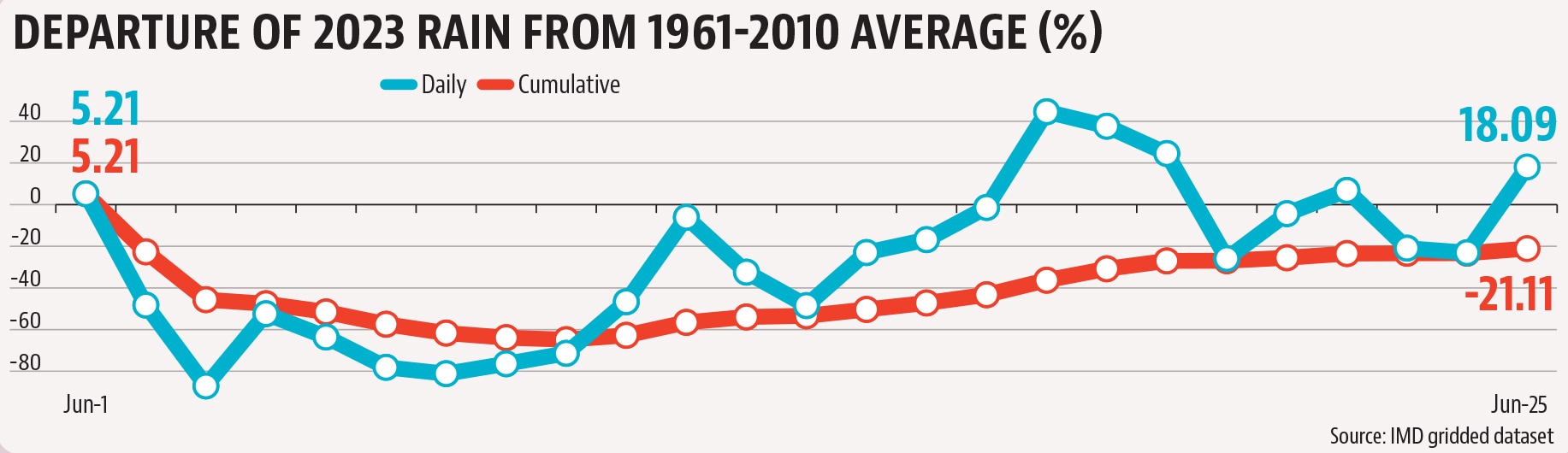
 There is a big deficit in the first month of the 2023 monsoon...India has received 99.6 mm rain this month till 8:30 am on June 25, according to the gridded dataset of the India Meteorological Department. This is 21% lower than the average rain during the 1961-2010 period, the benchmark for rain, and the 23rd lowest rain for this part of June since 1901. Clearly, the monsoon’s performance in its first month has been bad. It is not entirely unexpected. Four of the driest years of June 1-June 25 rain are from 2009 onward, and 2019 was 18% drier than this year.
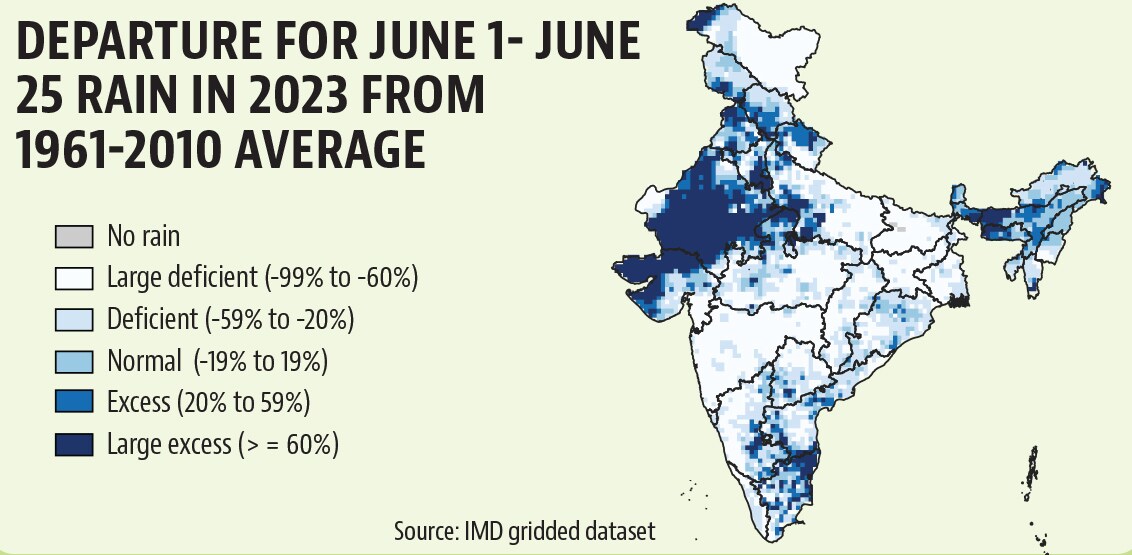
- ...which is worse in central and eastern regionsTo be sure, like all averages, the overall deficit in June hides regional variations. Almost two-thirds of the country (62.4%) has a deficit bigger than the India average. Moreover, not all levels of deficit the same. The Met department considers a deficit to be below normal at 20% or higher deficit, with a 20%-60% called deficient and that of 60% or higher called large deficient. As much as 38% of the country’s total area is large deficient and 25% deficient, with most of this area concentrated in central and eastern states and Maharashtra in the west. On the other hand, large parts of Gujarat, Rajasthan, Punjab, Haryana, and parts of northeastern states have received above normal rain, which is a surplus of 20% or more.
- However, rains have come closer to normal after Cyclone Biparjoy’s landfallSimilar to the regional differences, there has been temporal variation in the monsoon’s performance this month. A day after the onset of monsoon over Kerala on June 8 (late by seven days), the cumulative deficit from the 1961-2010 average reached a high of 65%. The deficit was 50% even on June 14. This cumulative deficit is less than half of the mid-June level now because daily rains have been closer to the historical average in the second half of June. Part of this is because the landfall of Cyclone Biparjoy and its remnant (a low-pressure area over Rajasthan) caused unusually intense rains in most of northwestern India. However, part of this is also because the monsoon system started making progress after Biparjoy’s landfall.
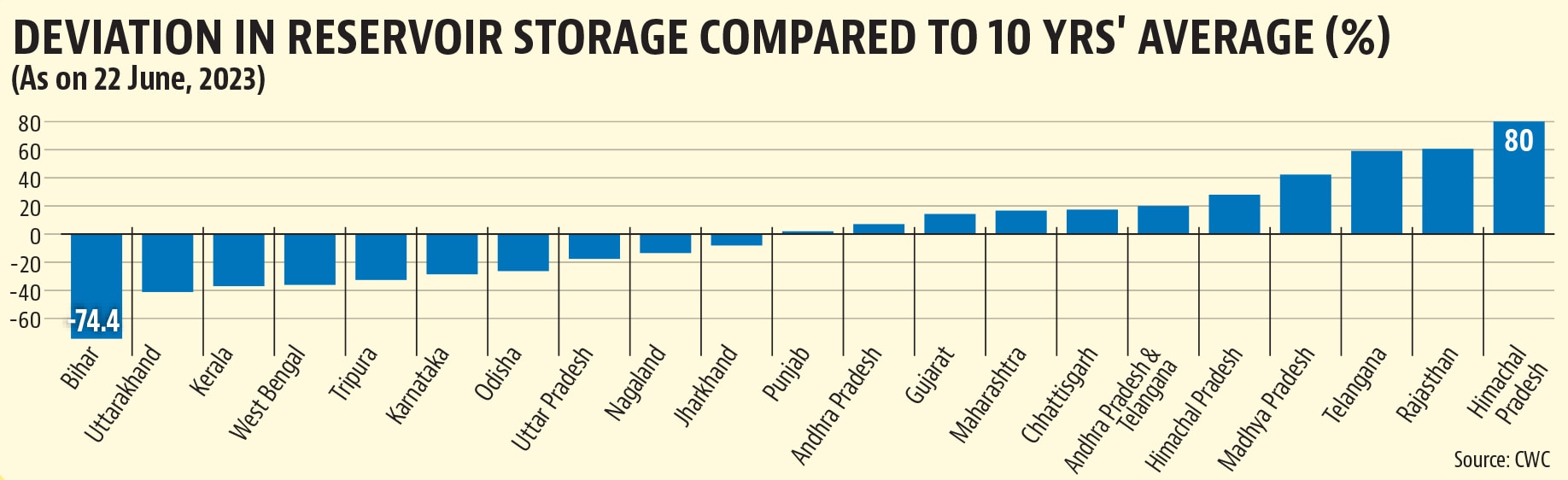
- Rice producing states have big deficits, but it is not all over yetAs the geographical pattern of rainfall shows, large parts of rice-producing states have big deficits. The top 10 rice producing states are Uttar Pradesh, West Bengal, Punjab, Andhra Pradesh, Odisha, Chhattisgarh, Bihar, Telangana, Tamil Nadu and Haryana. Together, they accounted for 78% of India’s rice output on average in the 2012-21 period. Most of the area in all these states, except Punjab and Haryana, is under big deficits so far this monsoon. However, it should not be taken to mean the rice output is doomed this year. This is because of two reasons. First, reservoirs are not running dry in most of these 10 states despite a deficit in June rainfall. The Central Water Commission tracks live storage status in 146 reservoirs across the country compared to the average storage in the past 10 years. It shows that only four major rice-producing states have a deficit in reservoir storage: Bihar, West Bengal, Odisha and Uttar Pradesh.
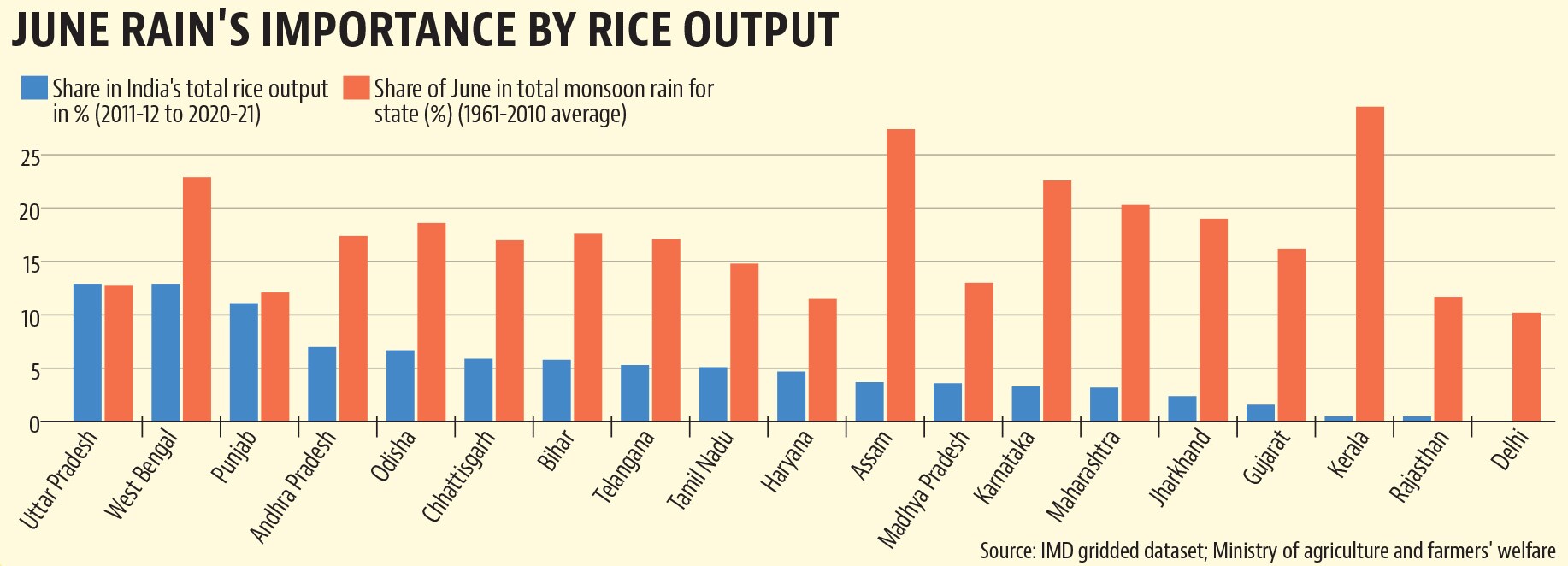
- So what does it mean for rice output?To be sure, the four eastern states account for 38% of India’s rice output. Does this mean a significant blow to rice output this year? It is not known yet because June is not the rainiest month in the rice-producing states. In north-western states of Punjab, Haryana and Uttar Pradesh, June accounts for just 11%-13% of monsoon rains. In all eastern states except West Bengal, it accounts for 17%-19% of monsoon rain, similar to the India average of 19%. Only in West Bengal, June rain accounts for almost a quarter (23%) of monsoon rains. Therefore, experts also think one must wait for trends in July and August to understand the impact on agriculture. “Below-normal rains can also impact winter crops (like wheat) in Q4 2023 and Q1 2024, by lowering the level of water reservoirs. That said, the spatial and temporal distributions of rains are more important than the overall level, with the months of July and August particularly important for summer crops,” Sonal Varma and Aurodeep Nandi said in a Nomura research note dated June 22.