E-Paper



Number Theory: Has spring 2024 been more pleasant than usual?
How pleasant or not is 2024 spring season in India? Here are four charts that show this
Updated on: Mar 25, 2024, 12:41:37 IST


Share via


Copy link

In the earth’s annual revolution around the sun, the sun’s rays fall perpendicular to the equator twice a year, the day being called an equinox. The first of this year’s two equinoxes took place last week on March 20. In the northern hemisphere, this is called the spring equinox because it falls roughly in the hemisphere’s spring season. While India does not have an official spring season, March can also be considered India’s spring season because of the spring equinox and because the official winter season ends in February. How pleasant or not is 2024 spring season in India? Here are four charts that show this.

Has spring 2024 been more pleasant than usual?
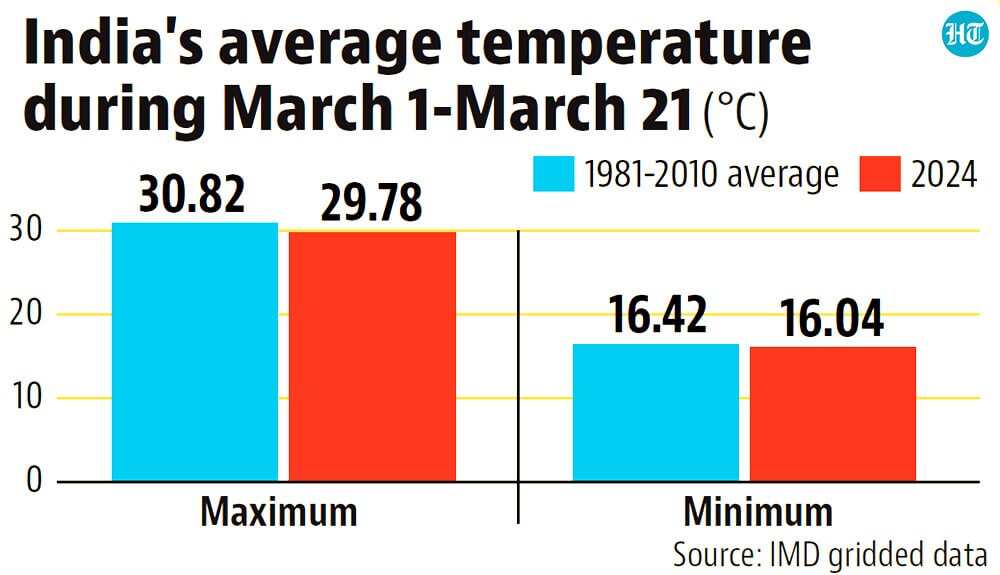
 Cooler by both maximum and minimum temperatures so farIndia’s average maximum in the first three weeks of March was 29.78°C, according to India Meteorological Department’s (IMD) gridded database. This is more than a degree Celsius lower than the 1981-2010 average (considered temperature’s normal) for this part of March: 30.82°C. Similarly, India’s average minimum for the first three weeks of March was 16.04°C, also lower than the normal of 16.42°C. This suggests that India is experiencing a cooler than normal spring so far this year.
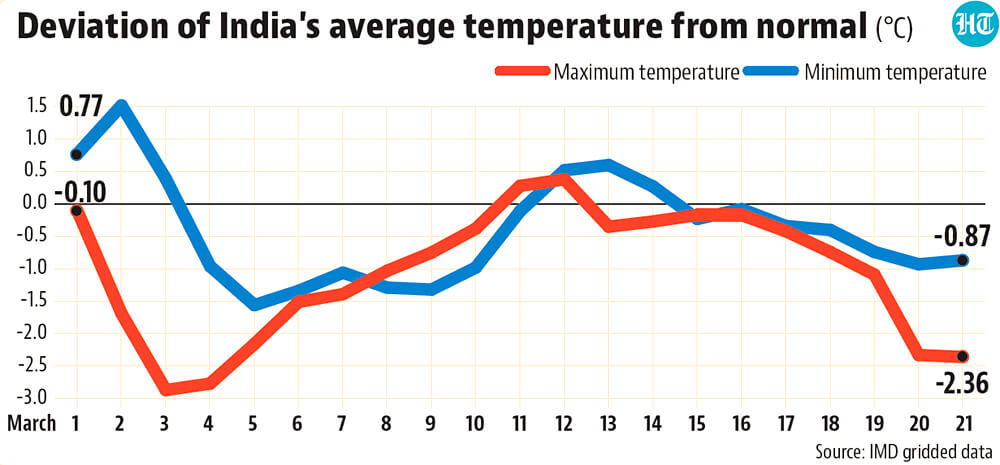
- But most of the cooling compared to normal happened in the early part of MarchTo be sure, the numbers given hide some variations that are important to understand how the month felt. One such variation is how daily temperatures behaved over the course of the month. It is important to check this because March is a month of transition between winter and summer in India. For example, even the average maximum for India reaches the 30°C mark by March 6 on the normal chart and the 32°C mark by March 18. Therefore, the part of the month driving the month’s average trend can affect how the month felt. Cooling in early part of the month might delay the feeling of spring and cooling in the later parts can prolong the feeling of spring. Daily temperature trends show that it is the former that has primarily driven the average for the month below normal. To be sure, both the maximum and minimum were close to normal in the week after March 10. This means that at least the later part of the month has not been very warm for India on average.
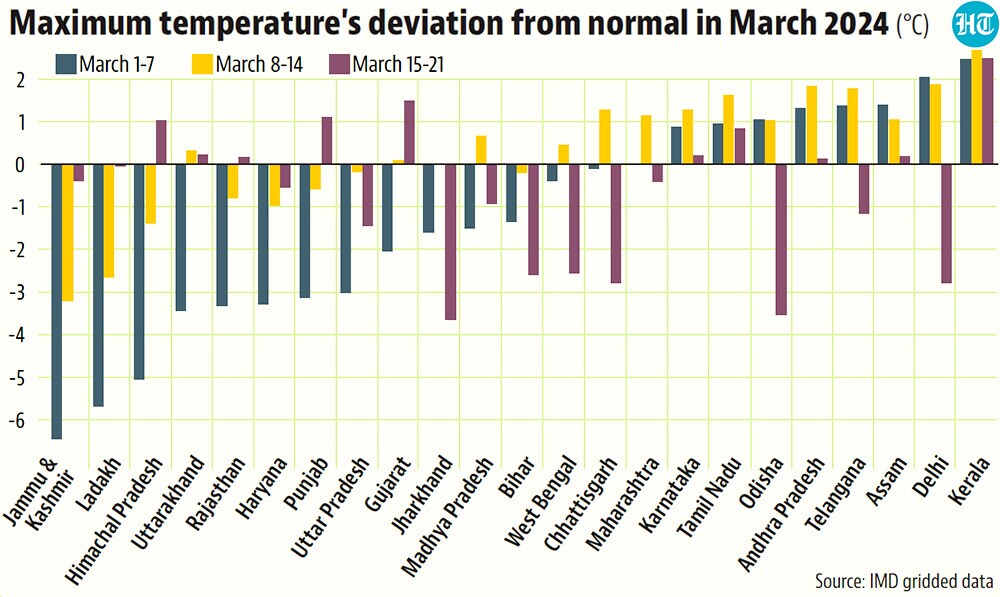
- Cooling in maximums was also limited to the northern half of the countryPerhaps an even more important aspect of March 2024 temperatures this year is its regional trend. For example, the drastic cooling in maximums seen in the charts above was limited to the northern half of the country. In most northern and north-western states, maximums were cooler than normal on average in at least two of the first three weeks of the month. One exception to this was Delhi, which was warmer than normal in the first two weeks, but turned cooler than normal in the third week. To be sure, Delhi in this analysis is bigger than its administrative boundaries because IMD’s gridded data on temperature cannot capture small areas. In contrast to the northern states, most peninsular and north-eastern states have been warmer than normal in each of the first three weeks of March. Among big states, the worst warming was in Kerala, where maximums have been at least 2.5°C warmer than normal in each of the first three weeks of March.
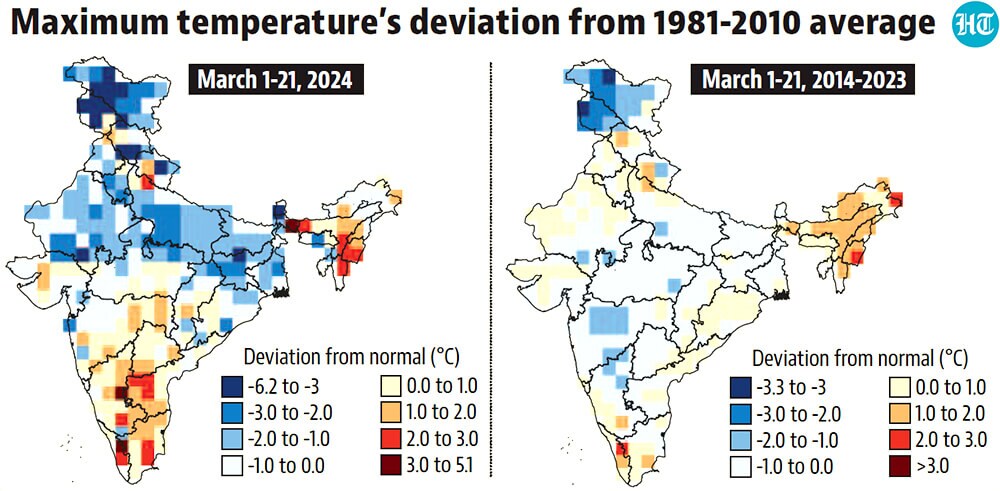
- The geographic trends in spring maximums this year have long-term parallelsOne such parallel is that 2024 is not a rare year when peninsular and north-eastern regions have experienced higher than normal maximums in the first three weeks of March. These two regions have experienced warmer than normal maximums on average even in the past decade in this part of March. This suggests that a warmer than normal March in these regions in 2024 is part of a long-term trend. However, such warming has also been seen in north-western India in the past decade, which is not the case this year. This suggests that north-western India has experienced a relatively cooler spring than it became used to in the past decade. However, this may not last long. IMD’s extended range forecast issued on March 22 shows that north-western India is likely to experience warmer than normal maximums in each of the next four weeks.