E-Paper



Number Theory: The growth and erosion of salaried employment in India
The authors are faculty at Azim Premji University. The views expressed are their own and do not necessarily reflect the views of the University
Published on: Oct 9, 2023, 09:45:53 IST

 Prefer HTon Google
Share via


Copy link

Over the past two decades, economic growth has pulled millions of workers out of agriculture in India. However, growth has not proved as effective in creating regular salaried employment. That is, most workers leaving agriculture have either left the workforce (in the case of women) or found employment in the informal sector. Moreover, even the salaried jobs created have been largely of the informal kind which do not come with written contracts or benefits. The consequence has been a persistent informal workforce, outside of the agricultural sector, largely in casual wage work and self-employment, and a growing informal economy within the formal sector.

The growth and erosion of salaried employment in India
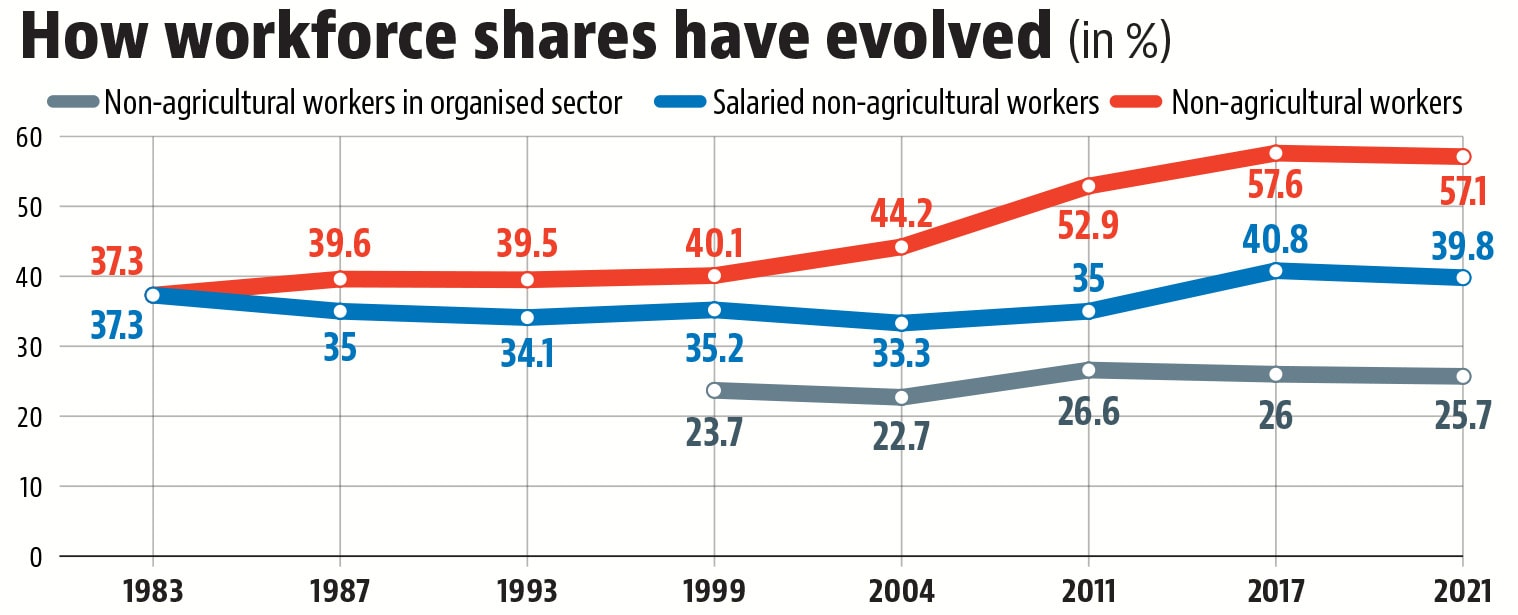
 Steady exit of workers from agriculture not accompanied by an equal rise in salaried workThe share of the workforce in non-agricultural employment increased by nearly 20 percentage points between 1983 and 2020. By comparison, during the same period, the increase in the share in salaried employment within the non-agricultural workforce, was only about 3 percentage points.
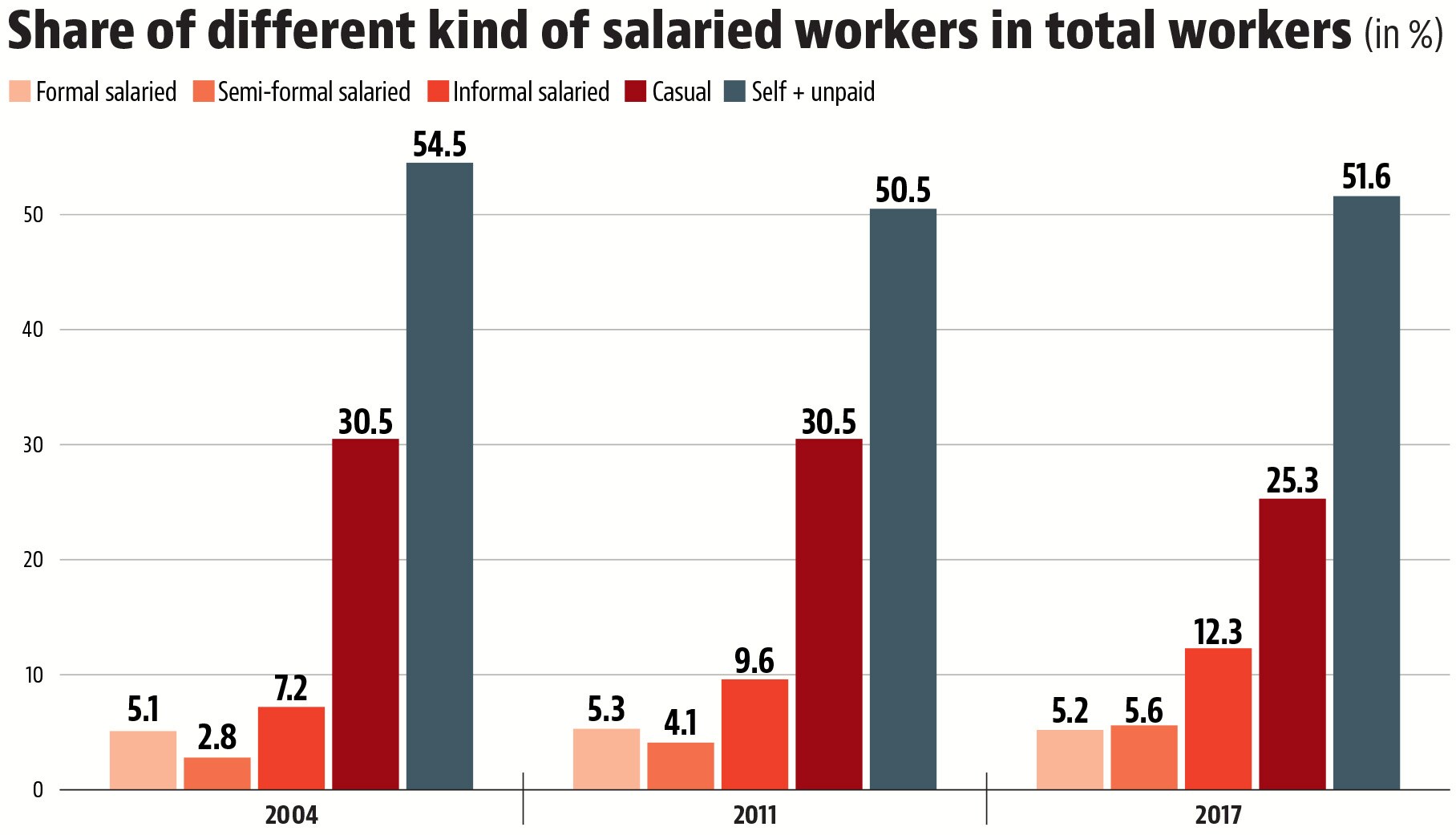
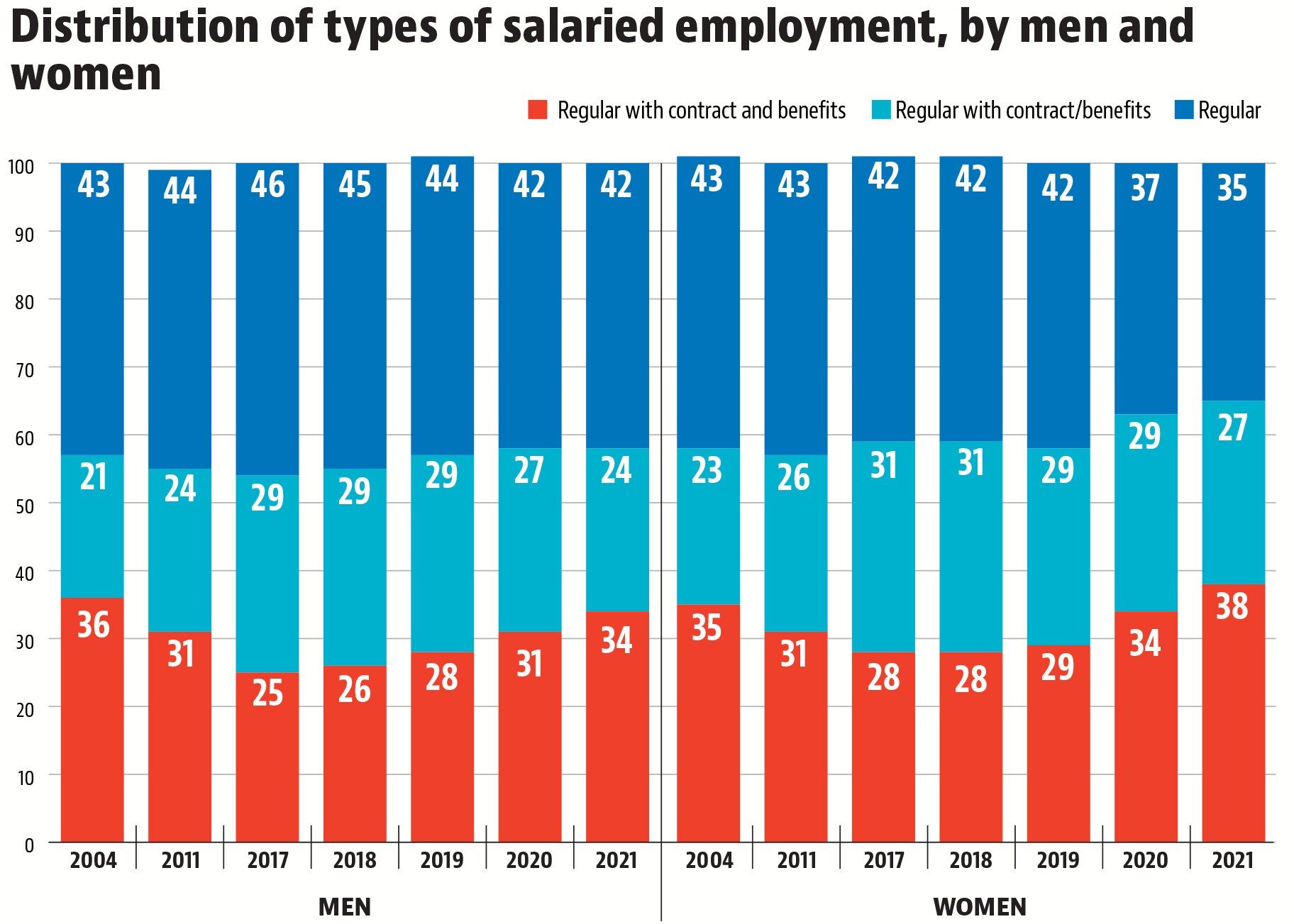
- Increasing informalisation of salaried workSince 2004, labour surveys started collecting data on the quality of regular salaried jobs. We categorise regular salaried employment into “formal” where the job comes with a written contract and benefits, “semiformal” with either written contract or benefits but not both, and finally, “informal” - regular salaried jobs with neither a written contract nor benefits. Most of the increase in salaried work has been in informal salaried employment. The proportion of formal salaried stagnated in this period at around 5 percent whereas informal salaried increased from 7 to 12 percent. If we look at the composition of the salaried workforce by itself (setting aside casual wage workers and the self-employed) the change can be seen more easily. In 2004, the formal category accounted for 36 percent of all regular wage jobs. By 2017-18, its share had fallen to 25 percent, and the share of semi-formal jobs had risen from 21 to 30 percent. Of the 35 million increase in regular wage jobs during the 2004 to 2017 period, only 2 million were in the formal category, about 16 million offered either a written contract or benefits and the remaining 17 million were in the informal category.
- More than men, women benefited from the increase in salaried workA larger share of the increase in salaried employment since 20004 has accrued to women than men. Strikingly, of the 35 million increase in salaried workers during this period, 26 million were women and 9 million were men. In 2004, about 10 percent of employed women were in salaried work and the corresponding share for men was 18 percent. However, by 2017, the share of women in salaried jobs had more than doubled to 25 percent. For men too, the share had increased, but by a smaller extent to 24 percent. Even more interestingly, of the increase in regular salaried work among women between 2004 and 2017, 18 percent was in jobs with contracts and benefits (and about 40 percent each was in the other two types), while for men only two percent of the new jobs were in this category. For men, the majority (52 percent) of the new regular salaried jobs were informal and had neither benefits nor a written contract. One reason for the slowdown in formal salaried employment for men is the relative contraction of the public sector as a provider of ‘good jobs’, a phenomenon we highlighted in this paper earlier. In more recent years, the ‘good jobs’ have been created more in education and health sectors which have traditionally been major sources of salaried work for women. Of course, it should be kept in mind that the majority of Indian women of working age are not employed in the first place. So the foregoing only pertain to the employed minority of women.