E-Paper



Number Theory: What HCES tells us about rural-urban inequality
A section of rural India has caught up with its urban counterparts in terms of ownership of white goods, as per the 2015-16 and 2019-21 NFHS data.
Published on: Feb 29, 2024, 08:49:02 IST

 Prefer HTon Google
Share via


Copy link

The 2022-23 Household Consumption Expenditure Survey (HCES) data, when it is released in full, will hopefully facilitate a rigorous analysis on various aspects of consumption inequality in India. Till the data is released finally – the National Statistical Office (NSO) is yet to come out with a date for it – what can we say about rural-urban inequality in India? Here are three charts which try and answer this question with data that is already available in the public realm.
What HCES tells us about rural-urban inequality
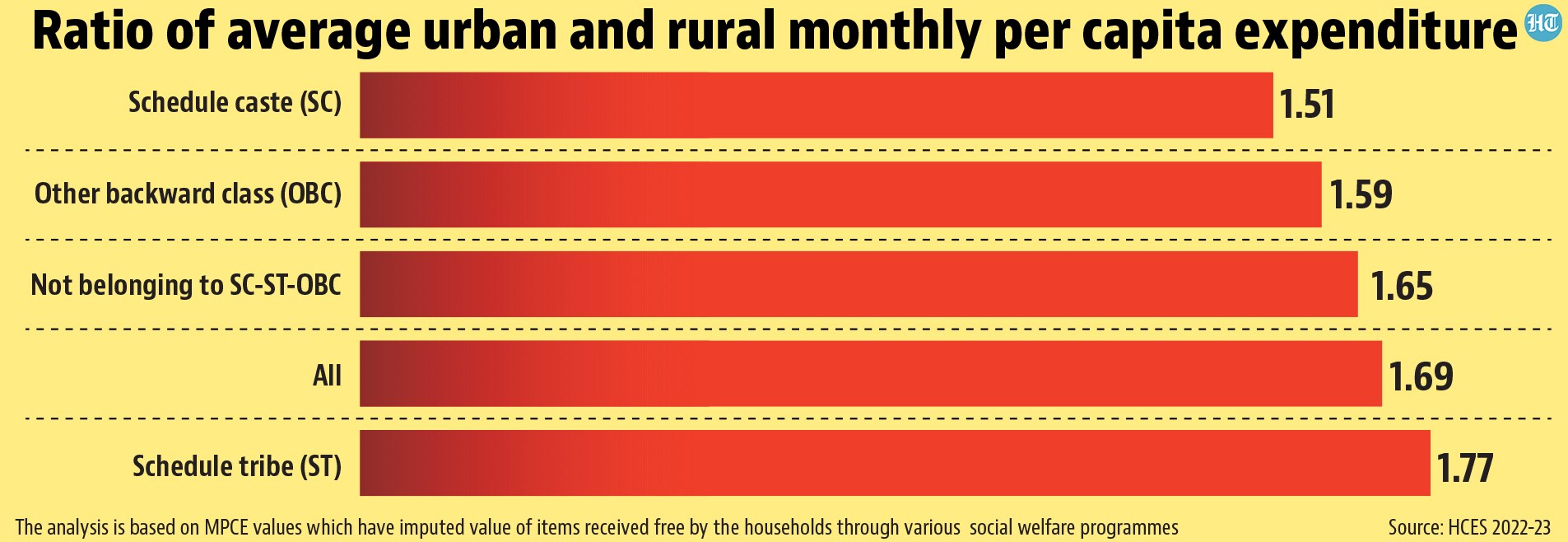
 The social inequality in rural-urban MPCERural-urban migration is one of the most sought-after routes in India to improve living standards. Data published in the HCES fact sheet shows that a rural to urban shift does not carry equal rewards across the social-divide in India. This can be seen from a comparison of average monthly per capita expenditure (MPCE) for scheduled tribe (ST), scheduled caste (SC), other backward classes (OBC) and persons not belonging to any of these groups in rural and urban areas. The ratio of average urban and rural MPCE is 1.51 for SCs compared to 1.59 for OBCs, 1.65 for persons not belonging to SC-ST-OBC groups and 1.77 for STs. The numbers for SCs, OBCs and non SC-ST-OBC groups suggest that SCs and OBCs face some sort of an entrenched disadvantage even when it comes to reaping the rewards of rural to urban migration. As far as the ratio being the highest for STs is concerned, it will have to examined more carefully when state-wise data is released because the economic condition of STs differs significantly in north-eastern states and regions such as central India, with STs in the latter being significantly poorer than the former.
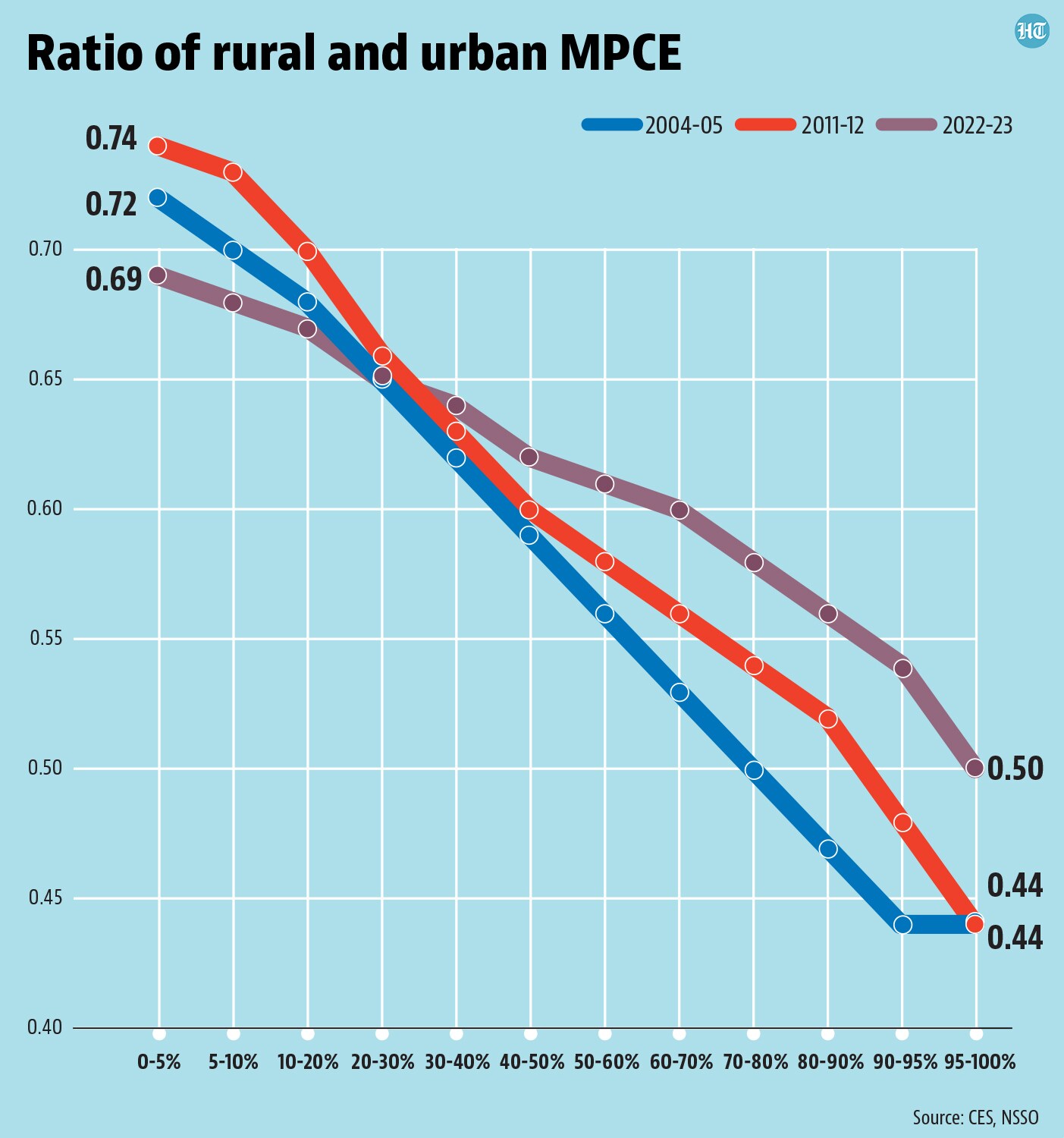
- The inter-class inequality in rural and urban MPCEThis is another interesting statistic from the comparison of 2022-23 fractile class-wise average MPCE for rural and urban areas with previous rounds. Simply put, it tells us how tempting it is for a poor or rich person to migrate from rural to urban areas. A comparison of ratio of average MPCE for rural and urban areas for 2004-05, 2011-12 and 2022-23 CES shows that it has always fallen as one moves from lowest to highest MPCE classes. This means that the rural-urban consumption (a proxy for income) gap increases as one goes from the poorer to the richer sections of the population. Intuitively, this makes sense, as high value activities are more likely to be concentrated in urban areas. While the broad trend is unchanged in the three CES rounds, the data does show that rural-urban MPCE ratio has fallen for the poorest classes and increased for the richer parts of the population in the 2022-23 HCES round. Relatively speaking, this means that it makes less sense for a richer rural person to migrate to urban areas now whereas the poorest population in rural areas has a greater incentive to boost their consumption spending by moving to urban areas.
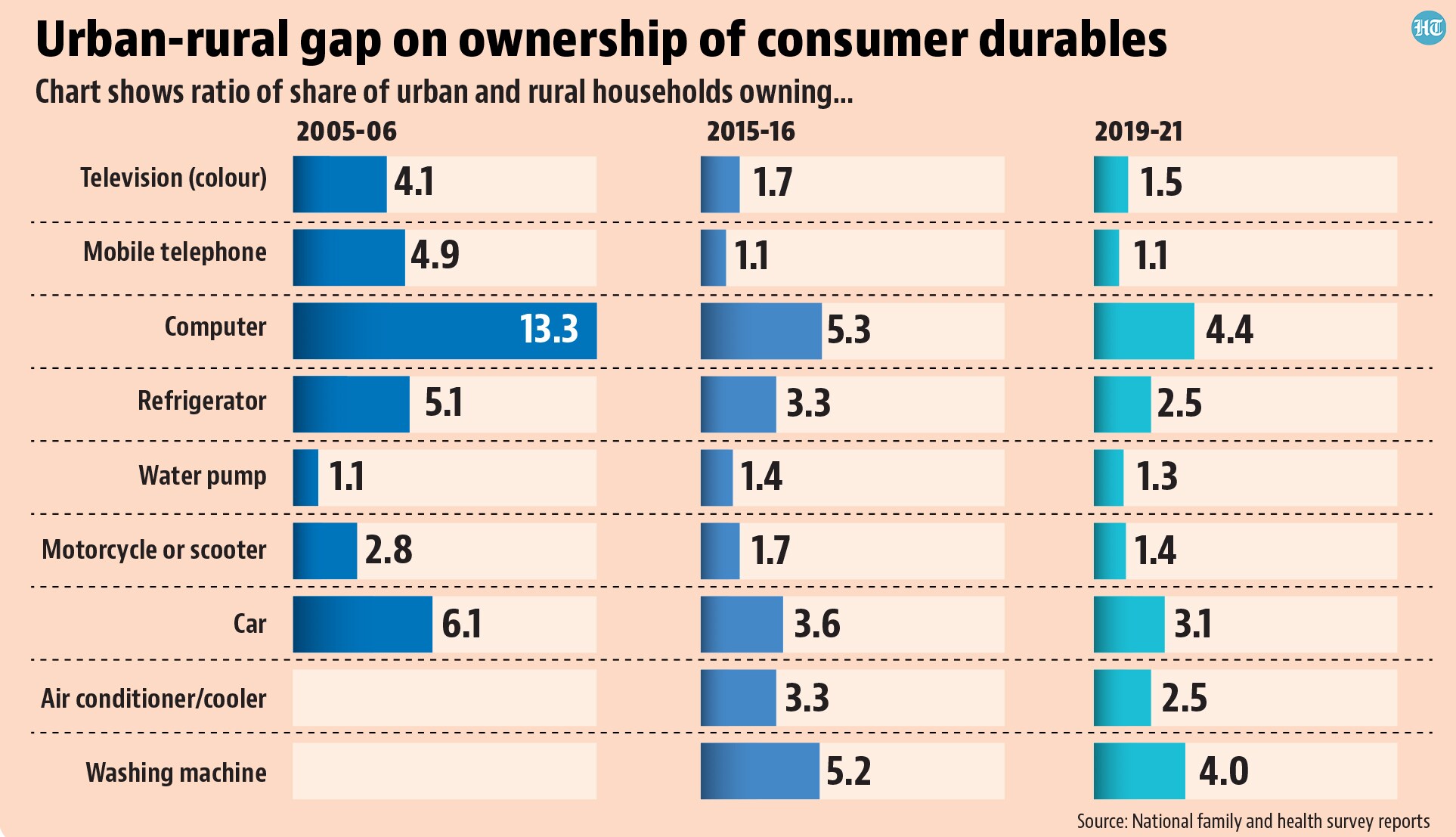
- When read with rural India driving ownership of consumer durable goods, this suggests a growing class differentiation even in villagesNational Family and Health Survey (NFHS) data gives details of ownership of various kinds of consumer durable goods in rural and urban India. A comparison of past three rounds of NFHS (2005-06, 2015-16 and 2019-21) shows that the rural-urban gap between ownership of various kinds of consumer durable goods has been coming down in India. The 2015-16 and 2019-21 NFHS rounds have consumer durables such as washing machines and air-conditioners/coolers which were not included in the 2005-06 round. These numbers suggest that a section of rural India has clearly caught up with its urban counterparts in terms of ownership of white goods. To be sure, it is entirely likely that urban areas have seen a qualitative improvement in the ownership of white goods over this period while rural Indians are just beginning to own entry level products of these kinds.
- While detailed and definite conclusions about consumption inequality or rural-urban aspects of this must wait for the publication of unit-level data of the 2022-23 HCES the data suggests that there is good reason to believe that while rural-urban inequality continues to exist in India, its manifestation is very different depending on one’s place in the social or economic hierarchy.