E-Paper



Number Theory: What is at stake in today's voting?
After Friday’s polling, the casting of votes will have concluded in almost one-fifth of India’s 543 PCs.
Published on: Apr 19, 2024, 09:04:39 IST

 Prefer HTon Google
Share via


Copy link

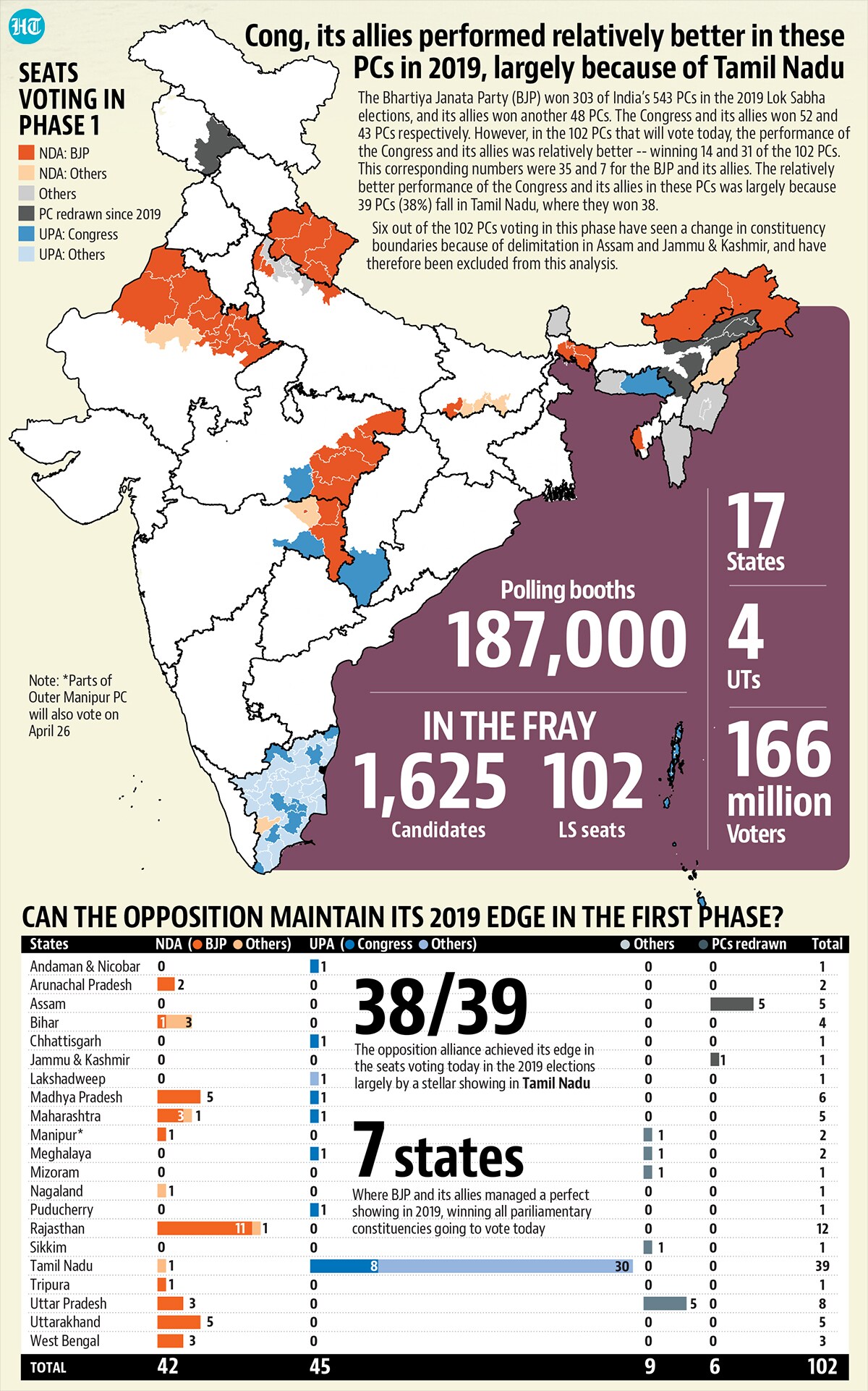
The 2024 Lok Sabha elections kick off on April 19 with the first and largest among the seven phases of polling across 102 parliamentary constituencies (PCs) in 17 states and four Union territories (UTs). Here is what the contest entails.
What is at stake in today's voting?
 Congress, its allies performed relatively better in these PCs in 2019, largely because of Tamil NaduThe Bhartiya Janata Party (BJP) won 303 of India’s 543 PCs in the 2019 Lok Sabha elections, and its allies won another 48 PCs. The Congress and its allies won 52 and 43 PCs respectively. However, in the 102 PCs that will vote today, the performance of the Congress and its allies was relatively better -- winning 14 and 31 of the 102 PCs. This corresponding numbers were 35 and 7 for the BJP and its allies. The relatively better performance of the Congress and its allies in these PCs was largely because 39 PCs (38%) fall in Tamil Nadu, where they won 38. Six out of the 102 PCs voting in this phase have seen a change in constituency boundaries because of delimitation in Assam and Jammu & Kashmir, and have therefore been excluded from this analysis.
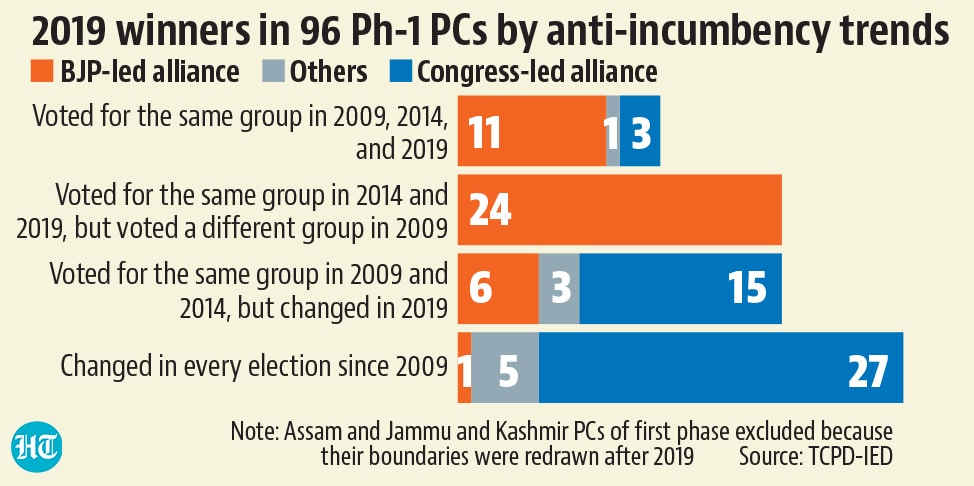
- How many of these PCs changed hands between 2014 and 2019?Of the 96 PCs that can be tracked going back to the 2009 Lok Sabha elections, 15 did not change the group they voted for in the past three elections if the parties are grouped as part of BJP-led alliance, Congress-led alliance, and others. Of these 15, 11 have voted for the BJP-led alliance consistently, three have voted for a Congress-led alliance consistently, and one for others. On the other hand, 33 PCs have consistently changed the group they have voted for since 2009. Of these 33 PCs, the Congress-led alliance won 27, and the BJP-led alliance just one in the 2019 elections, with others winning the remaining five PCs. Another 24 PCs changed hands only in 2019, of which 15 were won by the Congress-led group, and six by the BJP-led group. The remaining 24 PCs voted consistently for the BJP-led group in 2014 and 2019, but chose either a Congress-led alliance or others in 2009.
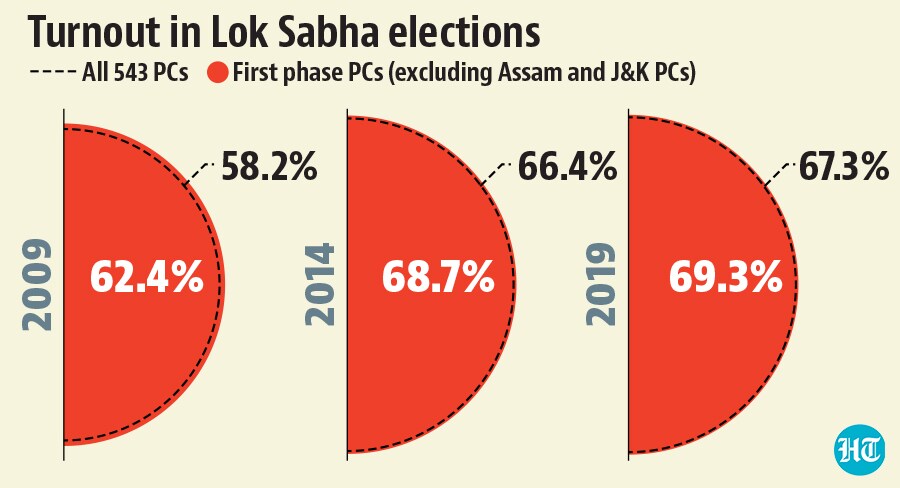
- How did these PCs do on the voter turnout front in 2019?The 2019 general elections had a voter turnout of 67.3%. Ninety-six of the 102 PCs that are voting in the first phase saw a higher voter turnout: 69.9%. Fifty-two of these PCs have seen a higher-than-average turnout in every elections since 2009. A comparison of elections held before 2009 is not possible because of a change in constituency boundaries in the 2008 delimitation. In 52 out of the 96 PCs, women voters turned out in larger numbers than male voters in 2019. In all, 228 out of the 543 PCs saw a bigger turnout of women voters in the 2019 elections. This means that the first phase of 2024 elections has a relatively bigger share of PCs where women voters had a greater influence then men.