E-Paper



Odisha constable tracks liquor dens by day. At night, he teaches poor children
A room in an under-construction house in a remote Odisha village comes to life every evening. This is where Odisha constable Debendra Samarath holds classes for scores of poor children in Nabarangpur, the district that reports the state’s lowest literacy rate

 Prefer HTon Google


Bhubaneswar: An Odisha excise department constable during the day, Debendra Samarath routinely checks cannabis plantations and raids illicit liquor dens in the Kodinga area of Nabarangpur district as part of his job.
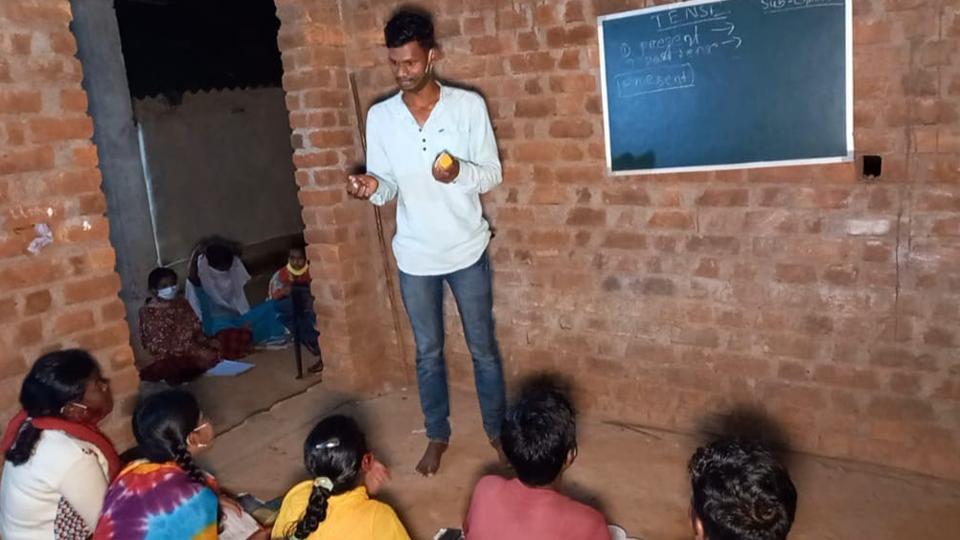
But once he is done with his day job, 25-year-old Samarath heads to an under-construction house in the village. This is where he gives free lessons to nearly 70 children from the village. As children crowd around the makeshift classroom, he teaches them mathematics, science, literature and English. There are almost no holidays in this school. And no one seems to mind.
It is his effort to ensure that the poor children in the district’s Karchamala village have a fair chance at a good life. As good as it can be in this remote village of a district that reported the state’s lowest literacy rate in the last decadal census.
“I always wanted to be a teacher. But I had to join the excise department as I did not want to remain unemployed. But after work, I am back to what I love doing most - teaching. My goal is no children should be deprived of education due to lack of money,” said Samarth, who started taking classes in an under-construction structure. The owner, Sitaram Pujari, let him use it for holding classes three years ago.
Samarath had to abandon his education because his family could not afford it. He dropped out of college and initially started selling fruits, like his father and would teach children in the evening.
Last year, he landed himself a job with the excise department as a contractual employee on a monthly salary of ₹12,000. He took the job. But Samarath’s heart was somewhere else, he said and continued teaching the village children after work.
“I want to give more time to the students but I am unable to do so because of the job responsibilities. Whatever free time I get, I devote it for teaching these students,” he said.
But time isn’t all that the excise constable spares for the children. Samarath indicated he ends up spending 10% of his salary on buying the notebooks and books of the children he teaches.
Odisha’s excise commissioner Ashish Singh, a 2004 IPS officer, said young people such as Samarath should be role models for everyone. “No work can be as noble as that of a teacher. I am proud that one of our employees is teaching poor kids of his village after office,” said Singh.
Teacher shortage is considered the bane of Odisha’s education system. According to the UNESCO 2021 State of the Education Report for India, Odisha has 68,717 government schools which require 28,816 more teachers. It said 67% of teaching posts in rural areas are lying vacant.