E-Paper



Odisha train accident: CBI on spot to probe ‘sabotage’; death toll touches 278 | Updates
The Central Bureau of Investigation was spotted at the accident site in Balasore Tuesday to probe the possible reasons behind the crash including ‘sabotage’.

 Prefer HTon Google


The death toll in the horrific triple train crash in Odisha’s Balasore, which happened last week, touched 278 on Tuesday after the Railways confirmed that three more people succumbed to their injuries while undergoing treatment.
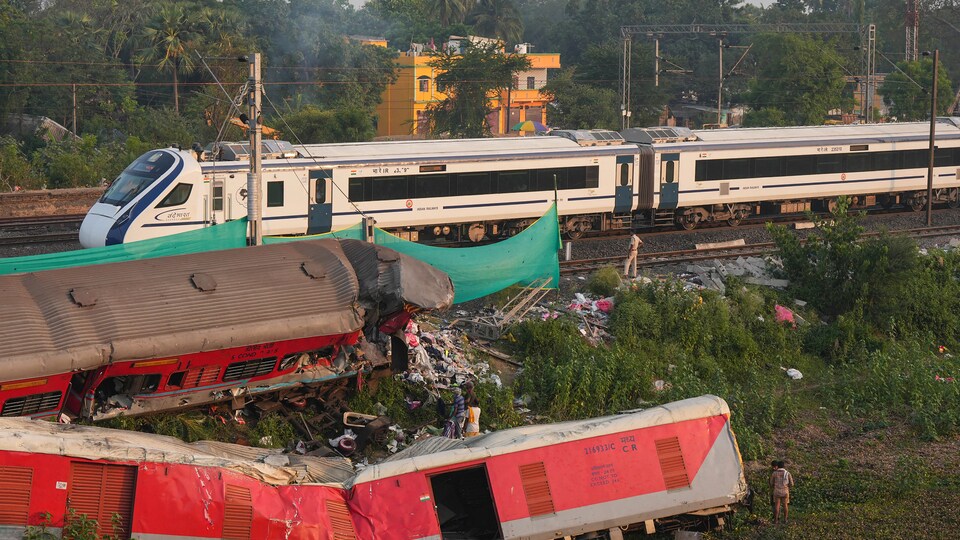
While the preliminary investigation pointed that the country’s worst train accident in three decades could have been a result of “a change in the interlocking system”, a 10-member Central Bureau of Investigation (CBI) team was spotted at the accident site this morning to look at all possible reasons behind the crash including ‘sabotage’.
CBI to probe Balasore crash
The CBI is looking into possible crash angles including human error and sabotage, a senior officer said Monday. This comes after the Union minister Ashwini Vaishnaw said Sunday that the Railways had sought the agency’s intervention over suspicions of a possible sabotage attempt in the crash involving the Coromandel Express, which rammed into a goods train. Within a few minutes, its derailed bogies collided with the last few coaches of the Howrah-bound Yesvantpur Express, passing by on the opposite line at the same time.
Also Read: Odisha train accident sheds light on plight of labourers leaving home for work
The CBI and the Central Forensic Science Laboratory (CFSL) will collect evidence from the accident site, obtain documents from the railway ministry, and conduct examinations of the victims, railway staff, rescuers, local administration, and eyewitnesses, to ascertain the cause behind the crash.
As per the latest figures, 278 people died in the accident while almost 1,100 were injured.
Preliminary investigation
As per the government officials, the CBI was given the charge as the initial report suggested an attempt of “deliberate interference” with the electronic interlocking system – an intricate system of interconnected safety checks, designed to keep trains from crossing each other’s paths.“Unless there is deliberate interference in the system, it is impossible that a route set for the main line is switched to the loop line,” an official familiar with developments had told HT earlier on transferring the case to the CBI.
Also Read: Odisha train accident: In new circular, railways calls for ‘double locking arrangements’
The locomotive pilot Gunanidhi Mohanty and his assistant, both of whom escaped with injuries, asserted that the train had moved forward only after receiving the green signal, the officials of the South Eastern Railway said. The preliminary investigation is underway and will take some time to conclude, the officials noted.
101 bodies still unidentified
About 200 people are still being treated at various hospitals in Odisha in the aftermath of the incident, the Divisional Railway Manager of the Eastern Central Railways Rinkesh Roy told news agency ANI. “Out of 278 people who died in the accident, 101 bodies are yet to be identified," the official said. 55 have been handed over to the relatives, he added.
On Monday, the Railways released helpline numbers so that the bodies could be identified and handed over to the relatives. “Dial 139-Indian Railways Helpline and Bhubaneswar Municipal Corporation (BMC) helpline-18003450061/1929 to locate your relatives affected in the Odisha Rail accident,” an official communication said.
Meanwhile, as the nation recovers from the profound impact caused by the accident, the Bahanaga Bazar railway station, the site of the disaster, resumed its operation Monday morning, following a speedy restoration work at the site that took about 48 hours to complete. Almost 600 metres of tracks were uprooted in the mishap while the train bogies were tossed around, prompting the public transport body to cancel nearly 90 trains and divert another dozens on the route.