
 E-Paper



On Bhutan visit, PM Modi pitches for improved connectivity, better border infra
Modi’s visit will also see the inauguration of a 1,020-MW hydroelectric project, which will increase Bhutan’s hydropower capacity by 40%

 Prefer HTon Google


NEW DELHI: India and Bhutan are taking several steps to bolster connectivity and border infrastructure, building on the work already done through an energy partnership to ramp up the Himalayan country’s hydropower capabilities, Prime Minister Narendra Modi said on Tuesday.
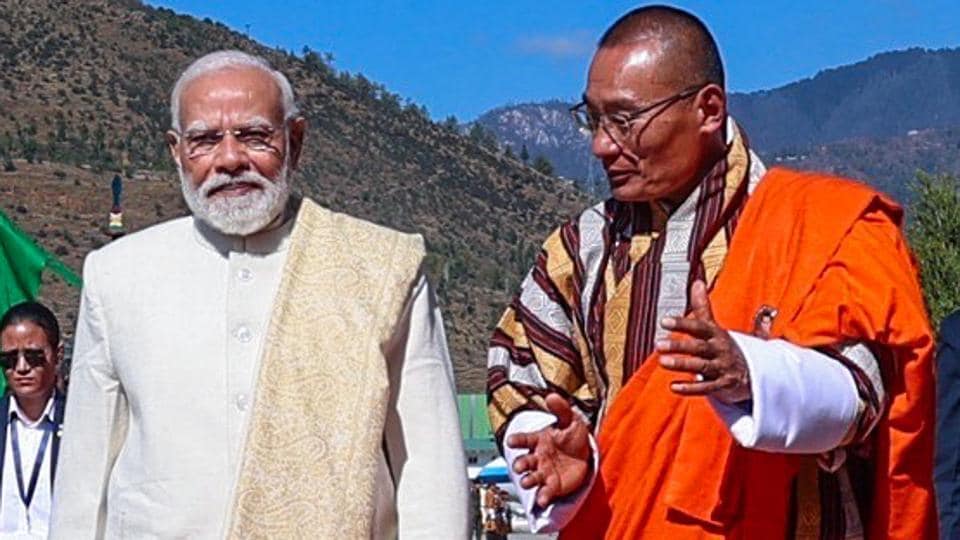
Modi also lauded the contributions of Bhutan’s former king, Jigme Singye Wangchuck, towards strengthening relations between India and Bhutan, as well as his efforts in establishing democratic systems in the country and promoting peace in border areas. Modi made the remarks at an event in Thimphu to mark the 70th birth anniversary of the former king.
Noting that connectivity creates opportunities, Modi referred to the government’s recent decision to link the cities of Gelephu and Samtse in Bhutan to India’s rail network. “Completion of this project will provide easier access for the industries here and Bhutanese farmers to India’s vast market,” he said.
Besides rail and road connectivity, both sides are making progress on border infrastructure, and India is providing support for Bhutan’s Gelephu Mindfulness City or economic hub, a pet project of the current King Jigme Khesar Namgyel Wangchuck. Modi announced that India will establish an immigration checkpoint near Gelephu to facilitate the entry of visitors and investors.
India has made a contribution of ₹10,000 crore for Bhutan’s current five-year plan, reflecting the intertwined nature of the progress and prosperity of both countries. The funds are being used in sectors such as roads, agriculture, financing and healthcare, he said.
The work in connectivity will build on the bilateral hydropower partnership, which has already made Bhutan the world’s first carbon-negative country. Bhutan is one of the leading countries in per-capita renewable energy generation, producing all of its electricity from renewable sources.
Modi’s visit will mark the inauguration of a 1,020-MW hydroelectric project, which will increase Bhutan’s hydropower capacity by 40%. He said work will also resume on another long-stalled hydroelectric project, and the two sides are also jointly working on solar energy.
India has taken numerous steps to ensure Bhutanese citizens receive a steady supply of essential items, and the Unified Payment Interface (UPI) facility is being expanded in Bhutan. India and Bhutan’s youth are collaborating to build a satellite and working together in various sectors, including education, innovation, skill development, sports, space, and culture, Modi said.
While paying tribute to former king Jigme Singye Wangchuck, Modi said his concept of “Gross National Happiness” became a key parameter for defining growth across the world. “The friendship between our two countries continues to flourish on the foundation you laid,” he said.
Pointing to the long-standing cultural links between the two countries, Modi said the Royal Bhutanese Temple was inaugurated in India’s Rajgir, and this initiative is expanding to other parts of the country. Responding to a request from the people of Bhutan for the establishment of a Bhutanese temple and guesthouse in Varanasi, the Indian government is providing land, he added.



