
 E-Paper



Pak spouses of Kashmiri men protest in Srinagar, seek citizenship or deportation
The protestors were demanding issuance of travel documents for their trip to their former homes.


Stranded for a decade, a group of women from Pakistan and Pakistan-occupied Kashmir (PoK) who had married Kashmiri men and traveled to Jammu and Kashmir after the 2010 announcement of an amnesty policy for former militants by the then chief minister Omar Abdullah protested in Srinagar on Tuesday demanding travel documents and citizenship or deportation to Pakistan.
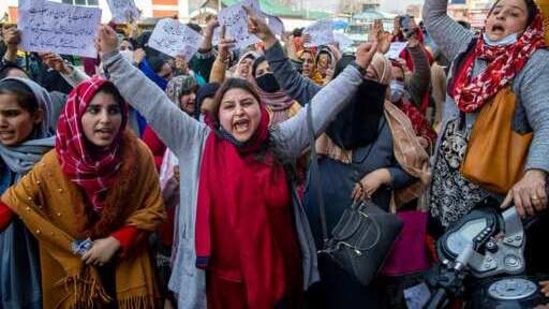
Dozens of women along with their families including small children, raising slogans and demanding justice, protested at Press Enclave Srinagar and then marched towards the city centre Lal Chowk, the business hub of the city.
“For the past 10 years we have been protesting peacefully again and again. We came here from Pakistan when the rehabilitation policy was announced. Our husbands brought us here and for the past decade there has been no forward movement on that rehabilitation policy – neither were we given citizenship nor did we get any travel documents,” said Saira Javed, a woman protestor from north Kashmir.
“Our demand or request to the government is that if they accept us please provide us travel documents and citizenship and if not then they should deport those who want to go back and for those who want to stay, something should be done to them,” she said.
The police intervened at Lal Chowk where the women were demanding an audience with the administration including Srinagar’s deputy commissioner Shahid Choudhary. A magistrate level officer then arrived to meet the protesters and some of them accompanied him to the DC’s office.
The protesters dispersed after that and a woman claimed that the DC assured them that their demands will be raised at the appropriate forum.
The protesters are part of the hundreds of women who came here with their Kashmiri husbands after the then chief minister Omar Abdullah announced a return and rehabilitation policy for former militants who were living in PoK.
Many young Kashmiri men had crossed the Line of Control (LoC) into PoK in the 1990s to get arms training after insurgency started in Kashmir valley. Some had given up violence, married there and started their lives afresh.
There are no official figures about the number of those who returned to Kashmir. The women say 400 of them came to Kashmir with their husbands.
“The issue is that we don’t have any documents or any identity in these 11-12 years. The only identity we have is that of being the wife of a militant. Neither we nor our children can go anywhere. Neither can we send our kids to study outside. Next time there will be a bigger protest and all 400 of us will come out if the government won't listen to us,” said another protestor.
Last week, some of these women had addressed a press conference to highlight their plight.
Owing to opposition from Pakistan, coupled with the then Indian government’s assertion that there were ‘practical issues’ involved in implementing the rehabilitation policy, the returning men and their families were forced to take Nepal route and then by road to Kashmir with authorities going soft on the travelers.
The informal entry meant there was no official recognition of their families or any documents which would help them to travel and acquire education.
“Why aren’t we allowed to meet our grandparents when all other children in Kashmir can meet them? What is our fault,” said a young girl accompanying the protesters.
The women said that many of the women have been divorced and husbands of some others have died.
“I came here in 2012. My mother died recently and I could not go to see her one last time. Our biggest problem is that we can’t meet our relatives and family members. Parents of many women died during these years but they could not go there and see them,” said Saba Fayaz, another protestor.


