
 E-Paper



'Pakistan will face Indian Navy's firepower if it resorts to anything evil': Rajnath Singh
Rajnath Singh warned that India will use every method to root out the menace of terrorism if Pakistan instigates any terror act against India.

 Prefer HTon Google


Union defence minister Rajnath Singh on Friday said that India will use the firepower of its navy in response to any future aggression by Pakistan.
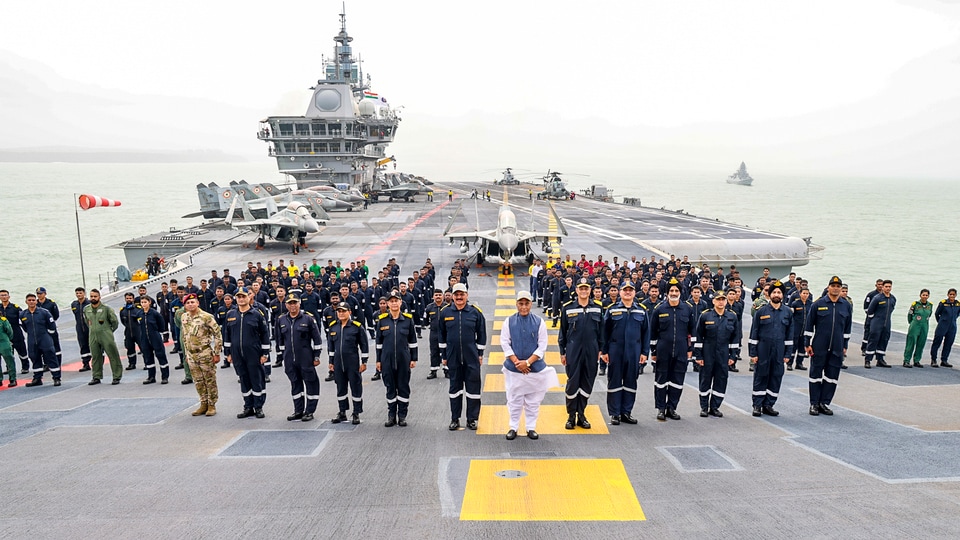
Addressing officers and sailors onboard India’s first indigenous aircraft carrier, INS Vikrant, off the Goa coast, Rajnath Singh lauded Operation Sindoor as the country's frontal assault against terrorism.
“Operation Sindoor is not just a military action, but India’s frontal assault against terrorism, and if Pakistan resorts to anything evil or unethical, it will, this time, face the firepower and ire of the Indian Navy," Rajnath Singh said at the event.
He also warned that India will use every method to root out the menace of terrorism if Pakistan instigates any terror act against India.
Also Read | Pakistan should hand over Masood Azhar, Hafiz Saeed to India: Rajnath Singh
“Now, if Pakistan instigates any terrorist attack against India, it will have to bear the consequences and face defeat. India will not hesitate. It will use every method to root out the menace of terrorism,” he said.
Rajnath hails Operation Sindoor
During Friday's event, Rajnath Singh lauded Operation Sindoor, saying that the armed forces' speed, depth, and clarity in the mission were remarkable.
“Our strike was so powerful that Pakistan began pleading with the entire world to stop India,” he said.
Also Read | PM Modi's latest warning to Pakistan from Bihar: ‘Fight against terror has neither ended nor halted’
The defence minister also lauded the navy's role in Operation Sindoor, saying that when the Indian Air Force destroyed the terror bases on Pakistani soil, the Navy’s aggressive deployment in the Arabian Sea, its unmatched maritime domain awareness and supremacy confined the Pakistani Navy to its own shores.
“Our Western Fleet ships deployed at sea, within 96 hours of the Pahalgam terrorist attack, carried out successful firings of surface-to-surface & surface-to-air missiles and torpedoes on the western & eastern coast. It demonstrated the combat readiness of our platforms, systems & crew and our intent & readiness, forcing the enemy to come into a defensive posture,” he said.
India's Operation Sindoor
Operation Sindoor was India’s direct military response to the April 22 terror strike at Pahalgam in Kashmir that killed 26 civilians in what was the worst attack on civilians since the 26/11 Mumbai strikes.
India launched the operation in the early hours of May 7, targeting nine terror camps in Pakistan and Pakistan-occupied Kashmir (PoK). The pre-dawn strikes – which killed at least 100 terrorists – sparked a series of attacks and counter attacks across the western border, involving fighter jets, missiles, armed drones, and fierce artillery and rocket duels.
Also Read | In 4 days, India's ‘Operation Sindoor’ caused massive damage in Pakistan
In one such counterattack on the night of May 9-10, the air force struck targets at 13 Pakistani air bases and military installations. After four days of fighting, military hostilities were stopped on May 10 as the two nations reached an understanding.


