E-Paper



Phase down fossil fuels, triple renewable energy capacity: UAE lays out COP28 plan
The UAE has called for the utilisation of every emission-busting tool available, including nuclear, battery storage and carbon capture and removal technologies, especially for the hardest-to-abate sectors


New Delhi: Tripling of renewable energy capacity, doubling energy efficiency and doubling hydrogen production to 180M tons per year by 2030 are highlights of Sultan-Al-Jaber, COP28 President Designate plan for the UN Climate Conference (COP28) scheduled to be held in Dubai in November. These will be critical in keeping global warming under 1.5°C over pre-industrial levels, he has said.
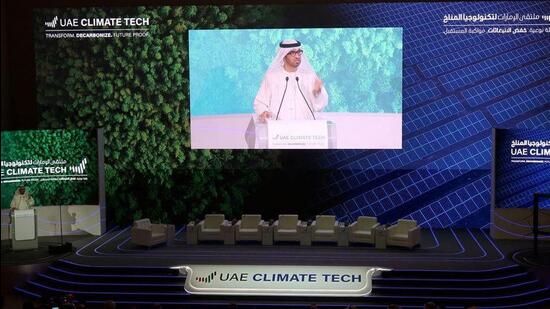
Al Jaber who is the UAE’s industry and advanced technology minister, is also CEO of State oil giant Abu Dhabi National Oil Corporation (ADNOC) and founding CEO of Masdar, a government-owned renewable energy company. Being the first serving oil firm CEO to take the post of COP28 President and UAE being economically heavily dependent on petroleum and natural gas, experts and activists had raised concerns about the potential conflict of interest since his nomination.
On Thursday, Al Jaber said phasing-down of fossil fuels is inevitable while addressing a ministerial on ‘Climate Action’ in Brussels with environment ministers of the European Union, Canada, and China. He also called for a comprehensive transformation of climate finance instead of piecemeal reform, with a special focus on supporting “climate-positive development” across the Global South.
“Today, I’d like to walk you through our plan of action. This plan is guided by a single north star. And that is keeping 1.5 within reach. To do this, we aim to match the highest ambition for the negotiated outcomes with an equally robust action agenda that can implement those outcomes in the real world,” he said.
He called for collective ownership of the global stocktake. “We must be brutally honest about the gaps that need to be filled, the root causes and how we got here. Then we must apply a far-reaching, forward-looking, action-oriented and comprehensive response to address these gaps,” he added. The Global Stocktake (GST) is the process of reviewing the implementation of the Paris Agreement and its goal of keeping global warming well below 2°C and pursuing efforts to keep it under 1.5°C above pre-industrial levels. It is scheduled to be held at COP28.
“On fast-tracking the transition, we must be laser-focused on building the energy system of the future, a system free of unabated fossil fuels, including coal, using all available technologies, while we rapidly decarbonize the system of today. As I’ve said many times, the phase-down of fossil fuels is inevitable. It is in fact essential. And it must also be responsible…We will co-create a practical action plan, based on the science, around pathways consistent with keeping 1.5 within reach. On the supply side, we are partnering with governments in the north and south to double energy efficiency, triple renewable energy capacity to 11,000 GW, and double hydrogen production to 180 million tons per year by 2030,” Jaber said.
Al Jaber called for the utilisation of every emission-busting tool available, including nuclear, battery storage and carbon capture and removal technologies, especially for the hardest-to-abate sectors. He also called on parties to update their nationally determined contributions (NDCs) under the Paris Agreement to keep the 1.5°C goal of the Paris Agreement within reach.
“Strong demand signals must come from the top through NDCs. The UAE just submitted a third update to its second NDC that pushes emission reductions to 40%, compared to business as usual, with clearly defined targets for all domestic sectors. That’s an almost 10% improvement on the previous disclosure. This aligns with our 2050 net zero initiative and our ambition to keep 1.5 within reach. At the same time, we will invest 54 billion dollars to triple clean energy capacity by 2030, massively scaling up hydrogen while maintaining zero coal in our energy mix. And I call on all governments to update their NDCs by September of this year, ensuring alignment with the Paris Agreement,” he said.
Al Jaber said UAE is working with the G20 high-level expert group to design a path forward for the delivery of climate finance to developing countries. “We are also working with the International Monetary Fund, the World Bank and Glasgow Financial Alliance for Net Zero (GFANZ) to unlock the power of the capital markets, standardize voluntary carbon markets and incentivize private capital and finance at a multiple,” Al Jaber said in Brussels.
Frans Timmermans, Executive Vice President of the European Commission said in a statement he wants all parties to align energy transition with the 1.5°C goal.
“Around the world, there is a major clean energy transition underway. We have started moving in the right direction, and some of us have set domestic targets. But we want to take the energy transition to another level, and to match domestic targets with global targets,” he said.
“Therefore, we want to mobilise all parties at COP28 to accelerate the global energy transition in line with the 1.5°C temperature limit of the Paris Agreement, or to be more precise, well below 2°C with an aim to hit 1.5°C,” Timmermans said.