E-Paper



PM Modi’s big Rajkot rally tomorrow signals BJP’s big Patidar outreach
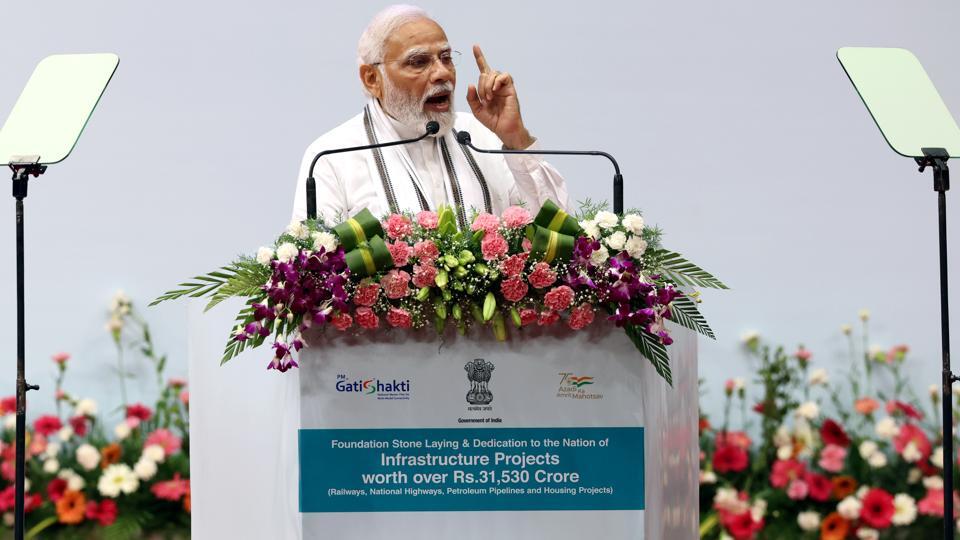
Prime Minister Narendra Modi is scheduled to address a huge gathering of members from the Patidar community on Saturday morning in Rajkot.

 Prefer HTon Google


AHMEDABAD: Prime Minister Narendra Modi, Bharatiya Janata Party’s star campaigner for the upcoming assembly elections in Gujarat, is likely to address a huge gathering of members from the influential Patidar community on Saturday morning after inaugurating a multi-speciality hospital built by the Shree Patel Sewa Samaj at Atkot village in Rajkot district, people familiar with the matter said.
“We aim to gather about three lakh people for the event. This could be one of the largest gatherings addressed by any political leader in recent times,” said an official at Shree Patel Sewa Samaj.
The Prime Minister, who will take part in various public functions during his two-day visit to Gujarat, will inaugurate the 200-bed K D Parwadia Multispeciality Hospital, located on Rajkot-Bhavnagar Highway.
The Patidar community, many of whom have the surname Patel, constitute about 12-14% of the state’s population.
Chief minister Bhupendra Patel belongs to the sub-group ‘Kadva Patel’ of the Patidar clan. The state has seen at least five Patel chief ministers including Anandiben Patel, Keshubhai Patel, Chimanbhai Patel and Babubhai Patel since the formation of Gujarat state on May 1, 1960.
Patidars have dominance in Saurashtra region where the Prime Minister is scheduled to visit on Saturday for the Atkot event. By turning out in huge numbers, the Patidars are going to put up a show of strength ahead of the crucial elections where the BJP is aiming to win for the sixth successive time.
The Atkot event is one of the several outreach programmes to reach out to the Patidar community that has been a solid bulwark behind the BJP, which has been in power in Gujarat without a break since 1998. Primarily a farming community, they have set up several successful businesses over the years, having a significant presence in sectors such as dairy farming, education, textiles, pharmaceuticals, real estate and diamonds. Patels also run most of the motels in the US.
The Congress had in the eighties come out with the ‘KHAM’ theory that advocated Kshatriya, Harijan, Adivasi, Muslim vote bank at core. The Patels, who voted for the Congress then, felt alienated as they believed that KHAM was essentially anti-Patel and anti-upper caste political alliance. They gradually shifted towards the BJP and have been their major supporter.
There are about 16 seats (out of 182) where Patidar voters dominate, of which nine are in Saurashtra, three in north Gujarat and four in Surat. Of these, seven seats in Saurashtra and three in Surat are dominated by the Leuva Patels, according to internal analysis by political parties. There are, however, close to 55 seats in the state where Patels are a major factor.
The BJP fielded 29 Leuva Patels and 23 Kadva Patels, while the Congress had 26 Leuva and 21 Kadva candidates in 2017. Of the total 54 seats in Saurashtra (including six in Kutch), the Congress won 30 in 2017, compared to 16 in 2012.
According to a Lokniti-Centre for the Study of Developing Societies post-poll survey in 2017, 68% of Kadva Patels and 51% of Leuva Patels voted for the BJP in 2017 compared to 78% and 63% in 2012. In comparison, Congress’s vote share among the Patidars increased—27% of Kadvas and 46% Leuvas voted for it in 2017 as compared to only 9% and 15% in 2012.
The BJP had suffered some setback in the Patel vote-bank due to reservation demands coupled with issues related to demonitisation and GST implementation. The party is now working to get them all back in the fold before the elections.
On April 12, PM Modi inaugurated a hostel and education complex of Shri Annapurnadham Trust backed by the Patidars at Adalaj near Ahmedabad.
“All communities play their part as per their capacity and Patidar community is never left behind in fulfilling their role for the society,” he told a gathering.
On April 15, the Prime Minister dedicated to the nation K. K. Patel Super Speciality Hospital in Bhuj, Gujarat via video conferencing. The hospital has been built by Shree Kutchi Leva Patel Samaj, Bhuj.
The Prime Minister’s visit to the state comes at a time when the Patidar Anamat Andolan Samiti (PAAS) convenor Hardik Patel has quit the Congress party which he supported in 2017 elections. The 28-year-old is likely to join the BJP in the next few days and contest his first elections in December this year, said a BJP official. A prominent Patel face, the youth leader spearheaded a quota agitation movement to seek reservation in government jobs and colleges for the Patidar community under the other backward classes category.
On April 29, the Prime Minister inaugurated the Global Patidar Business Summit (GPBS), organised by Sardardham, via video conferencing. The biennial event was held in Surat this year. Besides Saurashtra and parts of North Gujarat, Patidars have a sizeable presence in the diamond hub. In January 2021, elections were held in six out of eight municipalities of Gujarat. The Aam Aadmi Party (AAP) won 27 seats in Surat municipal corporation, replacing Congress as the main opposition party in the civic body. The AAP got a vote share of 28%. The party had fielded many PAAS candidates for the local body elections.