
 E-Paper



PM Modi’s favourite term is ‘feedback’: EAM Jaishankar
Jaishankar called PM Modi a product of democratisation in India and shared his own personal experiences of working with the PM to highlight Modi’s key traits

 Prefer HTon Google


In a conversation on a book on Narendra Modi’s 20 years in public office in New York, external affairs minister S Jaishankar offered a robust defence of Indian democracy, citing the increase in voter turnout and women’s participation in elections, the integrity of democratic processes, and the fact that everyone accepts electoral results.
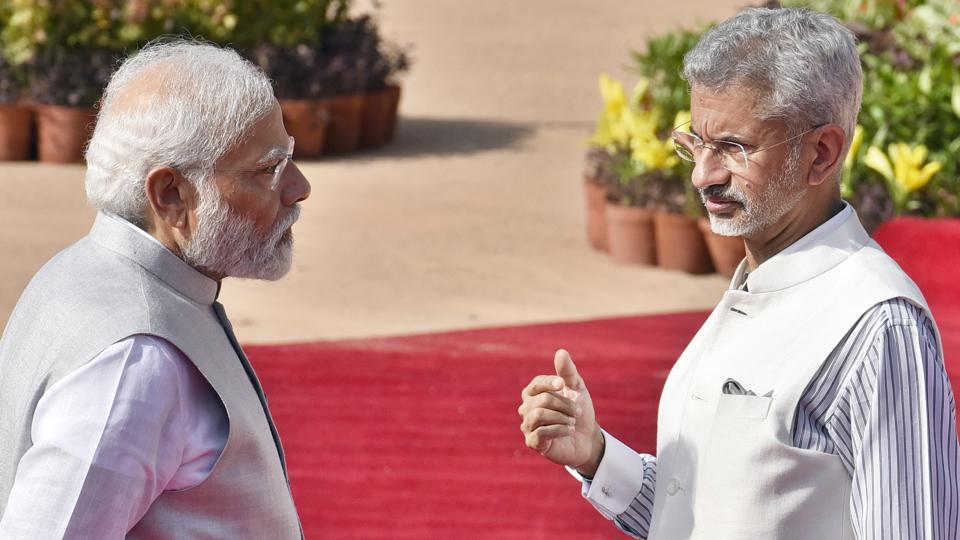
The minister also called PM Modi a product of democratisation in India and shared his own personal experiences of working with the PM to highlight Modi’s key traits — including his work ethic, leadership in good times and bad, meticulous preparation, openness and desire for feedback, and popular connect including with the diaspora.
Recalling one such instance, when he was foreign secretary and India’s consulate in Afghanistan’s Mazar-e-Sharif was under attack, Jaishankar said that he was busy juggling phones, figuring out what happened — “this was Afghanistan of that era, so you had to try to get a friendly warlord to go and help your people” — and keeping the courage at that end when at around 12.30 am, his phone rang.
“Normally, when the PM calls, you get a no caller ID. So it took me a bit by surprise. Even on that, someone connects him. This time, it was the PM. He asked me “jaage ho (are you up)? I said “haan (yes) sir”. What else would I be doing at 12.30 am, if not awake because in his life, that’s probably natural. Then he said, “TV dekh rahe ho (are you watching TV)?” I said, “yes sir.”
Modi then asked Jaishankar, “Kya ho raha hai wahan pe (what’s happening there)?” The minister recalled replying that the attack is on, but help is on its way. Then the PM said, “Khatam ho jayega toh phone kar lena (when it finishes, call).” Jaishankar told the PM that it might take two to three hours. “When it is done, I will let your place know.”
Then, there was a pause and the PM said, “Mujhe phone kar dena (call me).”
The minister said that he was sharing the anecdote because there is, among people in government, in public life, in political life, and for people in the country, a sense that the PM was there in good times and bad. Jaishankar said this attitude was visible during Covid too, when the PM took big decisions with enormous risk and showed the confidence to face the consequences of it.
While discussing the idea of democracy, Jaishankar said, “Sometimes I read these debates about how democracy is doing around the world and different countries give labels to countries of their choice. This is a country where look at the number of people who go to vote. It is continuously rising. Look at the number of women who are voting. That’s rising even faster,” Jaishankar said during a discussion on Modi@20: Dreams meet Delivery, a book to mark 20 years of Modi’s stint in elected political office that was released in Delhi earlier this year.
The minister then added, “Look at the integrity of the democratic processes, the fact that it is a country where elections are respected. People win, people lose; nobody challenges the process.” As the largely Indian-American audience began laughing at what appeared to be a dig at the trend in America, where former President Donald Trump not just challenged the 2020 elections but instigated a mob to stop the certification of results and election result deniers have won a fair number of positions within the Republican Party, the minister said, with a smile, “I am only speaking about India. Please do not read anything more into it.”
Asked whether there was a process of the “democratisation of democracy” underway in India, Jaishankar suggested that Modi himself was a product of that change. The minister said that the two most inclusive examples that prove that democracy has deepened are Indian politics and Indian cricket team, where representative patterns have changed.
Recalling his first interaction with Modi, when he was still CM and had come on a visit to China — an episode the minister recounts in the book — Jaishankar, who was then ambassador in Beijing, said that several things struck him about Modi even then. These included the level of preparation that went into the visit; the packed nature of the programme; and the fact that the CM had also sought a political briefing, which many of his other state counterparts did not do. The then CM had told Jaishankar that while he came from a different political party, he did not want to say anything that was even a millimeter different from national policy.
“The other bit which was different was he said please tell me what should I say and please also tell me what should I not say. And I saw during the course of the meeting, he would kind of half turn and give me a quick look which is like is there some feedback. By the way, feedback is his favourite term. After every meeting, he would want feedback. How did it go? Did I get the tone right? Did I get the substance right?”
The minister read out passages from his own chapter and that of actor Anupam Kher, badminton star PV Sindhu and writer, entrepreneur and activist Sudha Murty to highlight other features of Modi’s strengths.
Jaishankar also spoke extensively about India’s social safety net infrastructure especially during Covid, the provision of basic services, the thrust towards manufacturing, the reliance on technology to reform governance systems, and the air of optimism in India.


