
 E-Paper



Position paper aims to instil critical thinking: Karnataka NEP task force head
Madan Gopal also shared two links in which former President Pratibha Patil does mention the contribution of the Baudhayana Sulva Sutra during the International Congress of Mathematics in 2010


Position paper on ‘Knowledge of India’, which encourages students not to accept contents in textbooks as infallible truth and question ‘fake news’ like Pythagoras theorem and the apple falling on Isaac Newton’s head is part of the process of critical thinking, the chief of Karnataka’s National Education Policy (NEP) task force said on Sunday.
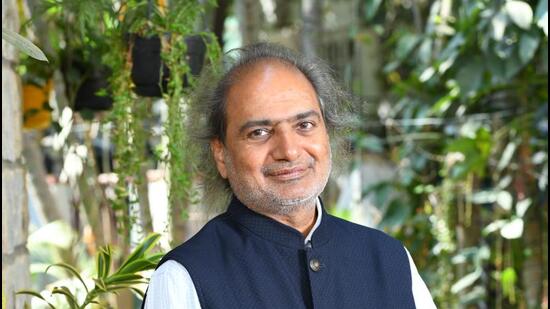
“Whereas the recommendation explicitly advocates instilling in our students the faculty of critical thinking by questioning anything and everything before accepting them, which is also incidentally the modern scientific way resonating well with the traditional Indian way of knowledge creation and dissemination, it is beyond comprehension to associate such a recommendation with any controversy,” Madan Gopal, the head of the task force, told HT.
Gopal also shared two links in which former President Pratibha Patil does mention the contribution of the Baudhayana Sulva Sutra during the International Congress of Mathematics in 2010.
“India has been at the forefront in contributing to innovations in arithmetic, algebra and geometry at different periods. The Pythagoras Theorem finds a place in Baudhayana Sulva Sutra, a work dating back to the 8th Century BC. The concept of zero or shunya originated from India. Pierre-Simon La Place, a French mathematician said in the 19th Century that, “it is India that gave us the ingenious method of expressing all numbers by the means of ten symbols, each symbol receiving a value of the position, as well as an absolute value; a profound and important idea.” The contributions of Aryabhatta and Brahmagupta to the development of Algebra and Astronomy in the 6th and 7th Centuries are well recognised. In the 12th Century, there was Bhaskaracharya. His work ‘Leelavati’ was the main source in mediaeval India for learning algebra and arithmetic,” according to the speech, available in government archives (http://pratibhapatil.nic.in/sp190810.html).
The ‘clarification’ comes days after Gopal, in an interview with HT, said that there were several discussions on international platforms like Google and Quora on the origin of the Pythagoras theorem and Newton’s theory.
“If you just go to Quora or Google, there is a lot of debate and discussion and evidence that it was Baudhāyana (ancient Indian mathematician) who propounded this theory which was subsequently adopted by Pythagoras. We have not denounced the theory, nor the teaching of the same will stop. We have only said that the origins are rooted in ancient India. I can send you the entire text from Quora,” he had said.
The apple falling on Newton’s head that led him to the theory of gravity was actually from ancient texts in Kerala.
“With a focus to empower the children to become responsible citizens of a grander India in future, some of the following suggestions may be implemented: encouraging an attitude of questioning and not merely accepting whatever the textbooks (or print/electronic/social media) say as infallible truth, with a clear foundation of how knowledge generation takes place and how fake news such as Pythagoras theorem, an apple falling on Newton’s head etc. are created and propagated,” according to the position paper.
The position papers, one of which even goes on to state that eating eggs and meat leads to lifestyle disorders, have come under sharp criticism by academic experts and the political opposition, who have accused the Bharatiya Janata Party (BJP) of trying to ‘saffronise’ school education.
With just one year to go before elections in Karnataka, the position paper lends to the possibility that it does have political connotations through which the BJP and its core support groups like pro-Hindu organisations have attacked the hijab, anti-conversion bill, halal, azaan and almost criminalise several activities associated with minority groups, people close to developments said.


