
 E-Paper



Public consultation on broadcasting bill underway: MoS I&B in Rajya Sabha
The minister of state (MoS) for information and broadcasting L Murugan gave identical responses to questions asked by Trinamool Congress (TMC) MPs Mohammed Nadimul Haque and Jawhar Sircar


Public consultation on the Broadcasting Services (Regulation) Bill is currently underway, the minister of state (MoS) for information and broadcasting L Murugan informed the Rajya Sabha during the ongoing monsoon session of the Parliament on Friday.
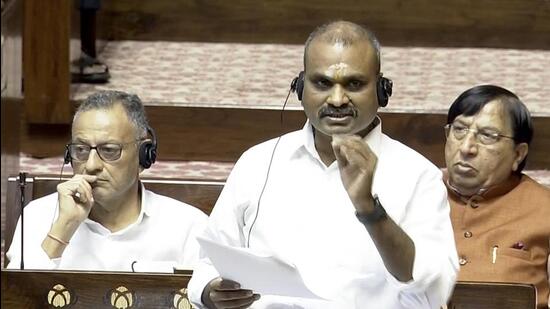
Murugan said that the bill was in drafting stage and stakeholders’ consultation in currently underway.
The minister gave identical responses to two different questions asked by Trinamool Congress (TMC) MPs Mohammed Nadimul Haque and Jawhar Sircar.
In both responses, he said that the bill was “placed in public domain for comments of the stakeholders including domain experts and the general public on 10.11.2023”.
Haque had asked the Ministry of Information and Broadcasting (MIB) if the government had taken steps “to ensure inclusion of larger public and civil society organisations during the consultation process of the draft bill”.
He had also asked the measures that the government had taken to distinguish between over-the-top (OTT) broadcasters and independent journalists given the application of Clause 20 of the 2023 version of the bill.
Sircar, on the other hand, had asked if “small budget independent journalists on social media have same obligations as corporates” and if it was true that “distinctions between journalism and content creation has blurred and the term ‘news and current affairs’ is too broad”.
He also asked if it was true that OTT and digital media “have been brought under broadcast, despite differences between linear and on-demand services”.
He also asked whether the OTT and digital media are exempted from criminal penalties for failing to inform the government on reaching prescribed threshold, and if democratic countries have Content Evaluation Committees to pre-certify content before it is broadcast.
To be sure, the first draft of the broadcasting bill was placed in public domain for public consultation on November 10. However, the second draft, as HT reported on July 27, shared with selected stakeholders last week and reported on by HT on July 26, has not been placed in the public domain.
Also Read: Broadcasting Bill still in drafting stage: MIB tells RS
For the second draft, stakeholders were instructed to collect their individual copies of the second draft and give an undertaking that they would not share the draft further.
Each copy given to stakeholders is unique, as it bears a watermark across each page that identifies the stakeholder through a number so that the MIB can trace leaks.
Stakeholders have to submit their comments by August 10.
HT had reported on July 26 that the second draft of the Bill expands the definition of ‘OTT broadcasting services’ and introduces the concept of ‘digital news broadcasters’.
As a result, all news and news adjacent content online --- videos and commentary on social media, websites, newsletters, podcasts --- is covered under this bill, and all content creators who regularly upload their content to social media can arguably be OTT broadcasting services.
This includes an independent journalist on YouTube, a person running a popular cooking channel on Instagram or YouTube, or a journalist who frequently tweets.
HT had also reported that the new bill exempts OTT and digital news broadcasters from criminal penalties for failing to inform the government of reaching the prescribed threshold (‘intimation’), something that the MIB had told the stakeholders in the July 9 meeting as well.
In at least four meetings that occurred between May and June, MIB officials assured the stakeholders that the difference between linear broadcasters and on-demand broadcasting services is recognised in the draft of the bill which allows for different programme and advertising codes for them.
To be sure, the bill is still in drafting stage, and all changes made after stakeholders’ consultation will have to be vetted by the law ministry and the Union Cabinet before it is introduced in Parliament.


