Rainfall damages key crops, could stoke food prices
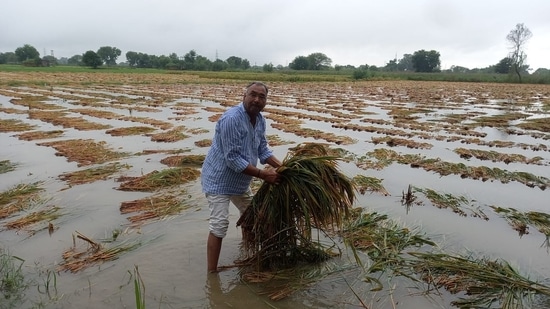
Farmers are struggling to save their produce as continuous rains in Uttar Pradesh, Rajasthan, Haryana, Madhya Pradesh and Punjab have flooded fields and soaked standing crops, leading to grain loss.
Heavy rainfall across states has pushed back harvesting and damaged ripened summer-sown crops, such as rice, coarse cereals or millets, soyabean, pulses, cotton and horticulture produce, which could stoke food prices, farmers and analysts said.
Continuous rain spells have caused damage to standing crops in the Braj region and disrupted power supply. (HT PHOTO)
Farmers are struggling to save their produce as continuous rains in Uttar Pradesh, Rajasthan, Haryana, Madhya Pradesh and Punjab have flooded fields and soaked standing crops, leading to grain loss.
Over the past two weeks, a moisture-laden trough, stretching from the cost of Gujarat into northern and central Indian states, pelted large swathes of the northern states with unseasonal showers. The wet spell has prolonged the retreat of the June-September monsoon.
Persistent downpours have damaged crops in at least 30 districts of Uttar Pradesh, delaying potato sowing amid widespread damage to bajra or pearl millet, a coarse cereal, said Harshit Goel, an official of the state’s revenue department.
The country witnessed an erratic monsoon this year. Rains skipped many paddy growing states, such as Bihar, Uttar Pradesh and West Bengal. A late surge in showers then inundated farms. Heavy rainfall is likely to continue over Uttarakhand, Uttar Pradesh and Bihar during next 24 hours, the state-run India Meteorological Department (IMD) said in a forecast on Tuesday.
Farmers in Punjab and Haryana said they were waiting for the rains to stop to operate harvesting machines. “Harvesting of paddy has come to a halt because combine harvesters cannot be operated in soft, wet soil. There will be considerable yield loss in paddy,” said Karnal-based Rajinder Singh, a former agriculture officer with the Haryana government.
Heavy showers have damaged paddy in Patiala, Fatehgarh Sahib, Mohali, Mansa, Sangrur, Muktsar and Tarn Taran districts, where early varieties were sown and the crop was ready for harvest when the rains began in the last week of September, Singh said.
“The rains will likely result in a spike in food prices, especially of vegetables. Heavy rains have also hampered movement of food trucks,” said Rahul Chauhan of IGrain Pvt Ltd. The showers have also heightened risks of pest attacks. “Weather would be congenial for infection of sheath blight in rice,” a crop advisory bulletin issued by the Punjab government on Tuesday (Oct 11) stated. Cultivators should “maintain proper drainage system in their fields” to save crops, a separate advisory by the IMD said on Tuesday stated.
Uttar Pradesh, the country’s second biggest producer of rice, has received 500% excess rainfall in October so far, data from IMD showed.
Adequate harvests are critical this year amid a global food crisis. India banned the export of wheat in May and then put curbs on rice shipments as extreme weather pummeled crops.
The rains have delayed planting of vegetable crops and if hot dry weather follows, farmers may have to watch out for pest attacks, said Sanjay Sangroiya, a horticulture expert who formerly worked at the Centre of Excellence for Vegetables in Haryana’s Gharaunda.

 E-Paper