E-Paper



Rajnath Singh visits Bhuj airbase, urges IMF to reconsider aid to Pakistan
Singh, who earlier visited Srinagar’s Badami Bagh Cantonment, called India’s zero-tolerance approach to terrorism a core part of its national defence doctrine

 Prefer HTon Google


Defence minister Rajnath Singh on Friday urged the International Monetary Fund (IMF) to reconsider its $1 billion financial assistance to Pakistan, underlining that such aid could amount to funding terrorism. “Any financial assistance to Pakistan is no less than terror funding,” he said at the Bhuj Air Force Station in Gujarat’s Kutch district.
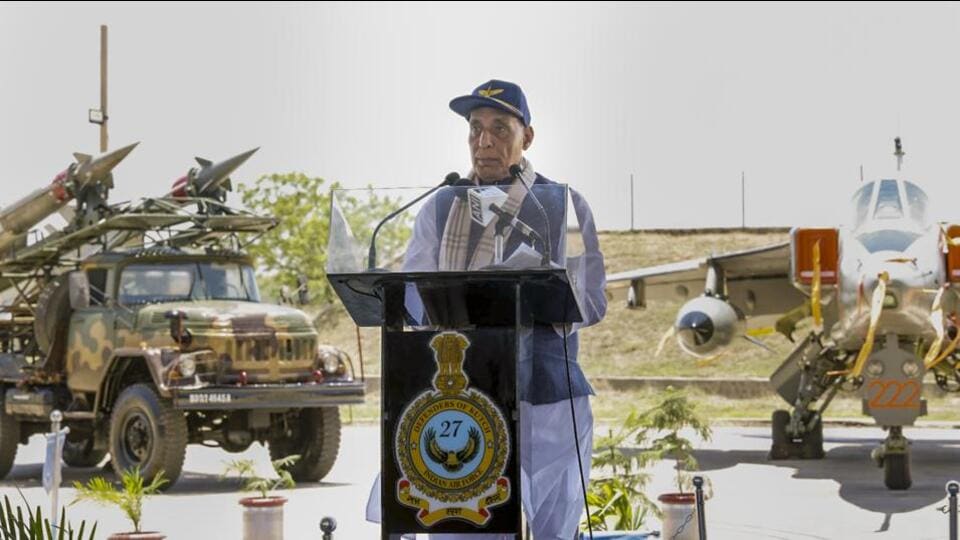
Singh’s visit to the station was his second to a military base in as many days after Operation Sindoor, India’s military response to the killing of 25 tourists and a local resident in the April 22 terror attack in Kashmir’s Pahalgam. Indian launched the operation on May 7, striking nine terror camps in Pakistan and Pakistan-occupied Kashmir (PoK) that sparked a series of attacks and counter-attacks. Fighter jets, missiles, armed drones, artillery, and rockets were used in the attacks.
On the night of May 9-10, the Indian Air Force (IAF) struck targets at 13 Pakistani air bases and military installations before the four-day hostilities stopped on Saturday as the two nations reached an understanding.
Singh, who visited Srinagar’s Badami Bagh Cantonment on Thursday, emphasised in Bhuj that India cannot allow funds Indian taxpayers contribute to global bodies such as the IMF to be diverted—directly or indirectly—for rebuilding terror networks. He called India’s zero-tolerance approach to terrorism a core part of its national defence doctrine.
Singh said Pakistan could use a significant portion of the IMF’s support to bolster terror outfits such as Lashkar-e-Taiba (LeT) and Jaish-e-Mohammed (JeM). “Pakistan will spend the tax collected from its citizens to give around ₹14 crore to Masood Azhar, the head of JeM terrorist organisation, even though he is a UN-designated terrorist,” he said.
Singh said the Pakistan government has announced financial assistance to rebuild the LeT and JeM terror infrastructure in Muridke and Bahawalpur.
Singh called Operation Sindoor a message to the world that India will not hesitate to act against terrorism. He called it a demonstration of military readiness and self-reliant defence capabilities. “Our actions were just a trailer. We will show the full picture if needed.”
Singh said attacking and eliminating terrorism is the new normal of New India. He warned Pakistan was currently “on probation” under an extended ceasefire until May 18 (Sunday). “If its behaviour improves, it is fine. But if there is any disturbance, the harshest punishment will be given,” Singh said.
He praised the IAF’s role in the operation. “When missiles were dropped inside the enemy territory, the world heard the echoes of India’s valour and might.” He called the BrahMos missile a symbol of indigenous strength. “This Made in India missile showed Pakistan the light of day in the darkness of night.” He lauded the Defence Research and Development Organisation (DRDO)’s Akash missile system and radar technologies, saying they reflect India’s rising self-sufficiency in defence manufacturing.
Singh said India’s fighter aircraft can strike every corner of Pakistan without crossing the border. He added that the IAF proved India’s evolving war strategy. “The world has witnessed how the IAF destroyed terror camps and later Pakistan’s airbases. The IAF proved that India’s war policy and technology have changed. They conveyed the message of New India that we are not just dependent on weapons and platforms imported from abroad...The Made in India equipment has become a part of our military power. The weapons manufactured in India are also impenetrable.”
Singh highlighted India’s progress in producing indigenous artillery systems, missile shields, drones, and counter-drone systems. “We are becoming exporters from importers, and this is just the beginning.”
Singh referred to Bhuj’s role in wars with Pakistan in 1965 and 1971, and the encounter with Pakistani drones this month. He described it as a “land of patriotism where soldiers stand tall to protect national interests.”
Singh thanked the armed forces for their service and sacrifice and reiterated the government’s commitment to equipping the military. “A strong nation respects its military and equips it with resources, technology, and full support.”
Chief of the Air Staff Air Chief Marshal AP Singh and other top IAF officers accompanied Singh.