
 E-Paper



Ratan Thiyam: Thespian who stretched limits of Indian stage
Ratan Thiyam, influential Indian theatre director and founder of Chorus Repertory Theatre, passed away at 77, leaving a profound legacy in theatre.

 Prefer HTon Google


Ratan Thiyam, one of modern Indian theatre’s most influential directors and the founder-director of Chorus Repertory Theatre in Manipur, passed away in the early hours of July 23 in Imphal.
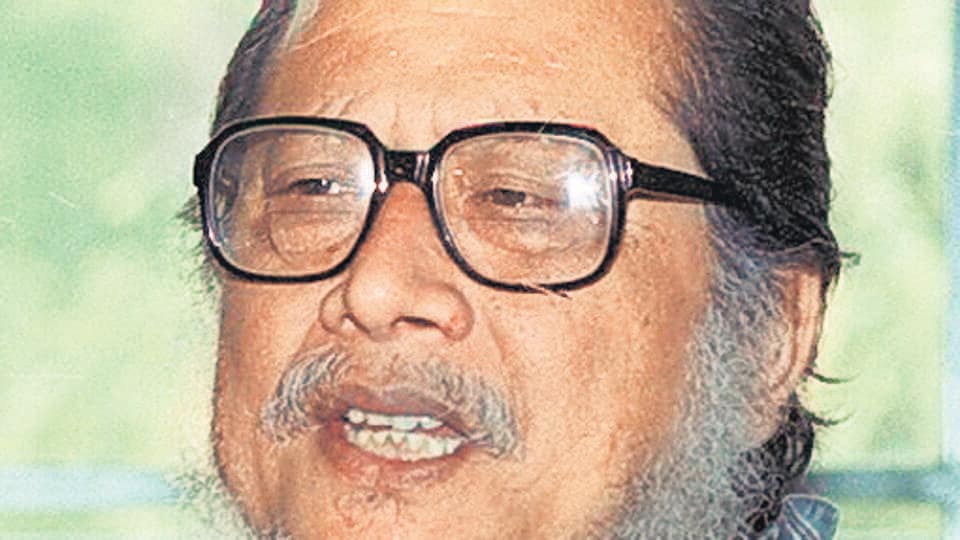
He was 77.
Over five decades, he shaped a theatre of discipline and immersion, where visual precision met a deep faith in the actor’s body and its possibilities. Productions like Chakravyuh, Andha Yug, Uttar Priyadarshi, Lengshonnei, and Lairembigee Eshe were more than adaptations of familiar epic narratives. In Thiyam’s hands, they became orchestrated acts of endurance, where time stretched and performance brushed against ritual. In doing so, he transformed the Indian stage’s relationship to time, movement, and scale.
Thiyam graduated from the National School of Drama in 1974, the first ever from Manipur to do so, alongside peers such as Rohini Hattangadi and Rajesh Vivek. In 1976, he returned to Manipur to set up Chorus on the outskirts of Imphal, on a quiet stretch of land bordered by paddy fields, red earth, and the open sky.
Recognition did not come easy. For an artist from Manipur, it meant building not just a body of work, but an entire ecosystem of rigour, almost from the ground up. The space he created was part theatre, part training ground, and part retreat, where actors trained for years in voice, movement, martial arts, design, and stamina. As he once said, “I have always found human expression more convincing when it is physically portrayed, when there is a body rhythm.” That rhythm governed everything, from lights and costume to sound and blocking. The ensemble didn’t simply perform roles; they held presence, moving like figures in a long ceremony, stretching gesture into image, and image into duration.
Critics at the 1987 Edinburgh Fringe Festival hailed Chakravyuh as “sheer poetry in motion,” with a “brilliant piece of choreography… unlike anything seen elsewhere.” Even for audiences unfamiliar with Manipuri, the energy held them for over two hours. In Japan, Andha Yug, staged in 1994 on the anniversary of the Hiroshima bombing, was praised for its intense intimacy and seismic resonance, shifting ancient epic violence into a contemporary register.
Recalling his early years at NSD, he reflected in a 2020 The Indian Express profile: “I came out knowing all about Greek and European theatre… I wanted to learn about indigenous Indian theatre. After all, we go to the roots to learn of our identity.” That search shaped his entire practice.
Thiyam’s aesthetic drew from the performance codes of the Natyashastra, Manipuri martial traditions, and Buddhist philosophy, not as fixed heritage, but as living systems that could be retooled to meet the urgencies of the present. Chorus Repertory became a site for a radical “new form”, one that refused both colonial mimicry and the comfort of cultural revivalism. Too often packaged into the shorthand of the ”Theatre of Roots”, his work rarely romanticised the idea of “roots”. It interrogated them, using tradition as a medium of confrontation, not comfort. “I believe that, in order to work, a piece of art must strike at the system and break convention,” he said.
Over time, others echoed, and gradually diluted that grammar in their own productions. Thiyam’s visual language, with its epic scale, ritual intensity, chanting chorus, and slow stylised gestures became the default setting for Indian theatre at festivals and in state-funded productions. What had once signalled radical decolonisation began to mirror establishment cultural displays. Many mistook his style for spectacle, missing the deeper provocations embedded in his form. Although Thiyam’s theatre was often seen as less overtly political than that of his contemporary Heisnam Kanhailal, the difference lay in form and method.
Thiyam chose spiritual gravitas and formal rigor over direct protest. His many institutional honours — the Padma Shri in 1989, the Sangeet Natak Akademi Fellowship in 2012 — did not blunt his dissent. In 2023, when Manipur was engulfed in ethnic violence, he refused to stay silent. Nominated without consent to the Centre’s symbolic peace panel, he resigned in protest, demanded real action, and sharply asked, “Are we a part of India?”
Thiyam held two key leadership roles at the National School of Drama. His first, as Director in 1987–88, ended prematurely amid student unrest and institutional challenges, despite his emphasis on rigour and discipline. He returned as Chairperson from 2013 to 2017. During this tenure, he critiqued the overuse of technology in performance and strongly defended indigenous theatre practices. His departure in 2017 marked the end of a tenure that underscored the friction between his singular aesthetic and a shifting theatre landscape.
While the impact of Thiyam’s absence will echo across the theatre world for some time, the structure he built endures. Chorus Repertory will continue, with his son Thawai and members of the ensemble carrying the work forward, as they have been doing for years.
The writer is a theatre practitioner and stage commentator


