E-Paper



Raw material export, import of finished products can’t be accepted: Modi
Prime Minister Narendra Modi called innovation and quality products two pillars of the expansion of the Indian economy while stressing rapid growth is impossible only through raw material export

 Prefer HTon Google


Prime Minister Narendra Modi on Tuesday underlined that the export of raw materials and import of finished products cannot be accepted and that this trend and value addition outside the country was being changed.
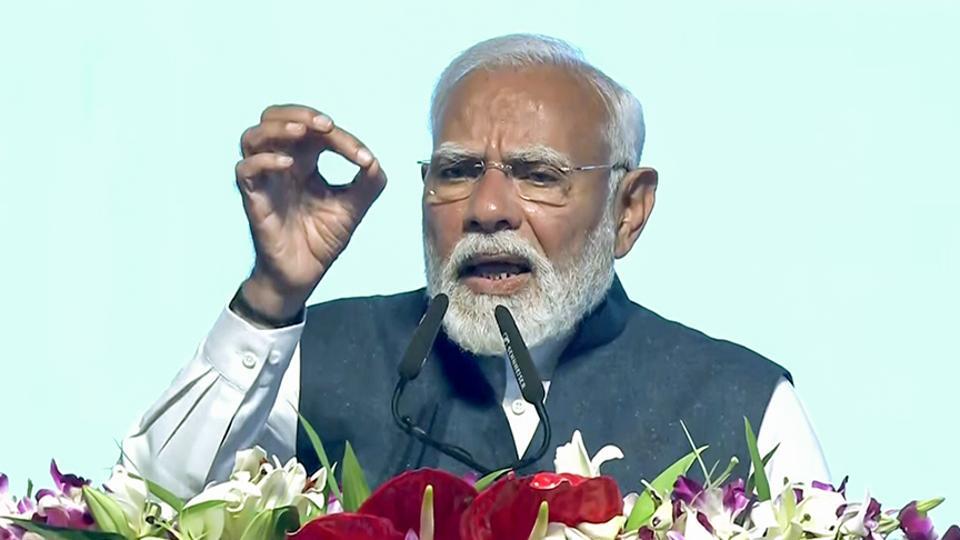
Modi called innovation in the service sector and quality products two pillars of the economy’s expansion. “The country’s rapid growth is not possible only through the export of raw materials. Hence, we are changing the entire ecosystem and working with a new vision,” said Modi in his inaugural speech at the two-day Utkarsh Odisha Conclave of investors in Bhubaneswar.
He referred to iron ore exports from Odisha and said his government is working to ensure a related industry comes up in the state. “The minerals are extracted here and exported to some other country where value addition is done and new products are made. These finished products are then sent back to India. This trend is not acceptable,” he said.
Modi said India is on a path of development driven by people’s aspirations. He added this is an era of AI and everyone is talking about it. Modi said aspiration and not just AI is the country’s power. “Aspiration grows when the needs of the people are fulfilled. In the last decade, the country has witnessed the benefit of empowering people. Odisha represents the same aspiration.”
He said Odisha represents new India’s originality and optimism. “Odisha has opportunities, and the people of Odisha have exhibited the spirit of outperformance.”
Modi said the 21st century is all about connected infrastructure and multimodal connectivity. “India is building specialised infrastructure at an unprecedented speed and scale. It will make India a great destination for investment.”
Modi said the world is talking about sustainable lifestyles and moving towards a green future. “The scope for green jobs is increasing. Hence, we have to change ourselves with the emerging trends. India is focusing on the green future and green tech. Be it solar, wind, or green hydrogen, these are going to power the energy security for Vikashit Bharat [developed India].”
Modi said he considers eastern India the country’s growth engine, and Odisha plays an important role in it. He urged industrialists to create an ecosystem in Odisha for aspirations and job opportunities. “To understand India, Odisha is the best destination as it has a rich history, heritage, and natural resources. The state is a perfect model for development and heritage.”
Modi called for exploring Odisha’s immense tourism potential. He added the state has a vast coastline and 33% forest cover, offering the scope of eco and adventure tourism. “Today, India’s focus is ‘wait in India’ and ‘heal in India’. For this, Odisha’s nature and scenic beauty are helpful. There is a lot of potential for conference tourism in the country.”
He said Bhubaneswar has a lot of good convention centres. “There is a lot of potential for concert economy as well. In the last 10 years, the demand for live concerts has gone up. You must have seen fabulous pictures of the Coldplay concerts in Mumbai and Ahmedabad.”
He called for a focus on necessary skills, event management, grooming of artists, security, etc. Modi added there is a lot of scope in this aspect in Odisha. “The state has a major role in Viksit Bharat and the people have taken a pledge for Samruddh Odisha. The Centre is extending all possible help to Odisha.”
Chief minister Mohan Majhi referred to Odisha’s potential thanks to its rich natural resources, impressive roads, air connectivity, ports, infrastructure, and an industrial-friendly policy. “In the last seven months, the Prime Minister has visited the state nearly five times. This shows his commitment towards the state. The Prime Minister has always brought a lot of welfare schemes and initiatives.”
Majhi said Modi’s presence at the conclave will instil confidence among the investors and business community. “Odisha is not only the land of opportunities, but will soon be the driving engine of the country, especially in eastern India.”
Industrialists Kumar Mangalam Birla, Anil Agarwal, Sajjan Jindal, Naveen Jindal, and Karan Adani and delegates from 16 countries including Singapore, Malaysia, Australia, Vietnam, Italy, Belarus, United Kingdom, and South Africa are participating in the conclave.