E-Paper



Refugees from over 50 yrs ago fight for recognition in Arunachal
Subisona Chakma is worried. Earlier this year, the 18-year-old from Dumpather village in Arunachal Pradesh’s Changlang district passed her Class 12 examination, earning a first division with 70%. Keenly interested in geography, Chakma zeroed in on a college in the neighbouring Tinsukia district in Assam for further studies. Except, those plans are now likely to go awry.

 Prefer HTon Google


Subisona Chakma is worried. Earlier this year, the 18-year-old from Dumpather village in Arunachal Pradesh’s Changlang district passed her Class 12 examination, earning a first division with 70%. Keenly interested in geography, Chakma zeroed in on a college in the neighbouring Tinsukia district in Assam for further studies. Except, those plans are now likely to go awry.
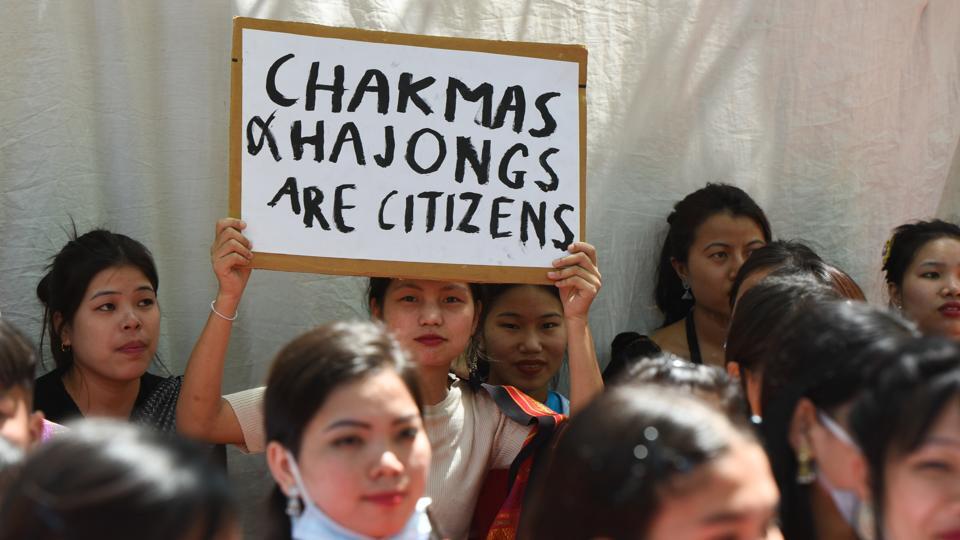
On July 31, the Arunachal Pradesh government decided to suspend residential proof certificates (RPCs) issued by the Changlang district administration to thousands of Chakma and Hajong residents in the districts, reopening a long standing insider-outsider debate, and throwing into uncertainty the future of members of communities that entered India fleeing persecution from Bangladesh decades ago.
Arunachal Pradesh issues three kinds of certificates. The first, Permanent Resident Certificates (PRC) are issued to indigenous residents, while Temporary Resident Certificates (TRC) are issued to residents from outside the state who enter to work. The third, residential proof certificates (RPC), are documents issued to Chakmas and Hajongs, refugees who entered India from Bangladesh in the early 1960s and their descendants. In the absence of the first two, these RPCs are key for the pursuit of higher education, and for government jobs.
The order, issued by Kaling Tayeng, commissioner of the Changlang district, also stayed any further issue of the crucial document. “The government of Arunachal Pradesh has decided to suspend all Residential Proof Certificates (RPCs) issued in Changlang district with immediate effect. Further, it has also been decided to suspend the issue of fresh Residential Proof Certificates (RPCs) forthwith,” the order, which has been reviewed by HT, said.
Subisona has both an Aadhaar number and a PAN card, but neither is accepted as proof of residence. Her entire family — a farmer father, mother, three sisters, and a brother — has the same documentation. The family owns and tills five hectares of agricultural land, allotted by the Centre to each Chakma and Hajong family when they were settled in Arunachal Pradesh more than 50 years ago. “I have applied for admission at a college in Tinsukia. The process hasn’t started, but if I am selected, I will need to show my RPC during document verification. I have no idea how I will be able to prove that I am a resident of Arunachal Pradesh. Besides admissions, RPCs are also needed to secure financial scholarships. The situation is very depressing,” Subisona said.
How did Chakmas and Hajongs reach Arunachal?
Between 1964 and 1966, as a wave of religious persecution against non-Muslims swept through the Chittagong Hills Tract (CHT) in East Pakistan(now Bangladesh), a total of 14,888 Chakmas, who are Buddhists, and Hajongs, who practice Hinduism, fled to India. These refugees were settled by the Government of India in the North East Frontier Agency, now called Arunachal Pradesh, under the “Definite Plan of Rehabilitation”. Each family was given on an average five hectares of land, and ₹6,000 in two tranches to help them rebuild their lives.
Hearing a petition by Chakmas and Hajongs in January 1996, the Supreme Court directed the Centre to grant citizenship to 4,627 of the original refugees that had entered Arunachal Pradesh as per the provisions of the Citizenship Act, 1995.
In 2016, considering another similar petition, the Supreme Court reiterated the decades-old order, asking the Union and state governments to process the citizenship applications of the 4,627 people within three months. This direction has not been complied with so far, government officials said.
The 2011 Census said that there are 47,471 Chakmas and Hajongs in Arunachal Pradesh.
A continuing controversy
Following the 2016 Supreme Court order, the Union government in 2017 moved to grant citizenship to the Chakma and Hajong refugees. It was decided that refugees would not have any land rights and would need to have an inner line permit (ILP) to reside in Arunachal Pradesh, a September 2017 order from the Union home ministry said.
However, right from the 1960s, indigenous organisations and tribal groups in Arunachal Pradesh have viewed the two communities as illegal migrants. The Union government’s move to grant citizenship evoked a sharp response in Arunachal Pradesh, and chief minister Pema Khandu wrote to the then Union home minister Rajnath Singh in September 2017 expressing the state’s inability to accept the Centre’s decision. Calling the issue one of deep emotional concern, Khandu wrote, “I reiterate that the people of my state are not ready to accept any infringement on the constitutional protection….and want to ensure that the ethnic composition and the special rights enjoyed by the tribes of Arunachal Pradesh are safeguarded at all cost.”
The 2011 Census says there are a 105 tribes in Arunachal Pradesh making up 68.78% of the state’s population.
In October 2017, the Arunachal Pradesh assembly adopted a unanimous resolution which said that the granting of citizenship to Chakmas and Hajongs would alter the state’s demography, asking the Centre to protect the rights of the tribal population. Speaking on the resolution when it was passed, Khandu accused the Chakmas and Hajongs of “creating law and order problems” and encroaching over 7,000 acres of forest and government land. By 2017, the government records showed that the number of Chakmas and Hajongs across the three districts of Changlang, Namsai and Papum Pare was 65,851.
Khandu told the assembly that of the 4,627 original refugees that had applied for citizenship, the cases of 2,810 had been taken up for hearing, and at least 1,500 had already died, or had shifted residence, Khandu said.
Khandu again raised the issue four years later in his 2021 Independence Day speech and said that Chakmas and Hajongs would be settled outside Arunachal Pradesh, finding support from Union minister Kiren Rijiju who has also stated in public meetings in the state that both communities must leave.
“It hurts us badly when after 57 years of rehabilitation we are branded as ‘refugees’ by none other than the CM himself. We want to live and die with dignity and honour in Arunachal Pradesh and cannot suffer through another mass migration to start life afresh in another state,” said a press statement issued by Arunachal Pradesh Chakma Gaonburah (village headmen) Association in August 2021.
Then, in November 2021, the issue caught fire again, after the Changlang district administration wrote to officials in the Miao, Bordumsa, Kharsang and Diyun divisions, asking for a “special census” to be conducted in all Chakma and Hajong inhabited areas. The letter asked officials in the four circles to finalise names of supervisors and enumerators by December 10 so that the survey could be completed by December 20 and a report submitted to the state government on or before December 31.
Calling this racial profiling, the Delhi-based Chakma Development Foundation of India (CDFI) urged Prime Minister Narendra Modi and Rashtriya Swayamsewak Sangh (RSS) chief Mohan Bhagwat to intervene and stop the exercise in December 2021. “This exclusive census is an act of racial profiling as only Chakmas and Hajongs are being singled out,” said Suhas Chakma of CDFI in a statement.
Faced with this backlash, the Changlang district administration then clarified and said that the move was only at a “proposal stage” and there was no plan to hold a separate census for Chakmas and Hajongs in the near future. “These are just instances of how much both the communities have suffered. Names of many are still not included in voter lists and Chakmas and Hajongs of Arunachal Pradesh are overlooked or denied benefits of central and state welfare schemes,” said Drishya Muni Chakma of APCSU.
The consequences of the new order
The July 31 order came a day after the state government constituted a five-member committee headed by Opak Gao, secretary (food and civil supplies), to inquire into issue of RPCs in Changlang, after the All Arunachal Pradesh Students Union (AAPSU), the state’s most influential student body, threatened to launch a strike from August 3 over the issue.
Following the formation of the committee, in which there will be two AAPSU members, the student body decided to temporarily call off their stir. The committee will submit its report within 15 days, officials said.
“The Changlang district administration was issuing RPCs to Chakmas and Hajongs since 1982 whereas there was no such directive from the Supreme Court. The committee will inquire how the RPCs were issued,” AAPSU vice president (protocol) Nabam Gandhi said in Itanagar on Sunday.
“The recent order to suspend all RPCs, and further such suspension of issuing fresh RPCs, will destroy the future of today’s generation. Denying RPCs to the youth will deprive them from their basic rights, such as of education,” APCSU president Drishya Muni Chakma countered.
But it isn’t just education that is at stake. Twenty-six-year-old Nunez Chakma has been preparing for bank exams for the past two years. A resident of Jyotipur in Changlang, with a Master’s degree in Botany from the Arunachal Pradesh University, Chakma now does not know whether he will qualify for a job. At stake is his family’s livelihood. His parents died many years ago, and while they got five acres of land from the government, the family has since expanded. He applied for a voter ID six times, but was rejected on each occasion.
“I have not sought a job in the scheduled tribe category and do not want to infringe on the rights of the tribal residents of the state. But with this new development, my RPC stands suspended. Even if I am able to secure a job, I won’t be able to prove I am a resident of Arunachal Pradesh,” Nunez said. “I want to appeal to the government to revoke the order. Otherwise, our future is bleak.”