
 E-Paper



Registration drive on as unorganised workers await relief in Karnataka
The Centre rolled out the scheme on Thursday with an aim to register around 380 million workers from this sector and provide them an e-Shram card, which will help them in availing of benefits of social security schemes being implemented by the central and state governments.


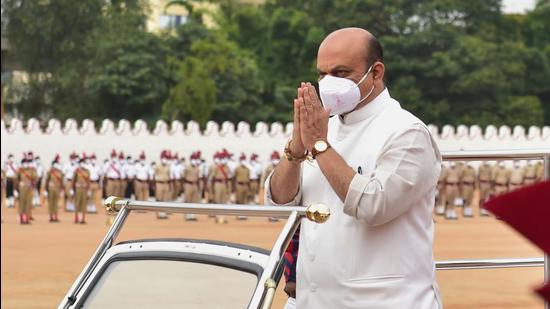
Karnataka chief minister Basavaraj Bommai on Friday flagged off a registration drive in the state for e-Shram, a union government-led initiative to set up a national database of unorganised sector workers hit hard by Covid-induced lockdowns.
The Centre rolled out the scheme on Thursday with an aim to register around 380 million workers from this sector and provide them an e-Shram card, which will help them in availing of benefits of social security schemes being implemented by the central and state governments. Karnataka targets to account for around 10.80 million unorganised workers.
Bommai said the state was identifying unorganised workers in the state. “For unorganised workers there was no security of employment, life insurance, health, educational or any other facilities. Along with security of livelihood, they should be paid equally for the same amount of work,” according to a statement by the chief minister’s office (CMO) in Kannada, attributed to Bommai.
The registration comes at a time when the Bharatiya Janata Party (BJP)-led government in the state has been accused of not providing adequate financial relief to sections worst hit the pandemic-induced lockdowns.
“Be it daily wage earners or agricultural workers, they should be paid adequately for their work,” Bommai said.
The statements come at a time when several workers from this sector are yet to receive any financial relief announced by former chief minister BS Yediyurappa, totalling around ₹2,100 crore, for those worst hit by the lockdowns.
“In the first package we have issued relief only to washermen and barbers. Now we have verified beneficiaries, collected Aadhaar data, de-duplicated names and have sent for the approval to release ₹215 crore from the finance department,” Akram Pasha, Karnataka’s commissioner for labour department, cane development and sugar, told Hindustan Times. “Around ₹60 crore was already paid to some of these sections so far.”
Pasha said there were 3 million construction workers and another 1.4 million workers in 11 categories that include washermen, barbers, mechanics and domestic help, among others.
However, there were doubts raised if the financial package, ranging between ₹2,000 and ₹5,000 for various sections, was adequate to compensate for loss of livelihood for months, Hindustan Times reported on May 20.
The taxi and auto drivers’ association, domestic workers’ association and several others have pointed out that most of their members are yet to receive any compensation.
In May last year, Yediyurappa announced a similar financial package of ₹1,610 crore which, among others, was aimed at providing ₹5,000 each to about 60,000 washermen, 230,000 barbers, 775,000 auto and taxi drivers, among others.
However, this time around there has been a sharp decline in the number of beneficiaries too, according to the statement by the chief minister’s office.
In the case of auto, taxi and maxi cab drivers, a one-time relief of ₹3,000 has been announced for 210,000 beneficiaries from an estimated 775,000 last time around.
Senior government officials said that in the first package, authorities could not trace all the beneficiaries accounted for, resulting in reduced delivery of benefits. One of the flaws, people aware of the complexities of the matter said, was that the government failed to recognise that there were more than one driver per auto or car, and more than one from the same profession in the same family.
A total of 210,000 auto drivers were given relief across Karnataka last time around when, in fact, there are around the same number of auto-rickshaws in Bengaluru alone.
There are no exact statistics on the unorganised workforce in most urban centres in the country mostly due to the lack of any unions, recognition from the government or issue of identification cards, activists and union members said. Among the most vulnerable are domestic workers, who have been forced to remain at home without pay, activists said.
The tedious paperwork for just ₹2000-5000 was another hurdle as these beneficiaries have to register on Seva Sindhu, provide a cache of documents including a certificate from the employer (residence of where the domestic worker is employed) or get a signed letter from a gazetted officer.
There were reports of touts seeking as high as ₹300-500 commission from unorganised workers to give out relief, raising more questions on the mechanism for relief disbursal.
According to government data, out of the total 1,823, 445 applications it received on Seva Sindhu (apart from those already registered) for relief, there were 35,839 from the same family and 1,38,754 rejected applicants.
Other eligibility criteria led to a disqualification of 4,17,667 applications, data shows.
And of this, only 2,14,731 applicants have received the relief, totalling ₹42.95 crore as another 1,191,047 await their turn.


