
 E-Paper



‘Ayodhya means…’: What RSS chief Mohan Bhagwat said ahead of Ram Temple event
Ram Mandir Pran Pratishtha ceremony is being organised in Ayodhya on 22 January. RSS chief Mohan Bhagwat will be present inside the garbha griha.

 Prefer HTon Google


Ahead of the Pran Pratistha ceremony at Ram Temple, Rashtriya Swayamsevak Sangh (RSS) chief Mohan Bhagwat delved into the historical significance of the occasion as he urged to end the decades of conflict surrounding the Ayodhya dispute. In an article originally published in Marathi, Bhagwat highlighted India's prolonged struggle against invaders spanning 1,500 years and what he described as the systematic destruction of religious places by foreign forces to weaken and demoralise society.
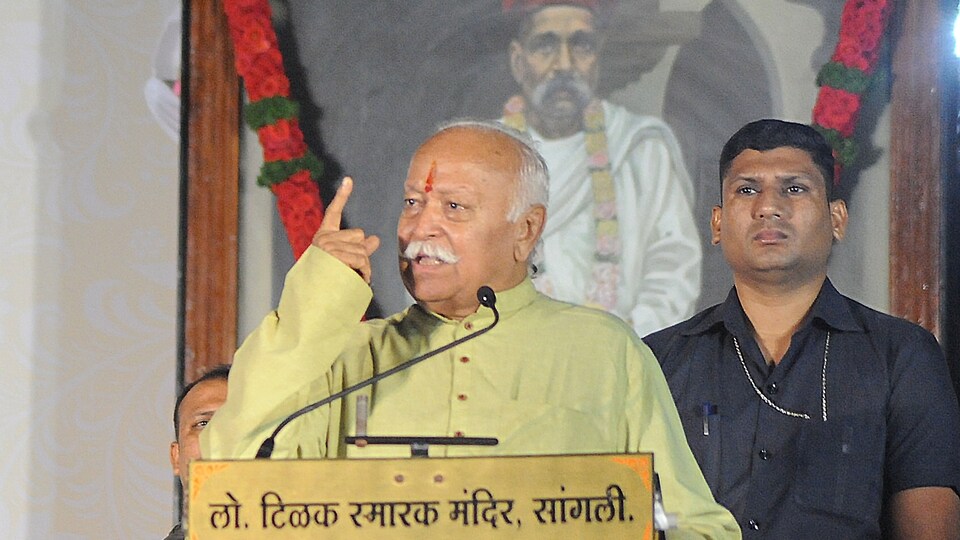
“The aim of early invasions was to plunder and sometimes (like Alexander's invasion) were for colonisation. But the attacks from the West in the name of Islam only brought complete destruction and alienation of the society. heir aim was to demoralise the Bharatiya society so that they could rule over Bharat unhindered with the weakened society,” he wrote.
“The demolition of Shri Ram temple in Ayodhya was also done with the same intention and for the same purpose. This policy of the invaders was not limited to just Ayodhya or any one temple, but was a war strategy for the entire world,” the RSS chief added.
Pran Pratishtha Day 6: Ram Lalla idol to undergo ceremonial bath with medicated water
Bhagwat underscored the consistent attempts to control the birthplace of Lord Ram, noting the failed 1857 War of Independence and subsequent British efforts to divide Hindus and Muslims.
He also discussed the prolonged legal battle in the post-independence era and the Ram Janmabhoomi movement that gained momentum in the 1980s, leading to the Supreme Court's decision in favour of the Hindu side in 2019.
What was the Ram Janmabhoomi movement?
The Ram Janmabhoomi movement was a socio-political campaign in India that centred around the disputed site in Ayodhya, believed by Hindus to be the birthplace of Lord Ram. The movement gained prominence in the late 20th century, particularly during the 1980s and 1990s. The primary demand of the movement was the construction of a temple dedicated to Lord Rama at the site, where the Babri Masjid, a mosque built in the 16th century, stood.
The movement gained momentum with the formation of the Vishva Hindu Parishad (VHP) and the Bharatiya Janata Party (BJP) actively participating in the campaign. The agitation reached its peak on December 6, 1992, when a large gathering of Hindu activists, including some political leaders, demolished the Babri Masjid.
'Hey Ram': Opposition MPs react as AIIMS, other Delhi hospitals declare half-day on January 22
The Ram Janmabhoomi-Babri Masjid issue became a focal point in Indian politics, influencing elections and public discourse for years.
The legal battle over the ownership of the site continued for several decades. In 2019, the Supreme Court of India delivered a landmark judgment, allowing the construction of a Hindu temple at the disputed site while also directing the allocation of an alternate piece of land for the construction of a mosque.
Bhagwat's call for unity
Bhagwat stressed the need for unity and social reconstruction, envisioning a society embodying the virtues of Lord Ram.
“From the Dharmic point of view, Shri Ram is the most worshipped deity of the majority society and the life of Shri Ramchandra is still accepted as an ideal of conduct by the entire society. Hence, now the conflict that has arisen as for and against over the dispute should be ended,” he said.
“The bitterness that has arisen in the meantime should also end. The enlightened people of the society must see that the dispute ends completely. Ayodhya means a city 'where there is no war ', 'a place free from conflict'. On this occasion, in the entire country, reconstruction of Ayodhya in our mind is the need of the hour and also the duty of all of us,” he further wrote.


