
 E-Paper



S Jaishankar's Maldives visit has a message for Dhaka
The Maldives president has made it clear that he was following the same policy of prioritizing Maldives’ interests.

 Prefer HTon Google


New Delhi: After External Affairs Minister S Jaishankar’s visit to Male, Maldives President Mohamed Muizzu told the media that he would not allow anything that goes against the foreign policy of his government and that he was following the same policy of prioritizing Maldives’ interest.
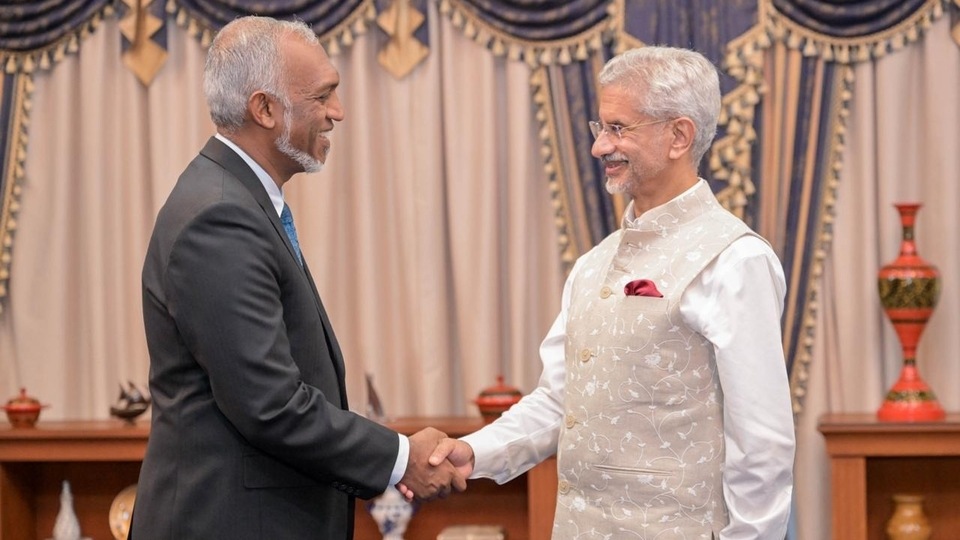
President Muizzu was replying to a question on whether his government would allow the ‘India Out’ campaign launched by the ruling PNC-PPM coalition to grab power last year. The Maldives President said that he had not changed the foreign policy of his country. The response came immediately after Minister Jaishankar left for India in a special aircraft after spending two days in Maldives and launching several projects.
Also read: Indian Navy approaches government for two nuclear attack submarines
During Jaishankar’s visit, President Muizzu and his ministers were all milk and honey with the visiting dignitary as if there was no friction between the two countries since Muizzu was sworn in last November 17. Behind this perceptible change was the fact that Maldives is in dire economic crisis and even communist China cannot bail out Male without quid pro quo. The fact is that Maldives is facing a budgetary gap running into a couple of hundred million USD with India already rolling over a payment of USD 50 million to SBI in May and another USD 50 million due in September. Maldives has to pay some USD one billion to the market in 2026 and the country faces a default.
While the Modi government is committed to helping out the Maldives as a neighbour, Maldives is also a message to strife-torn Bangladesh as only India has come forward to help these countries when in dire economic crisis. Not China, not the US or the West. This is despite Maldives President Muizzu trying for financial support from Turkey, China, the Middle East and big brother China, who normally gives loans through Exim banks at market rates.
President Muizzu’s decision to forge bilateral cooperation with India comes from his own assessment of the past year of assuming power and the realization that only India can deliver on development, security and financial stress. Despite the 28 island project and the Greater Male connectivity project being launched by India before Muizzu assumed power, these development projects are on the verge of fruition and in the interest of the Maldives and not any political party. In the past year, President Muizzu has also realized the security requirements of Maldives with drug runners, pirates and arms smugglers operating in the deep Indian Ocean. He realizes that without Indian security support, Maldives stands exposed to the dark forces. Finally, like Sri Lanka, Maldives also faces financial stress and India is willing to help out without any leverage as it has shown by rolling over repayments.
The Interim government in Bangladesh will also soon realize that it faces a crisis on the development, security and financial stress front and it is only India under Modi who is willing to help without extracting the proverbial pound of flesh.
Even though Bangladesh is currently going through a political crisis with Islamists targeting Hindu minorities in the name of supporters of the Awami League of ousted PM Sheikh Hasina, the fact is that Dhaka is facing an economic crisis and will have to come to India like Sri Lanka in 2022 for financial support. The same would be the situation of Nepal but its currency is linked with the stable Indian Rupee.
The statement of President Muizzu is also welcome as it means that reality has dawned on Maldives and the rise of Islamists in Male is not in the interest of the new government. The fact is that Minister Jaishankar was given a red carpet treatment, more than the previous Ibrahim Solih regime. The neighbouring countries are getting the message that Modi’s India cannot be trifled with.


