
 E-Paper



From Nehru to Savarkar to Bengal: PM Modi's top quotes in Vande Mataram debate
Debate comes amid political row after PM Modi accused Congress of removing certain lines from it in 1937. That act, he says, “sowed the seeds of Partition”
Updated on: Dec 8, 2025, 14:51:30 IST

 Prefer HTon Google
Share via


Copy link

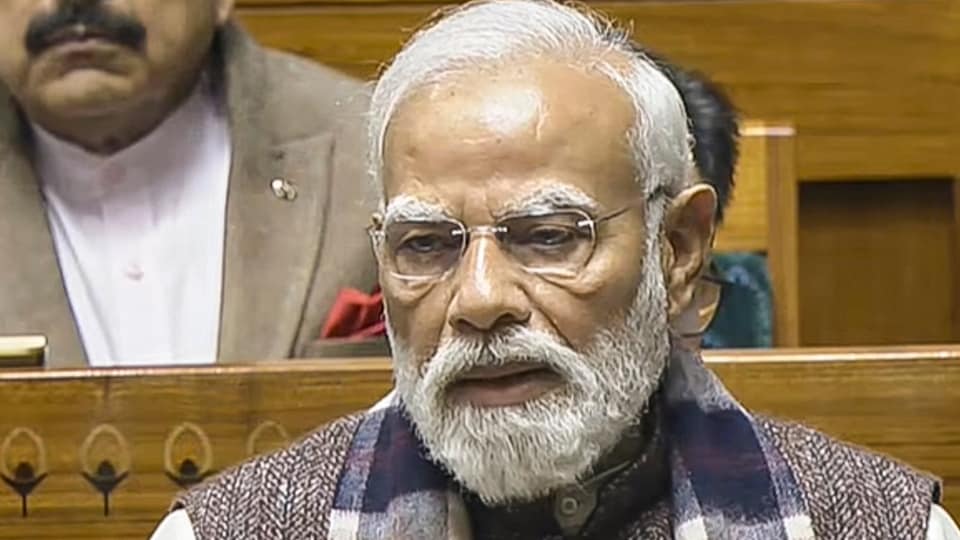
Prime Minister Narendra Modi listed the history and anti-colonial pitch of Vande Mataram in a special discussion in Parliament on Monday, marking the 150th anniversary year of the national song. “Remembering the sacred Vande Mataram today is a great privilege for all of us in this House,” PM Modi said, speaking in the Lok Sabha.
Follow | Live updates from Parliament
This discussion comes as a debate was ignited after the PM and the ruling BJP accused the Congress of removing certain lines from the song in 1937 and “sowing the seeds of Partition”.
Here are some key points the PM made in the Lower House of Parliament:
- Attack on Congress, Nehru: PM Modi said “some forces” carried out a “vishwasghaat” (betrayal) of the national song in the last century. “It is our duty to tell our next generations who did it,” he said, speaking in Hindi. “Muslim League (pre-Independence) led by Mohammed Ali Jinnah, in 1937, carried out a drive against Vande Mataram. But the Congress and Jawaharlal Nehru, rather than opposing them, started probing Vande Mataram instead.”
- ‘Excuse of communal harmony’: “Within five days of Jinnah's protest of 1937, Nehru ji wrote to Subhas Chandra Bose that some parts of the song can irritate Muslims.” The entire country was shocked, the PM said. "Yet, on October 26 that year, the Congress made a compromise and divided Vande Mataram into parts. And the excuse was that ‘this is for communal harmony’."
- ‘Led to Partition’, INC now ‘MMC’: He said this acceptance of removing some stanzas from Vande Mataram was an instance of the Congress's “politics of appeasement”, and it led eventually to a “compromise of the partition of India”. He added, “The Congress continues the same policy. It seems INC (Indian National Congress) has become ‘MMC’” — reusing to his recent coinage “Muslim League-y Mao-wadi Congress” after the BJP-led NDA's Bihar election victory.
- On Bankim ‘babu’: “Bankim da wrote Vande Mataram at a time when it had become fashionable to look down upon India,” PM Modi said, referring to Bankim Chandra Chatterjee, the poet who wrote Vande Mataram. An Opposition MP from Bengal later interrupted and told him not to say Bankim "da” (‘da’ meaning brother) but use “Bankim babu” intead ('babu' being an equivalent of a more resepctful ‘sir’). PM Modi corrected himself immediately, and said “thank you” multiple times to the MP, switching to “babu” instead.
- Major Bengal reference: “Bengal became a laboratory for the British colonial regime's ‘divide and rule’ policy. When they committed the sin in 1905 (of diving Bengal province), Vande Mataram stood like a rock. It became the song of the streets. It inspired people. The British sowed the seeds of division through Bengal, but Vande Mataram became the strand and song for national unity,” Modi said. He spoke several lines in Bangla and Tamil languages, referring to slogans and some translations of Vande Mataram.
- ‘British raj banned it because…’: “Vande Mataram was not just a mantra for political freedom; it was a sacred war cry to rid Bharat Mata of the vestiges of colonialism,” PM Modi said. “Vande Mataram was written at a time when British rulers were trying to take their anthem 'God Save the Queen' to every household,” he added. “The British were forced to ban Vande Mataram; they brought in laws to prevent printing and propagation of the poem.” The ban was in effectively in place from 1905 to 1908.
- Savarkar in London: He also mentioned how VD Savarkar sang Vande Mataram at the India House in London. “We are sitting here because lakhs chanted Vande Mataram and fought for Independence,” PM Modi said, after listing several names of freedom fighters.
- 100th anniversary and Emergency: “When Vande Mataram completed 50 years, country was under colonial rule, and at its 100th anniversary the nation was under Emergency,” PM Modi further said, referring to the Emergency imposed by the then PM Indira Gandhi (1975–77). "At that time, the Constitution was throttled, and those who lived and died for patriotism were pushed behind bars. The Emergency was a dark chapter in our history. Now we have the opportunity to restore the greatness of Vande Mataram. And I believe this opportunity should not be allowed to pass," Modi said.


Get the latest India News, breaking headlines, and real-time updates from across the nation. Stay informed on politics, government policies, crime, weather, and CEC Gyanesh Kumar row Live.


