
 E-Paper



SC divulges details of split over collegium procedure
In an unprecedented move, the Supreme Court on Monday put out in public domain the details of a failed collegium meeting and the dissent of the collegium members that led to aborting the proposal to appoint four new judges.


In an unprecedented move, the Supreme Court on Monday put out in public domain the details of a failed collegium meeting and the dissent of the collegium members that led to aborting the proposal to appoint four new judges.
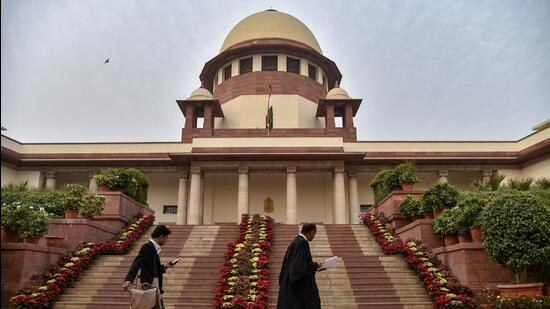
A resolution uploaded on the court website on Monday morning disclosed the developments between September 26 – when the names of eleven persons were considered by the collegium for appointments as Supreme Court judges – and October 7, when the Union government wrote to Chief Justice of India (CJI) Uday Umesh Lalit to name his successor.
As reported first by HT on October 3, CJI Lalit initiated a proposal for the appointment of four new judges in the Supreme Court by seeking written consent of his fellow judges in the collegium after the September 30 meeting of the collegium could not take place due to unavailability of one of the judges.
The move was unparalleled because the collegium members – the first five judges of the Supreme Court – sign the resolutions in person after zeroing in on the names that are to be recommended to the Union government for appointment. Apart from the CJI, the collegium currently comprises justices Dhananjaya Y Chandrachud, Sanjay Kishan Kaul, SA Nazeer, and KM Joseph.
The resolution available on the website states that the name of Bombay high court chief justice Dipankar Dutta was recommended for elevation following the meeting held on September 26 while the deliberation on another 10 names were postponed to September 30 to let the collegium members go through judgments of the potential candidates.
However, on September 30, the meeting could not take place after Justice Chandrachud did not attend it, as the most senior judge sat in court till 9.10pm to finish the judicial work on the last working day of the Supreme Court ahead of the Dussehra vacation.
On the night of September 30, CJI Lalit wrote to the collegium members, requesting them to accord their consent to the four names – Punjab & Haryana high court chief justice Ravi Shankar Jha, Patna high court chief justice Sanjay Karol, Manipur high court chief justice PV Sanjay Kumar, and senior advocate KV Viswanathan.
According to the resolution, while justices Kaul and Joseph supported the CJI’s proposal, justices Chandrachud and Nazeer “objected to the process of selection and appointing judges by circulation.”
The statement added: “The letters of Hon’ble Dr Justice Chandrachud and Hon’ble Mr Justice S Abdul Nazeer, however, did not disclose any views against any of these candidates. This was brought to their Lordships’ notice and reasons were solicited and/or alternative suggestions were invited vide second communication dated October 2 addressed by the CJI. There was no response to said communication.”
Suggesting that a fresh collegium meeting was planned in view of the stalemate, the resolution pointed out that “the matter was, therefore, ideally suited to have a discussion across the table amongst the Judges forming the Collegium.”
Meanwhile, on October 7, the Union law ministry wrote to CJI Lalit, requesting him to name his successor to take the helm after the judge retires on November 8.
“In the circumstances, no further steps need be taken and the unfinished work in the meeting called for September 30, 2022 is closed without there being any further deliberation. The meeting dated September 30, 2022 stands discharged,” concluded the statement, explicating the proposal to appoint four new judges stands aborted.
Former CJI RM Lodha, however, did not find favour with the resolution. “Transparency does not mean divulging details of the process or each and every thing that transpired before the final decision. What is required to be disclosed is the final decision,” justice Lodha told HT.
He added that bringing out all such details may eventually affect the functioning of the collegium system.
Even as the proposal regarding the four names stands terminated for now, they can still be considered in future meetings of the collegium, which will be headed by justice Chandrachud once he takes over as the 50th CJI on November 9. He will have a term of two years as the head of the judiciary in India, and will retire on November 10, 2024.
At present, the top court is short of five judges out of its sanctioned strength of 34. The Centre is yet to clear justice Dipankar Dutta’s name for appointment to the top court. It has, till date, also not approved another collegium resolution of September 28, when names of three high court judges for elevation as chief justices of the Orissa, Karnataka and Jammu & Kashmir high courts were recommended, besides the transfer of two high court chief justices and three judges.
If justice Dutta’s name is approved by the Centre, justice Chandrachud will have two years to fill up 18 vacancies – four current and 14 set to arise between October 2022 and September 2024.


