
 E-Paper



Supreme Court to hear review plea against PMLA verdict today
The review petition questioned the Supreme Court’s order on July 27 upholding powers of search, seizure, summon, arrest and bail under Prevention of Money Laundering Act in total disregard to fundamental rights of accused, and absence of procedural safeguards provided under CrPC

 Prefer HTon Google


Paving the way for a possible reconsideration of the judgment upholding the provisions of the Prevention of Money Laundering Act, 2002 (PMLA) — something that analysts and experts was suggested in its ruling on the Benaami Property Transactions Act of 1988 yesterday — the Supreme Court on Wednesday directed the review petition filed by Member of Parliament Karti P Chidambaram to be listed in open court for arguments on Thursday.

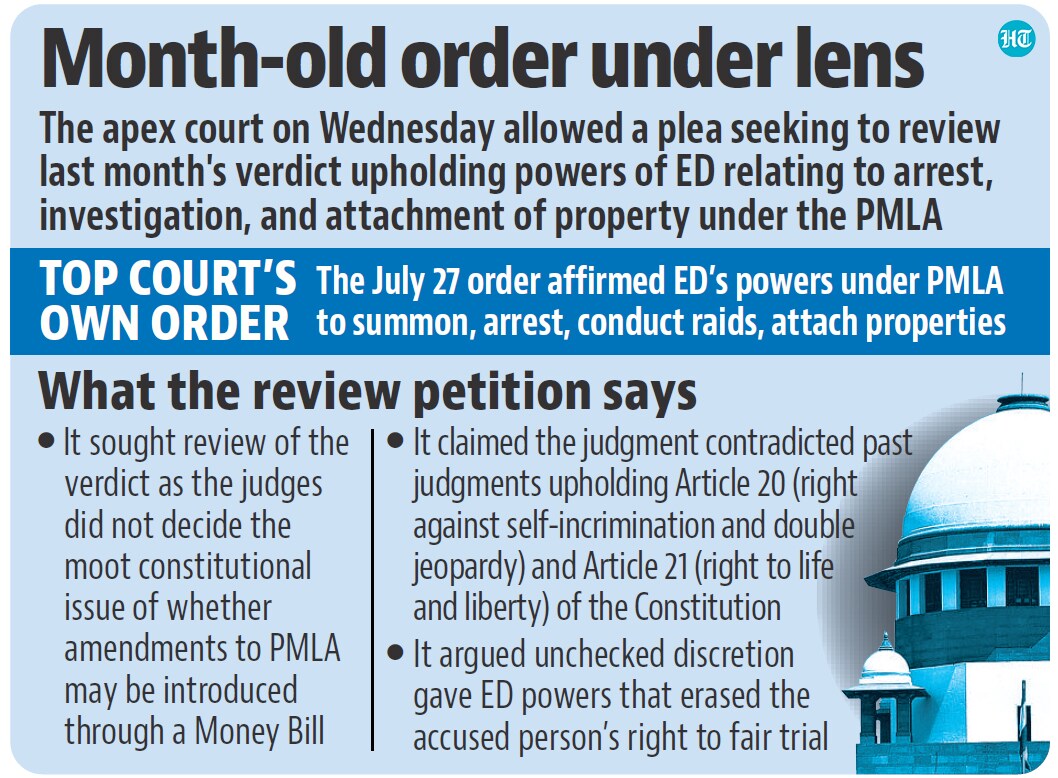
The review petition questioned the Supreme Court’s order on July 27 upholding powers of search, seizure, summon, arrest and bail under PMLA in total disregard to fundamental rights of accused, and absence of procedural safeguards provided under the Code of Criminal Procedure (CrPC). Since the judgment was given by a three-judge bench headed by justice AM Khanwilkar (who retired on July 29) and justices Dinesh Maheshwari and CT Ravikumar, the review petition was heard in chambers by Chief Justice of India (CJI) NV Ramana along with the other two judges who decided the matter.
The short order passed on the review plea said: “The application for oral hearing is allowed. List the matter in the Court on August 25.” Karti, who is an accused in the INX Media case investigated by ED, and is the son of former Union home minister P Chidambaram, filed the review petition on Monday citing more than 40 grounds to show how the July 27 judgment was manifestly erroneous. Interestingly, the petition has got a hearing in less than 48 hours of being filed and mentioned for urgent listing.
In a judgment rendered on Tuesday by the Supreme Court, a three-judge bench headed by CJI Ramana, while striking down two offensive provisions on prosecution and confiscation under the Prohibition of Benami Property Transactions Act, 1988 referred to the PMLA judgment of July 27 and said that certain aspects of the judgment required further exposition in an appropriate case as they created scope for arbitrary application.
The judgment referred to confiscation proceedings under Section 8 of PMLA where it limited application of Section 8(4) of PMLA providing for interim possession of property by ED before conclusion of final trial to exceptional cases. This was allowed in view of the unique scheme provided under the PMLA law. CJI Ramana, who wrote Tuesday’s judgment, said, “Having perused the said judgment (of July 27), we are of the opinion that the aforesaid ratio requires further expounding in an appropriate case, without which, much scope is left for arbitrary application.”
Chidambaram sought review of the PMLA verdict as the judges did not decide the moot constitutional issue of whether the amendments to PMLA could be introduced through a Money Bill. Since this issue of constitutional importance was pending before a five-judge constitution bench in a 2020 case (Roger Mathew v South Indian Bank), he argued that the PMLA verdict should have awaited the decision. Alternatively, he argued, the case regarding PMLA amendments ought to have been referred to the same constitution bench.
Further, Chidambaram claimed that the judgment under review suffered from grave error in law, as it contradicted past judgments of the top court upholding Article 20 (right against self-incrimination and double jeopardy) and Article 21 (right to life and liberty) of the Constitution and by being contrary to settled principles of criminal jurisprudence.
The plea further said that the judgment, by validating each contentious provision of the PMLA as constitutional, failed to understand its far reaching consequences. It said that in the definition of money laundering, projecting or claiming proceeds of crime as untainted property is an essential ingredient. “The offence is not complete unless the proceeds of crime are “projected or claimed as untainted property”. The impugned judgment is in grave error in rejecting this submission and deserves to be reviewed,” the plea stated, adding that the judgment has re-written the law made by Parliament which is not permissible.
Chidambaram further questioned the retrospective operation of the law permitted by the Supreme Court decision and said, “An act committed even 100 years ago (in respect of an offence under IPC) can be resurrected and the person concerned can be accused of ‘money-laundering’ after the PMLA was brought into force and the offence included in the Schedule… Such a result is expressly forbidden by Article 20 of the Constitution.”
As regards the “twin conditions” to be met by accused to get bail under Section 45 PMLA, Chidambaram questioned how the Court extended it to anticipatory bail proceedings as well. The twin conditions require the accused to prove innocence and allow the public prosecutor to be heard before the bail plea gets decided. He said that depriving the accused of a copy of FIR, complaint, case diary and incriminating documents would make it impossible for them to persuade the court of their innocence . “Such an outcome is extremely prejudicial to the accused and is violative of the principles of “fair and reasonable procedure” and “substantive due process” enshrined in Article 21 of the Constitution,” Chidambaram added.
Along with the review plea, he filed two separate applications for stay of the judgment and to have the matter heard in open court.


