E-Paper



SC upholds Article 370 abrogation, says hold polls by Sep 2024, restore statehood
A five-judge constitution bench held hearings for 16 days on whether the August 2019 decision of the Union government to scrap Article 370 and bifurcate J&K into two Union territories was valid

 Prefer HTon Google


The President had the power to abrogate the Constitution’s Article 370, which gave Jammu and Kashmir (J&K) a semi-autonomous status, the Supreme Court ruled on Monday, rejecting the argument that it was a permanent provision and directing the holding of elections in the region by September 2024 and the restoration of the statehood at the earliest.
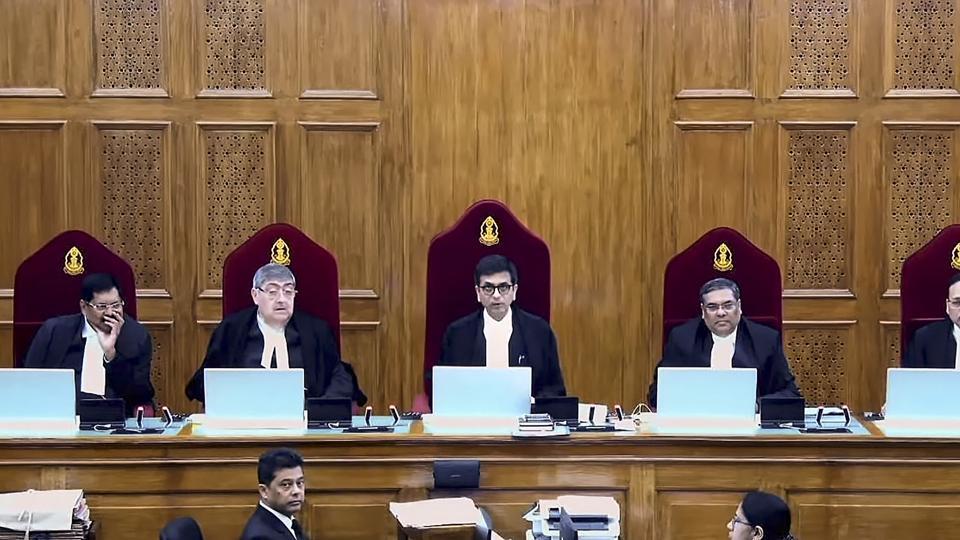
A five-judge constitution bench held hearings for 16 days on whether the August 2019 decision of the Union government to scrap Article 370 and bifurcate J&K into two Union territories was valid before reserving its verdict on September 5. J&K was under the President’s rule when the provision was nullified amid a lockdown and a communications blockade.
Comprising Chief Justice of India (CJI) Dhananjaya Y Chandrachud and justices Sanjay Kishan Kaul, Sanjiv Khanna, BR Gavai, and Surya Kant, the bench pronounced three concurring judgments. It did not go into the re-organisation of the erstwhile state into two Union territories citing the government’s submission that J&K’s statehood will be restored.
The CJI read out his majority judgment, and on behalf of justices BR Gavai and Surya Kant. “It is not relevant to hold whether the proclamation to abrogate Article 370 was valid or not,” he said, holding that there are restrictions on powers to be exercised after the imposition of President’s Rule under Article 356.
He added the Union government can exercise the power of a state government under the President’s rule. “Parliament/President can exercise legislative powers of a state under proclamation.”
The CJI said that J&K did not retain independent sovereignty after it joined the Union of India in 1947. “J&K surrendered its complete sovereignty with the merger.” He added J&K Constitution was only to further define its relationship with India. “J&K did not have any internal sovereignty either. Its Constitution was subordinate to the Constitution of India.”
The CJI said a recommendation of the J&K constituent assembly before the abrogation of Article 370 was not necessary. “Power of abrogation under 370 is for integration of J&K. Cannot sit in appeal over the President’s decision to abrogate Article 370 except in extraordinary circumstances. ...the President could have applied all provisions of the Constitution to J&K with the concurrence of the Centre and it was not required to also obtain concurrence of the state assembly.”
The hearing in the case commenced on August 2 after over three years. In March 2020, another five-judge bench declined to refer the matter to a larger bench. The reference was sought on the grounds that two previous judgments of the apex court were conflicting with each other, but the bench did not agree with this contention.
Senior advocate Kapil Sibal spearheaded the legal submissions on behalf of the petitioners in the case.
The petitioners argued that Article 370 was an embodiment of a constitutional promise to the erstwhile princely state of its unique status despite its accession. They argued that the dissolution of J&K’s Constituent in 1957 gave Article 370 the status of a permanent provision, which could not be nullified.
The government underlined that Article 370 was not an embodiment of any special status to J&K but was “only a stop-gap arrangement” in the process of its “complete integration” with the Union of India.
.