
 E-Paper



Shah calls for special jails to aid extradition
Amit Shah proposed special jails for fugitives, revocation of their passports upon red notices, and a national database to enhance extradition efforts in India.


Union home minister Amit Shah on Thursday asked for special jails in every state and Union Territory that meet international standards so as to ease the extradition of fugitives, and also recommended revoking passports of fugitives as soon as Interpol red notices are published against them.
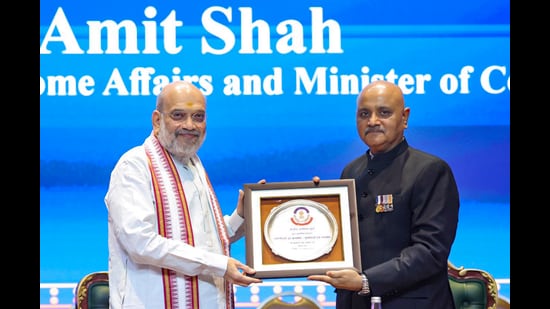
The home minister also suggested creating a national database of fugitives and a special cell of the police in every state and UT to deal with extradition cases.
He was addressing the opening session of a two-day conference on “extradition of fugitives: challenges and strategies”, being organised by CBI (Central Bureau of Investigation), at Bharat Mandapam, where central and state agencies are discussing various aspects of tracing fugitives and bringing them back to India.
HT had reported on October 13 that such a multi-agency conference for fugitives and extraditions is being organised.
“India cannot be truly secure until those residing abroad who harm the country’s economy, sovereignty, and security begin to fear the Indian justice system. I have some suggestions for developing actionable points for this conference. Every state should establish special prisons for fugitives in line with international standards,” Shah said on Thursday. “There is also a need to develop coordination mechanisms and protocols between the passport issuance process and law enforcement agencies, so that when the process of issuing a red notice begins against any passport holder, their passport can be red-flagged and revoked”.
The extradition of fugitives, wanted for economic and other offences, presents a significant challenge for enforcement agencies such as CBI and the Enforcement Directorate. India is fighting high-profile legal battles to extradite economic offenders such as Mehul Choksi and Nirav Modi, in Belgium and the UK respectively. It won its case to extradite Vijay Mallya from the UK, but his extradition is stuck due to certain confidential proceedings, according to the British government. It is likely that he has applied for political asylum.
Speaking at the conference, Central Bureau of Investigation (CBI) director Praveen Sood said that a total of 388 extradition requests from India are pending with various countries. Till date, 957 Interpol red notices have been issued against various kind of fugitives. A red notice is a request to 195 Interpol member countries to locate and provisionally arrest a fugitive.
One argument proffered by such offenders during extradition proceedings is the standard of Indian jails.
“Creating special prisons is needed because fugitives argue in foreign courts that prisons in India are not up to the standards, and that their human rights will not be protected. While I do not agree with that, if it is an excuse, why give them that chance? Every state capital should have a cell which conforms to international standards in its entirety,” said Shah.
“The passports of fugitives should be revoked as soon as Interpol red notices are issued against them,” Shah said. Officials familiar with the process said revoking passports will make the fugitives stateless.
He added that India should create a “database which will have all the details about the person’s crime, his status in foreign country, his network etc, and it should be shared with the police of all states”.
“The states/UTs police should have an expert special cell to ensure effective preparation of extradition cases. To guide these special cells, a dedicated division within the CBI should also be established to review extradition requests,” Shah added.
The minister also asked Indian agencies to make use of section 355 and 356 of the Bharatiya Nyaya Sanhita (BNS), that facilitate “trial in absentia” , against the fugitives, adding that the issue is linked to India’s national security. “Till they fear our law, we won’t succeed,” Shah said.
The home minister added that since the introduction of the Fugitive Economic Offenders (FEO) Act in 2018, the government has recovered nearly $2 billion from fugitives under this law.
Sood also said that the processing time for publishing Interpol red notices for fugitives based on India’s request has come from 14 months to just three months now due to Bharatpol.
“Due to Bharatpol, the time taken in publishing Interpol red notices has reduced from 14 months to just three months now. We have only eight proposals (for Interpol notices) pending right now,” Sood said.
Bharatpol is a paperless, real-time information sharing portal for the states’ police and central agencies seeking international assistance through CBI instead of using traditional methods of letters, emails and faxes.
Out of the 957 red notices issued till date on India’s request, 231 are related to CBI cases, 130 to National Investigation Agency (NIA), 21 to Enforcement Directorate (ED) cases, 12 to Narcotics Control Bureau (NCB) cases and the remaining related to various state police forces.
Sood said 189 red notices are related to economic offences, 254 to terrorism cases, 21 to money laundering, 55 to narcotics, and the remaining to crimes such as rape, murder, kidnapping, etc.
“But, one cannot take pride in these figures just yet, for two reasons: first, the number is still quite low compared to other countries, and second, the real work begins only after the notices are published. The next major task is to locate the wanted fugitives and eventually bring them back to the country to face judicial proceedings,” he said.
“In 2023, we were successful in bringing back 29 fugitives, and in 2024, 30 fugitives. So far in 2025, 35 fugitives have been brought back to face judicial proceedings,” the CBI chief said.


