
 E-Paper



Amit Shah: Communalism, radicalism results of appeasement politics
The BJP has been criticised by opponents for fostering sectarian politics. The comments of the party’s former spokesperson Nupur Sharma against Prophet Mohammed snowballed into a major controversy and a clutch of counties registered their protest.

 Prefer HTon Google


Communalism and radicalism in India is the outcome of the politics of appeasement by opponents of the Bharatiya Janata Party, home minister Amit Shah said on Sunday as he moved a resolution on the concluding day of the party’s national executive council meeting in Hyderabad.
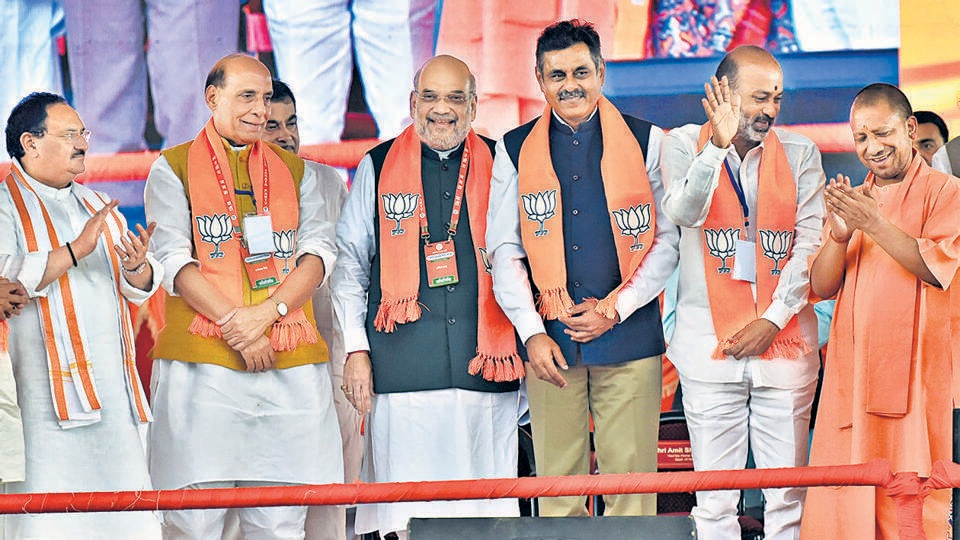
There should be an end to political violence and fundamentalism in the country, Shah said.
“He said the country will become a vishwaguru (world leader) once the politics of appeasement, dynasty and casteism end in the country,” Assam chief minister Himanta Biswa Sarma said at a media briefing.
Responding to a question on whether the resolution took note of the recent killings in Rajasthan’s Udaipur and Amravati, Sarma said: “Our country has suffered for so long, and it is (because) of appeasement, casteism and dynastic politics. Once these are over, these problems will end.”
The BJP has been criticised by opponents for fostering sectarian politics. The comments of the party’s former spokesperson Nupur Sharma against Prophet Mohammed snowballed into a major controversy and a clutch of counties registered their protest.
The party has distanced itself from the controversy and alleged there is a narrative being spun by its opponents to discredit the government. It referred to the victory in the recent assembly elections as a validation of its ideology.
Also Read | BJP to focus on panna pramukhs to improve expansion campaign
The party will be a force to reckon with in the next 30-40 years, Shah said, and its political identity will be shaped by its commitment to Sabka Saath, Sabka Vishwas, Sarma said.
“He said for the next 30-40 years it will be the era of the BJP. And the recent electoral success of the BJP (in four of the five states that went to polls earlier this year) has clearly demonstrated that politics of casteism, appeasement and dynasty has come to an end, and the era of performance and development has begun,” Sarma said.
Even as it accuses its opponents of nurturing politics of appeasement and cultivating vote banks based on caste and faith, the BJP too is accused of consolidating Hindu votes. The party, however, asserts that performance and merit are the two key criteria for selection of candidates for elections and for top jobs in the government.
Shah credited Prime Minister Narendra Modi’s leadership for the party winning polls repeatedly. “He said the definition of politics has changed,” Sarma said, adding that the party applauded the governance under Modi and that in the past eight years, corruption and policy paralysis has ended.
“The home minister said the BJP has established its address in the northeast and it will be difficult to dislodge the party from there. He also said Odisha, Tamil Nadu, Telangana, West Bengal and Kerala will soon have a BJP government,” Sarma said.
Shah also said the next growth area for the BJP will come from southern India.
Also Read | In welfare pitch, BJP slams ‘family politics’
The resolution, seconded by Sarma and Karnataka chief minister Basavaraj Bommai, reiterated that the recent Supreme Court verdict on the 2002 Gujarat riots was “historic”. The apex court on June 24 dismissed a petition by Zakia Jafri challenging the clean chit by the special investigation team to Modi, who was then the chief minister of Gujarat.
“It exposed the conspiracy of some opposition parties, NGOs and ideologically motivated journalists to defame the Prime Minister,” Sarma said.
Shah also took a swipe at the opposition, particularly the Congress, for being divided. The home minister said the Congress is in turmoil and has not been able to hold free and fair internal election despite a demand for it.
“Congress is nirash (disappointed) and hatassh (dejected). They have been opposing everything from the Ram temple to Amrit Mahotsav, from vaccines to surgical strikes and even CAA,” Sarma said. CAA is the contentious citizenship law that saw widespread protests across the country.
The resolution took note of the two presidential elections since 2014, when the BJP rose to power at the Centre. Sarma said Shah made a mention of how during the first election in 2017, the BJP picked a Dalit (Ram Nath Kovind), and the second time, the upcoming July 18 presidential poll, a scheduled tribe woman (Droupadi Murmu).
The resolution applauded the reading down of Article 370 in Jammu and Kashmir, the new Agnipath military recruitment policy and the appointment of a chief of defence staff (CDS).
“Shah said the foreign policy is in national interest. India’s views on environmental concerns matter. He also said it was the Prime Minister who could introduce the post of CDS and has the courage to implement OROP, banned import of 3,000 defence items and the export has gone up six times,” Sarma said. OROP refers to the uniform pension for defence personnel retiring in the same rank with the same length of service, regardless of their date of retirement.
In response to a question on the suggestions made by Modi at the eccutive committee meeting, Sarma said, “He made various comments and suggestions. He said there is a need to bring the development of the northeast into focus, and that the workers should take the message of the country’s achievement to the grassroots. He feels the story of NDA’s presidential nominee Droupadi Murmu’s struggle should be bought into the limelight,” Sarma said. The BJP leads the National Democratic Alliance.
On the implementation of the citizenship law, Sarma said Shah flagged it as an achievement. “He will decide the time, but we are committed to its implementation,” he added.
To a question on the status of the Naga accord, Sarma said the home minister has said that post-2014, the government has initiated major development activities and AFSPA was recently removed from nearly 66% of the northeast region. AFSPA is short for Armed Forces (Special Powers) Act, which confers the military wide-ranging powers to maintain public order.
“He said by 2024 there will be no fault-line in the northeast,” Sarma added.
Commenting on the resolution, former MP and Telangana Pradesh Congress Committee vice-president Mallu Ravi said it was unfortunate that it was passed in Hyderabad, which is the land of secularism.
“What the Congress is following is not politics of appeasement, but politics of inclusiveness. We believe in the development of all religions...” Ravi said.


