E-Paper



Number theory: The relevance of NCP in Maharashtra and India
Sharad Pawar formed the NCP in 1999, after opposing Sonia Gandhi as the prime ministerial candidate, and leaving the Congress


In a surprise announcement during the launch of his autobiography on May 2, Sharad Pawar said he is stepping down as the president of the Nationalist Congress Party (NCP). This announcement followed rumours that a section of the party led by his nephew Ajit Pawar was planning to join the ruling Bharatiya Janata Party (BJP) in Maharashtra. While Ajit Pawar has denied these rumours, he did have a short-lived alliance with the BJP after the 2019 assembly elections to form a BJP-NCP government, although this was done without Sharad Pawar’s knowledge. Does this mean that the NCP is likely to split? The answer to this question is best known to NCP legislators. However, even Pawar stepping down as the president of the NCP -- if he goes through with his decision -- will be a big change in what is essentially a family-run party. How important is this party and what would its growth or decline mean? Here are four charts that answer that.
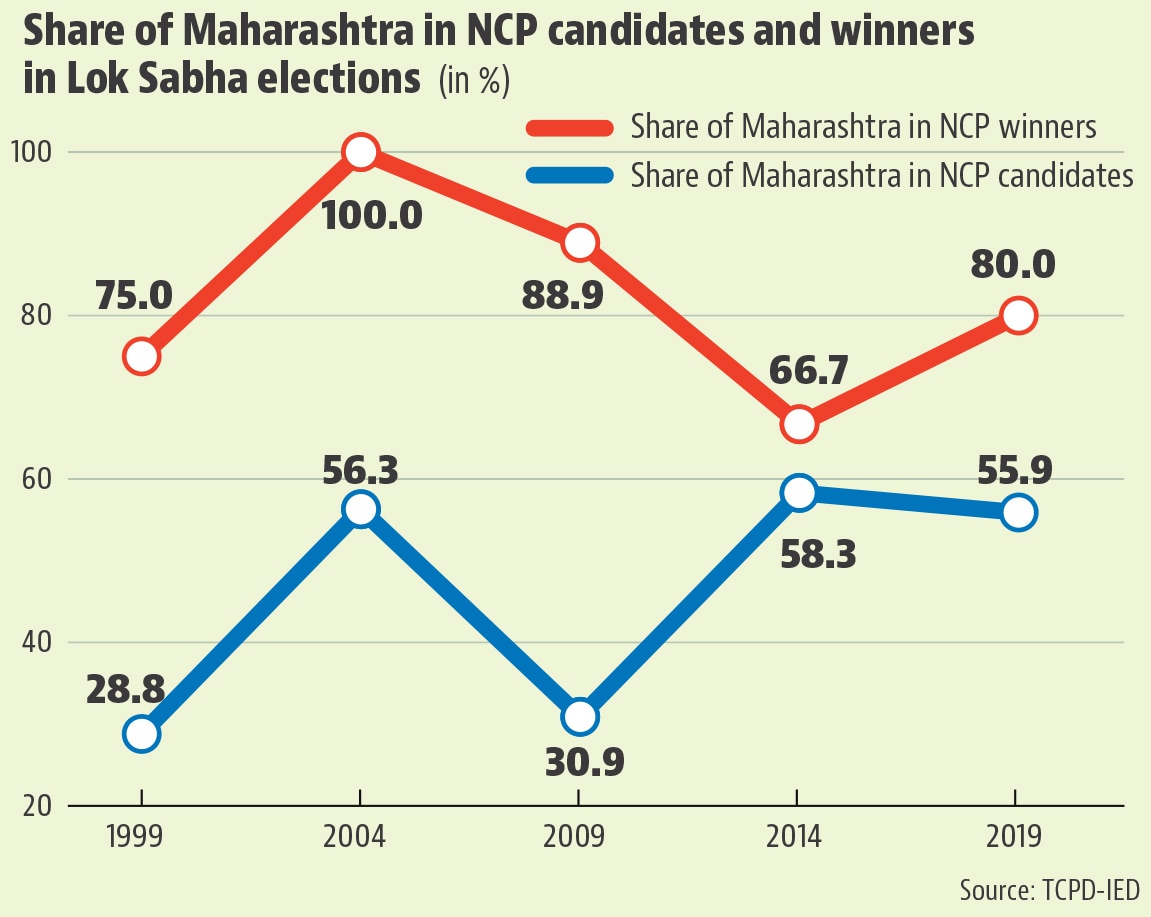
 NCP MPs have come from very few statesSharad Pawar formed the NCP in 1999, after opposing Sonia Gandhi as the prime ministerial candidate, and leaving the Congress. The NCP fought its first Lok Sabha election in the same year from 132 seats and won eight. After 1999, the party fought much fewer seats, ranging from a minimum of 32 in 2004 to a maximum of 68 in 2009. Its seat share in the Lok Sabha also remained low, although it went even lower than usual in 2014 and 2019. What remained constant throughout this period, however, is that most of the Lok Sabha seats it contested came from Maharashtra, and the state had an even bigger share in NCP’s victories. The small share of its non-Maharashtra MPs came from just four states and Union territories since 1999 – Bihar, Meghalaya, Manipur, and Lakshadweep. Some of this was the result of the 1999 expulsions from Congress. The NCP performance in Meghalaya could be attributed to the presence of PA Sangma, who was also expelled with Sharad Pawar from Congress in 1999.
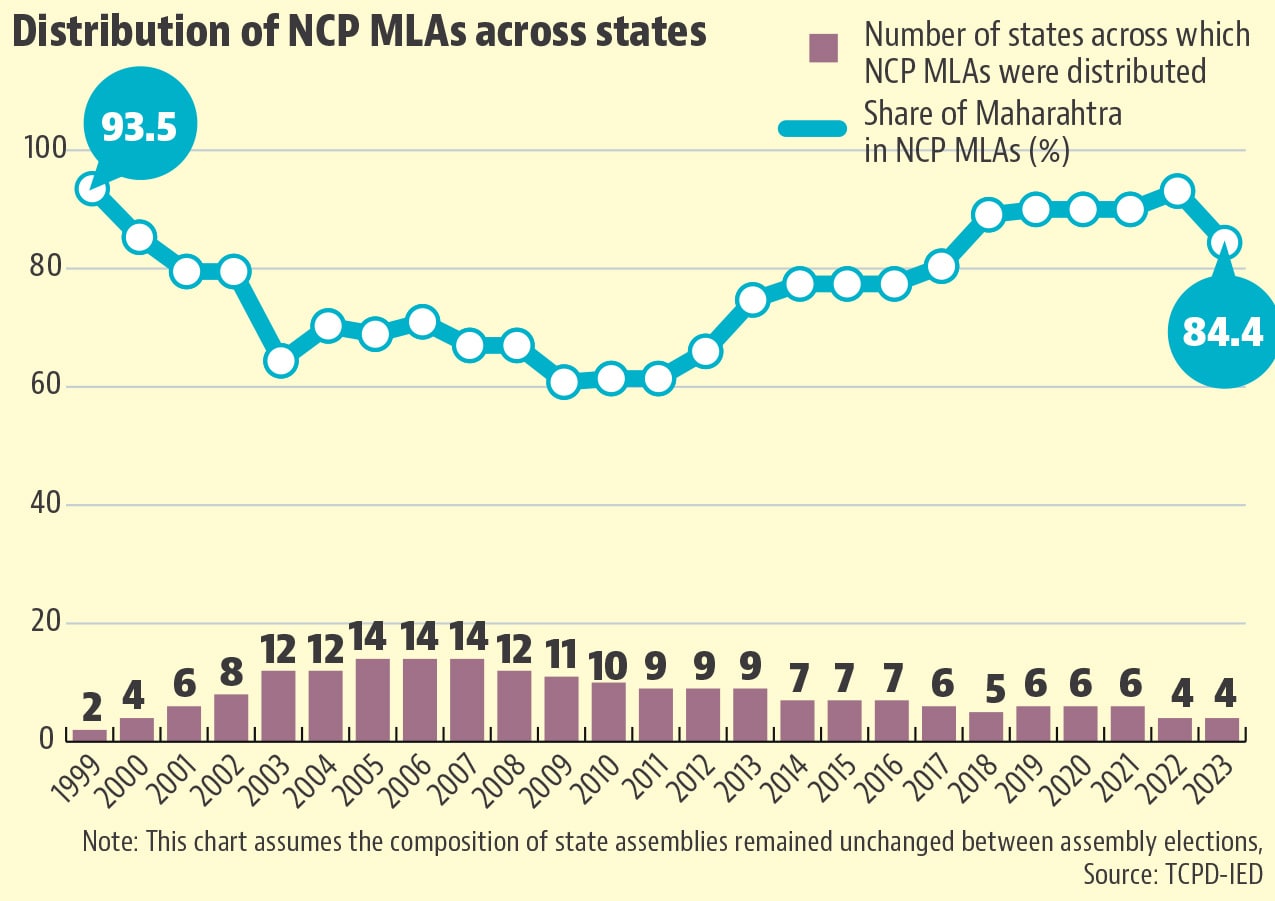
- But NCP MLAs have come from a larger number of statesAs the chart here shows, at least two-thirds pf NCP MPs came from Maharashtra after every Lok Sabha elections. A similar share of NCP MLAs also came from Maharashtra. However, because the number of NCP MLAs was always been much bigger than the number of NCP MPs, its MLA pool came from a larger number of states: 18 since 1999. To be sure, NCP had MLAs across a maximum of only 14 states during any one year (from 2005 to 2007) and its footprint has almost consistently decreased after 2007. As a result of its decreasing footprint, the Election Commission of India (ECI) withdrew NCP’s national party status in April. A party must have a minimum number of MPs, MLAs, and vote share across a minimum number of states to be recognized as a national party.
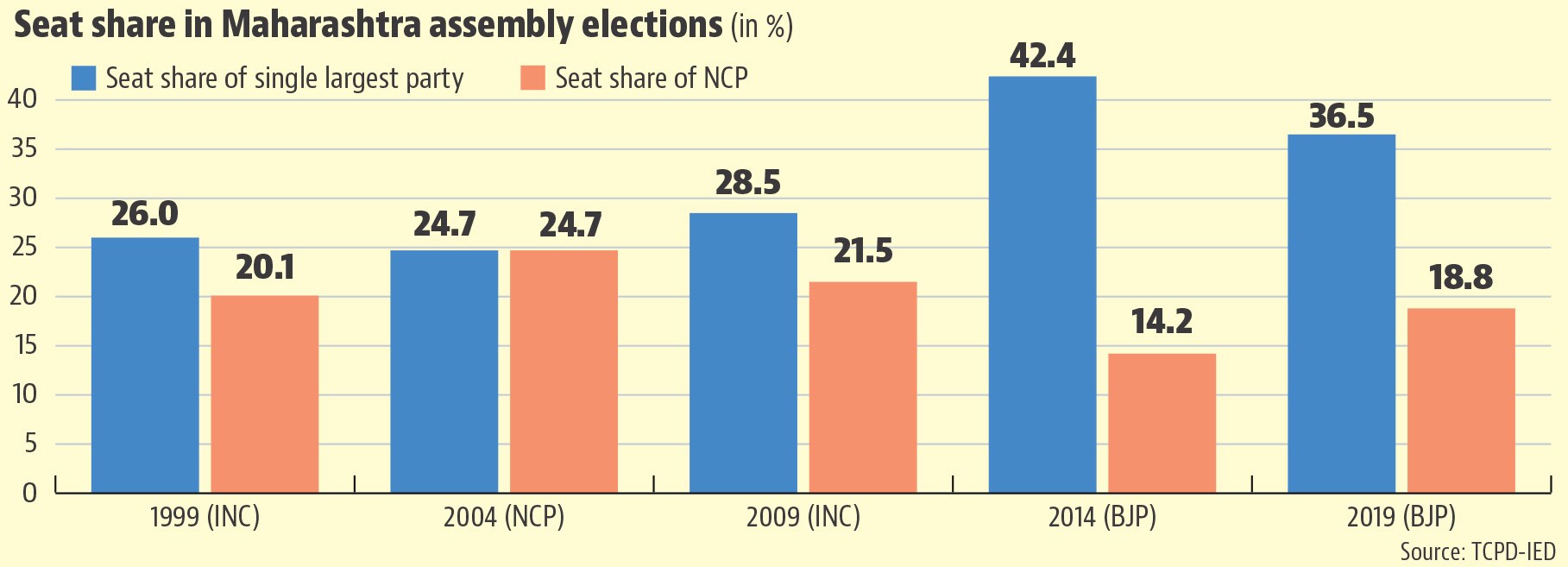
- National party or not, NCP has been important in MaharashtraWhatever the NCP’s stature in national politics may be, it is an important player in Maharashtra. This is because no single party has won a majority on its own in the state’s assembly elections since 1990. Therefore, either as a pre-poll alliance partner or otherwise, the 14-24% assembly constituencies (ACs), NCP has won in Maharashtra since 1999 remain important for anyone looking to form a government in the state.
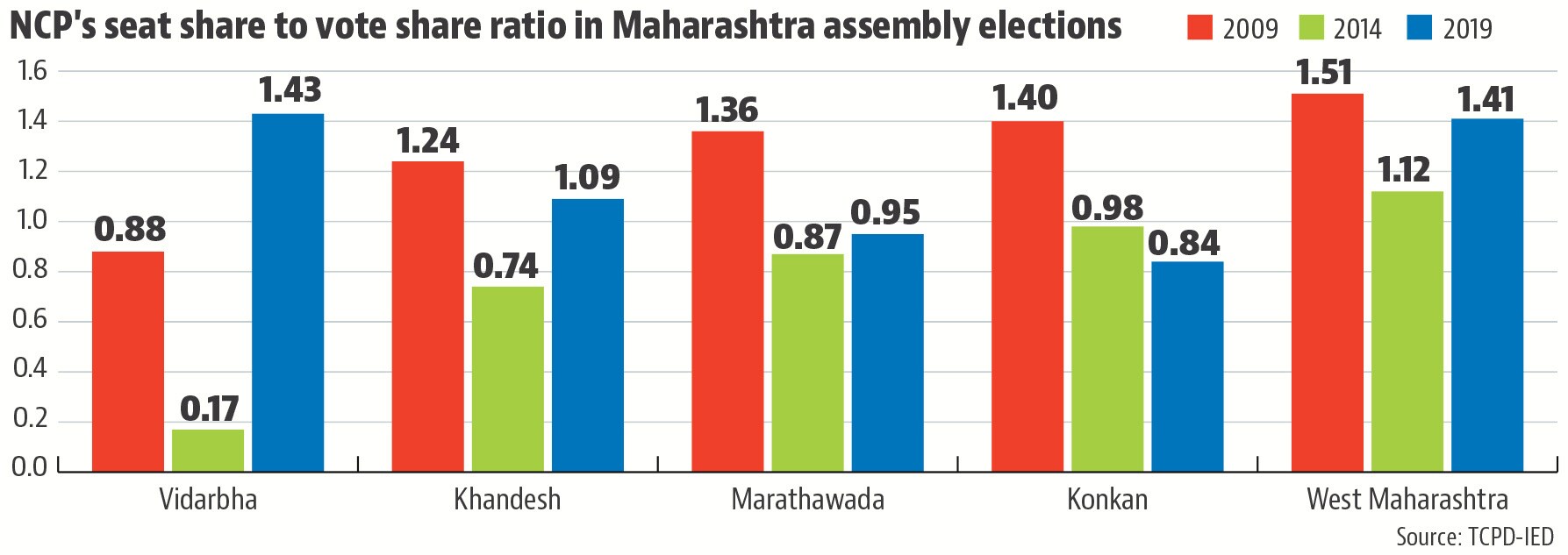
- However, even in Maharashtra, NCP is a big player only in western MaharashtraThis can be understood from an example. If the different subregions of Maharashtra were individual states, NCP would have won a single-party majority only in one: western Maharashtra. It is only in this subregion that the party has ever won at least half the ACs. It is also the only region where the party held on to its vote share and converted it into seats relatively more consistently. This can be seen from a higher and more consistent seat share to vote share ratio in the region. This is likely the case because Sharad Pawar belongs to this region. In other regions, it has either not performed as well or has been consistently losing ground. To be sure, NCP’s individual performance is not the best metric to judge its importance in the run up to the 2024 Lok Sabha elections in Maharashtra. If the Opposition manages to keep the Maharashtra Vikas Angadi (MVA) alliance comprising of the NCP, Congress and Shiv Sena (Uddhav) intact, it could pose a serious challenge to the ruling National Democratic Alliance (NDA) in the state. This is exactly what makes the optics of Sharad Pawar offering his resignation politically important.