
 E-Paper



Stage set for polls in 5 states
The elections will also be a significant challenge for the Opposition bloc and will be the first major electoral exercise since the formation of INDIA coalition

 Prefer HTon Google


Over 161 million people in five states across India’s heartland, south and northeastern fringes will vote in assembly elections next month, the election commission of India announced on Monday, pressing the trigger on the home stretch of the 2023 poll season leading up to the general elections next summer.
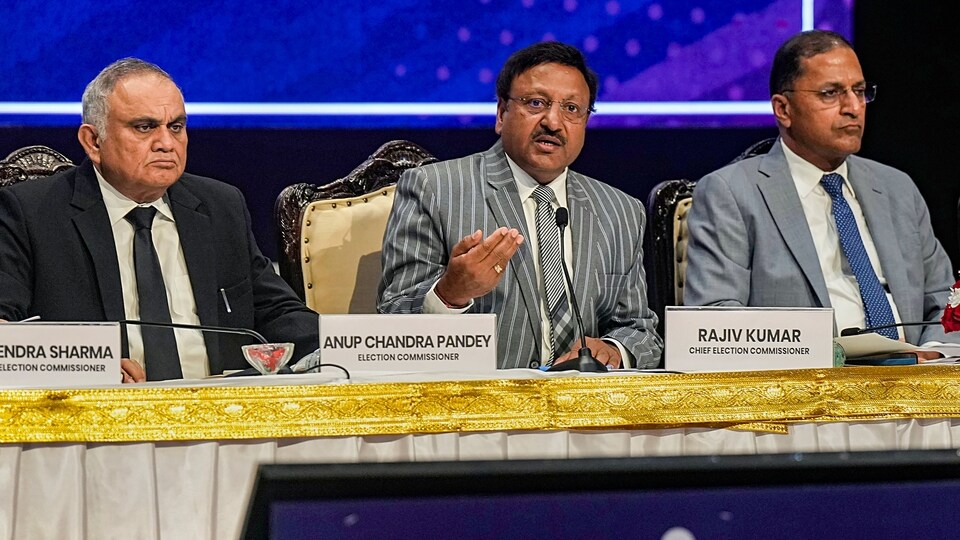
Mizoram, the smallest of the poll-bound states with 40 seats, will vote on November 7. Elections in Chhattisgarh, which has a 90-member assembly, will be held in two phases on November 7 and 17. Madhya Pradesh, Rajasthan and Telangana will go to the polls on November 17, 23 and 30, respectively.
The votes will be counted on December 3.
Chief election commissioner Rajiv Kumar said the polls in these states hold a unique significance, because they will act as the final assembly elections before general elections in 2024.
The five-state elections are widely seen as a virtual semi-final for the Lok Sabha polls scheduled to be held in April-May next year and a sandbox for shaping electoral narratives, coalition arrangements and leadership decisions. Three of the five states – Rajasthan, Madhya Pradesh and Chhattisgarh – will also feature near-bipolar contests between the Bharatiya Janata Party (BJP) and the Congress, offering an opportunity to test the strengths of the two national parties that will go head to head in nearly a third of all Lok Sabha seats.
To be sure, the results of these polls are not necessarily mirrored in the general elections. In 2018, for instance, the Congress won in this poll cycle across the heartland states — Rajasthan, Madhya Pradesh, Chhattisgarh — but the BJP swept 62 of the 65 Lok Sabha seats six months later.

BJP national president JP Nadda said his party will form the government in all five states
“I welcome the announcement of assembly elections by the Election Commission,” he said in a post on X (formerly Twitter). “Under the leadership of respected Prime Minister Shri @narendramodi ji, BJP will form government in all the states with an overwhelming majority and will work with determination to fulfill the aspirations of the people for the next 5 years,” Nadda said in the post in Hindi.
Congress chief Mallikarjun Kharge said the elections would be the swansong for the BJP from these states.
“With the announcement of elections in 5 states, the farewell of BJP and its allies has also been announced,” Kharge said in a social media post. “In Chhattisgarh, Madhya Pradesh, Rajasthan, Telangana and Mizoram, the Congress party will go to the people with strength. Public welfare, social justice and progressive development are the guarantees of the Congress Party,” he posted in Hindi.
The polls, however, are the first major electoral exercise since 26 parties came together to form the Indian National Developmental Inclusive Alliance (INDIA) earlier this year to take on the BJP, and will be a significant challenge for the Opposition bloc to perfect its messaging, coordination and leadership. It also comes weeks after Bihar released its landmark caste survey that showed backward communities make up nearly two-thirds of the state, setting into motion an electoral narrative with the potential to upend heartland politics and propel caste into the core of the electoral discourse in the 2024 polls.
The Opposition has made a nationwide caste census a core demand, hoping that caste contradictions can cleave BJP’s rainbow Hindu coalition among the marginalised castes, but the five-state polls will be the first grassroots test to see if the narrative has any genuine traction. This will be especially important in Rajasthan, which last week announced its own caste survey.
Sanjay Kumar, director at the Centre for the Study of Developing Societies (CSDS), said the Congress may focus on caste during its campaigns. “However, I doubt it will be a major factor,” he said.
These are also the first elections since the triumphant G20 summit and will show to what extent the government’s efforts at blunting anger about inflation – in recent weeks, the government has announced a set of price-moderation measures, especially on gas cylinder costs – have worked on the ground. The polls will also play out against the backdrop of a debate on subsidies and government handouts.
According to Kumar, the BJP will try leverage to G20 as an event that improved India’s standing in the world, but added that the effective of this peg remains to be seen.
And these are the first set of elections since Parliament passed the historic women’s reservation bill that set aside a third of seats in national and state legislatures. Though it won’t come into effect before the next general elections, the focus will be on whether political parties nominate enough women candidates.
Kumar added, that like the caste census, the awareness of the women’s reservation bill may not echo with voters. “In state elections, people vote for candidates and local issues,” he said.
Though the results in 2018 and 2019 did not match, the assembly polls were an important indicator of the national mood in some ways – the BJP, for example, brought in the PM Kisan scheme in the 2019 interim budget after farm anger singed the party in heartland polls, and helped reverse its losses among cultivators.
Elections will begin in Mizoram, where incumbent chief minister Zoramthanga will look for his second consecutive term. The Mizo National Front, a constituent of the BJP-led National Democratic Alliance (NDA) and North East Democratic Alliance (NEDA), will square off against the Congress and the Zoram Peoples Front. Mizoram’s politics has been roiled by the ethnic violence that has convulsed neighbouring Manipur and the polls will show if ethnic rifts overwhelm local factors on which state politics usually hinges.
Chhattisgarh’s first phase will be held on November 7, when the troubled Bastar region that has 12 of the state’s 90 seats, will also vote. The Congress is looking to retain its government in the state — one of only four states where it is in power on its own — after securing a landslide mandate in the 2018 elections, winning 68 seats. The BJP has announced a clutch of candidates early in the state, hoping to win back a chunk of crucial backward Sahu vote, but is hobbled by factionalism in its state unit and the lack of a leader with statewide appeal.
Madhya Pradesh, the largest of the five states to go to the polls, will see a head-to-head battle between the BJP, which has ruled the state for 18 of the last 20 years, and the Congress, which is hoping to cash in on anti-incumbency to dislodge chief minister Shivraj Singh Chouhan. The Congress narrowly won the last assembly polls, but its government collapsed after 22 lawmakers quit in 2020. This time, the BJP is hoping to use populist schemes and Prime Minister Narendra Modi’s appeal to undercut discontent about the state administration.
Its northern neighbour, Rajasthan, is witnessing an intense battle between the BJP and the Congress. The desert state usually votes out the incumbent every five years. But this time, Congress chief minister Ashok Gehlot is hoping to put up a tough battle, using a bouquet of welfare and cash transfer schemes, and exploiting factionalism in the BJP. But the state’s opposition party is confident that political tradition will continue, and Modi’s popularity will carry the day.
In the southern state of Telangana, the Bharat Rashtra Samithi (BRS), Congress and BJP are locked in a triangular fight with some early surveys suggesting a neck-and-neck battle between the regional behemoth and the Congress. The results will be crucial not only for the 2024 polls, but also opposition dynamics because the BRS has maintained equal distance from the NDA and INDIA. The BRS has ruled the state since it was formed in 2014 but is battling anti-incumbency and corruption charges.


