E-Paper



Pellet guns, electric batons: 5-member Supreme Court panel to probe July 20 police action on Jantar Mantar protesters
Scores of students participated in the CJP-led protest march to Parliament on July 20, seeking the resignation of Dharmendra Pradhan and demanding exam reforms.


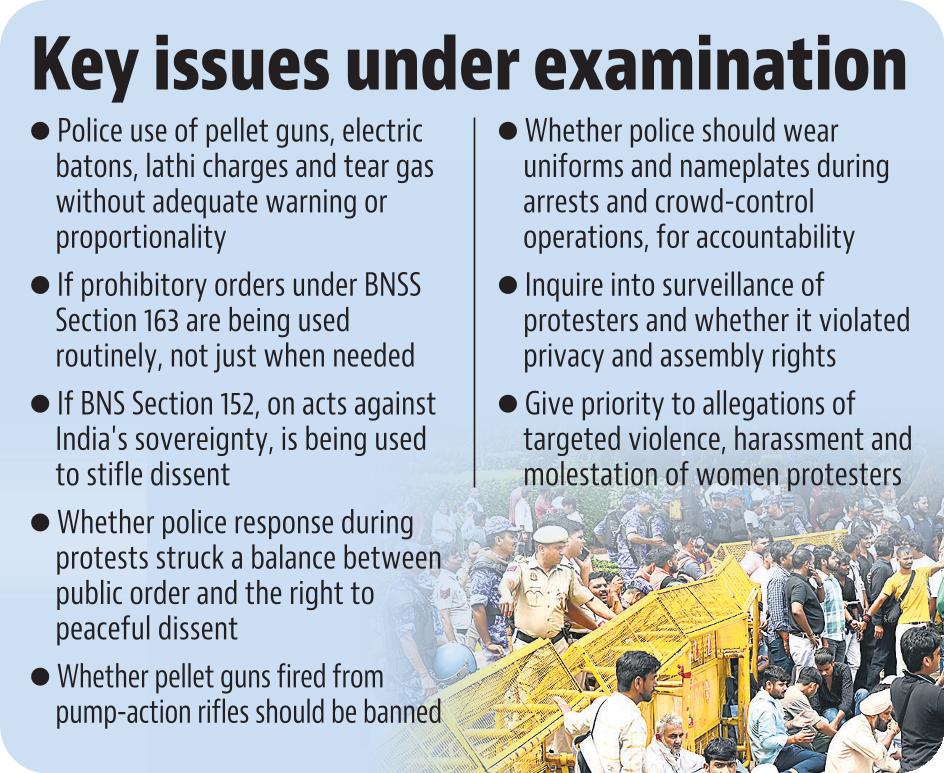
The Supreme Court on Thursday constituted a five-member committee headed by its former judge R Subhash Reddy to conduct an independent inquiry into allegations of violence during the July 20 student protests while looking into far-reaching issues such as pellet gun use, mandatory uniforms for law enforcement personnel during crowd control, blanket prohibitory orders, the legality of police surveillance, and whether a BNS provision was stifling dissent.
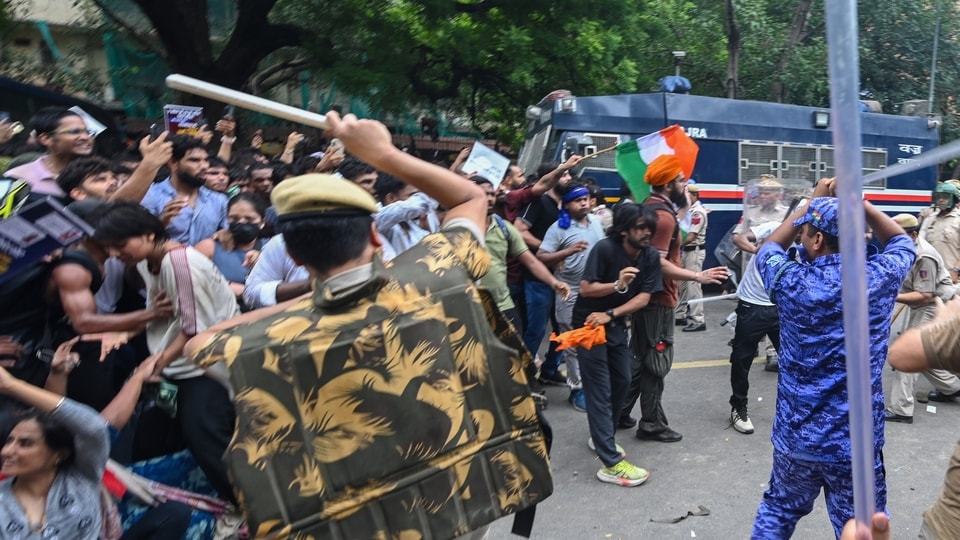
A bench, comprising Chief Justice of India Surya Kant and justices Joymalya Bagchi and V Mohana, said the competing allegations made out a prima facie case for an independent and impartial investigation into allegations of excessive and disproportionate use of force by police and security personnel during the July 20 student protests, while also examining claims of violence against police personnel and damage to public property.
Five-member panel
The committee comprises justice (retired) R Subhash Reddy, former Supreme Court judge, as chairperson; justice (retired) Ravi Shankar Jha, former chief justice of the Punjab and Haryana high court; justice (retired) Shalinder Kaur, former Delhi high court judge; Rishi Kumar Shukla, former Central Bureau of Investigation director; and LR Bishnoi, retired director general of police, Meghalaya.
ALSO READ | SC to examine legality of facial recognition, biometric surveillance at Jantar Mantar
Justice Reddy served in the apex court between November 2, 2018 and January 4, 2022; justice Jha served as the Punjab and Haryana HC chief justice between October 6, 2019 and October 13, 2023; justice Kaur served as a Delhi High Court judge between October 20, 2023 and September 7, 2025; Shukla served as CBI chief between February 4, 2019 and February 3, 2021, and Bishnoi served as Meghalaya DGP from May 20, 2022 to May 19, 2024.
The July 20 protest came during a movement headed by the Cockroach Janata Party (CJP) targeting inefficiencies in the conduct of the NEET exam for admission to medical colleges, and seeking the resignation of the Union education minister. The fallout of the clashes during the sprawling protests eventually pushed the education minister to quit last month.
ALSO READ | 'Mere agitation can't justify lathi-charge': SC on July 20 student protest crackdown at Jantar Mantar
CJP spokespersons Saurav Das and Ashutosh Ranka did not respond to HT’s request for comment.
The court said the composition took into account the expertise and experience of the members as well as the need for diversity in the panel.
Panel to examine police use of force
The committee was given a wide-ranging mandate. It will examine allegations that police and other security agencies used pellet guns, electric batons, lathi charges and tear gas without adequate warning or proportionality, causing grievous and lasting injuries to protesters.
It will also examine whether police responses during protests and public gatherings were proportionate and adequately balanced the maintenance of public order with the constitutional right to peaceful dissent.
ALSO READ | Why were police personnel in plain clothes during CJP parliament march? Delhi police says this
Significantly, the committee will consider whether the use of metallic kinetic projectiles or pellets fired from pump-action or projectile-action guns should be banned, given the grave and sometimes irreversible injuries allegedly caused by their deployment against protesters. Such guns have been used for almost a decade in Jammu and Kashmir and HT reported that at least five people alleged that they were hit with pellets during the July 20 stir.
Uniforms and nameplates under scrutiny
The panel will further examine whether police and security personnel should be required to wear proper uniforms and visible nameplates while making arrests or using force during crowd-control operations, to ensure that individual officers can be identified and held accountable.
The committee will also inquire into allegations concerning the monitoring and surveillance of protesters and whether such measures were consistent with their constitutional rights to privacy and peaceful assembly.
ALSO READ | ‘Shouldn’t we praise Delhi Police?': Rijiju says no one harmed during protest
Focus on women protesters and compensation
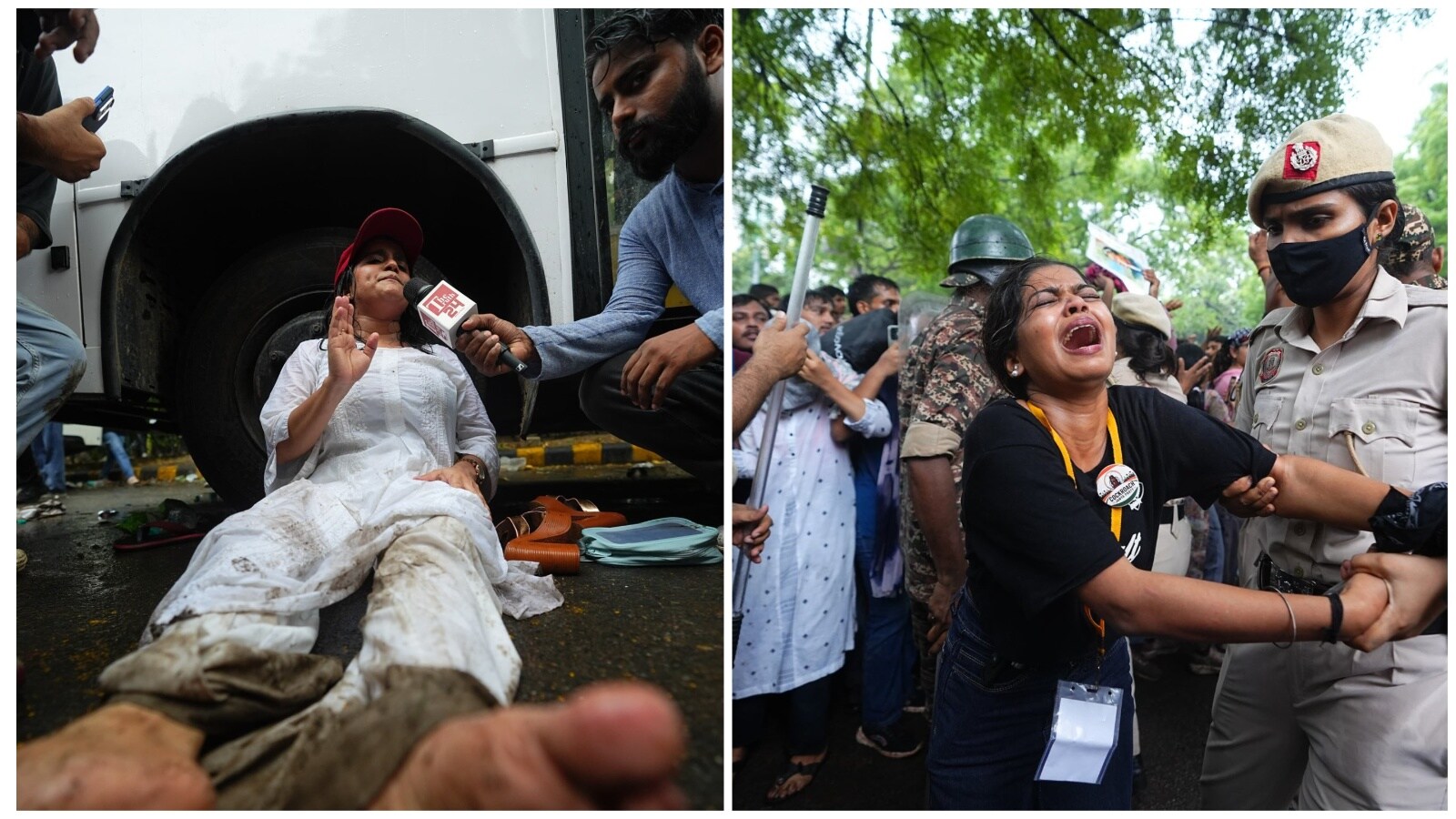
The court asked the panel to give priority to allegations of targeted violence, harassment, molestation and secondary victimisation of women protesters. It will also examine the medical and other support extended to victims of alleged police abuse and consider the question of interim compensation for injured protesters.
Section 163 prohibitory orders
Another area of inquiry will be the use of blanket prohibitory orders under Section 163 of the Bharatiya Nagarik Suraksha Sanhita, 2023. The committee will examine whether such orders are being used routinely or pre-emptively to foreclose peaceful assembly rather than as a proportionate response to a real and imminent threat to public order.
It will similarly examine the invocation of Section 152 of the Bharatiya Nyaya Sanhita, which criminalises acts endangering the sovereignty, unity and integrity of India, and whether the provision is being used to stifle political dissent and peaceful protests. This provision mirrors the now-scrapped sedition clause in the now-retired Indian Penal Code.
Inquiry won't be one-sided
At the same time, the Supreme Court made clear that the inquiry would not be one-sided.
The authorities had alleged that antisocial elements with serious criminal antecedents masqueraded as aggrieved students and indulged in violence, resulting in clashes in which police personnel suffered grievous injuries.
The committee therefore was also directed to examine the alleged use of force and violence by protesters against police and security personnel, damage caused to public property, including government installations and vehicles, and injuries suffered by police personnel as well as the mental and emotional trauma caused to their families.
The court said all these issues merited examination and permitted the HPEC to consider any other issue incidental to them. The panel can enlist forensic, technical and domain experts wherever necessary.
Panel to examine chain of command
The court specifically directed the committee to examine the chain of command behind alleged police excesses, identify those responsible and determine whether existing laws, rules or norms were breached in the use of force. It will also examine interim compensation for injured persons on both sides.
The inquiry will not be a one-time exercise. The court directed the committee to undertake a continuous and periodic assessment and submit interim findings so that the Supreme Court can take appropriate measures and issue directions as warranted.
The first interim report -- dealing with alleged grievous injuries caused by police and security personnel and allegations of targeted violence, harassment and molestation of women protesters -- was sought at the earliest.
The court, however, cautioned that the broader constitutional questions arising from the case would be decided by the Supreme Court itself after hearing the rival contentions. The HPEC would primarily assist the court by examining factual aspects.
Protesters can submit evidence
The order also gave protesters and other affected persons a direct avenue to approach the committee. Parties may submit documentary evidence, relevant material and suggestions to the HPEC. Complaints and representations can also be made anonymously to protect the identity of complainants and witnesses.
The police, paramilitary forces and investigating agencies were directed to preserve and hand over to the committee all CCTV footage, drone footage, body-worn camera recordings, videography, wireless communication records and PCR call logs relating to the protests.
The court also clarified that constitution of the HPEC would not prevent police or security authorities from taking administrative or disciplinary action against officers found to have violated conduct rules.
SC had intervened on July 28
The order follows the Supreme Court’s July 28 intervention, when it found a prima facie case for an independent investigation into allegations of violence during the protests and directed authorities to release detained or arrested children below 18 years, subject to an exception for those accused of grave and heinous offences or having serious criminal antecedents.
The court also directed authorities to preserve the personal information and digital data of protesters collected during the demonstrations and barred its disclosure or publication in the public domain.
The Delhi Police has claimed that more than 240 police and uniformed personnel and around 200 protesters were injured on July 20, with around 5,000 police personnel deployed to manage a gathering it estimated at over 30,000 protesters spread across nearly three kilometres.