E-Paper



Supreme Court grants Teesta Setalvad protection from arrest, stays Gujarat HC order for 7 days
Setalvad got the reprieve from a specially constituted three-judge bench, which was set up after the two judges on the previous bench had a difference of opinion

 Prefer HTon Google


New Delhi: Following a day of dramatic events that involved three benches of constitutional courts, the Supreme Court late on Saturday evening protected activist Teesta Atul Setalvad from arrest for a week, observing “heavens won’t fall” if she remains out on interim bail in connection with charges of falsifying evidence in the 2002 Gujarat riots case.
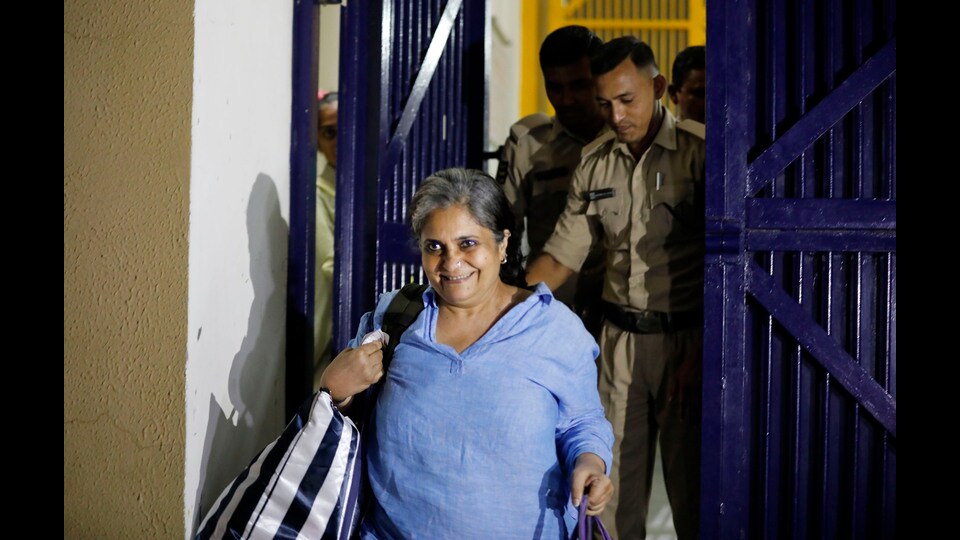
Setalvad got the reprieve from a specially constituted three-judge bench, which was set up after the two judges on the previous bench had a difference of opinion. At 11am on Saturday, the Gujarat high court dismissed Setalvad’s regular bail plea, and further rejected her plea for an interim bail for 30 days to enable her to approach the Supreme Court.
The high court order compelled Setalvad to rush to the top court, which allowed her an urgent hearing on a court holiday within hours. The two-judge bench sat at 6.40pm but failed to agree on granting her protection. Thus, the matter was referred to a larger bench of three judges, which sat at 9.15pm and accorded Setalvad interim relief for seven days after a 40-minute hearing.
“A person has been on bail since September 2022 under the orders of this Court...10 months have passed. What urgency was that the person should not be given even seven days to challenge the order of denial of bail? Will the skies fall if interim protection was granted? What was the alarming urgency for the high court to pass such an order?” lamented a three-judge bench led by justice BR Gavai while staying the Gujarat high court order for a week.
The bench, which also comprised justices AS Bopanna and Dipankar Datta, noted that the single judge bench of the high court “ought to have granted her some time to enable her challenge the matter before this Court” even as it had rejected Setalvad’s plea for regular bail on Saturday morning.
“The single judge was totally wrong in not granting even a week’s protection when this Court had granted her interim protection in September 2022...At this stage, there is only the question of liberty...a judgment coming on Saturday and declining a grant of relief. Whether heavens were going to fall in the next seven or eight days?” it asked solicitor general Tushar Mehta, who appeared for the Gujarat government.
Setalvad along with co-accused former IPS officer RB Sreekumar were arrested on June 25 last year for allegedly fabricating evidence, committing forgery and hatching a criminal conspiracy to frame Prime Minister Narendra Modi and others in the 2002 communal riots cases in Gujarat. Their arrest by the Gujarat police had come merely a day after the Supreme Court’s judgment that reproached Teesta and some others for their intention to “keep the pot boiling” for an obvious ulterior design, and added that “all those involved in such abuse of process, need to be in the dock and proceeded with in accordance with law.”
However, on September 2, another bench of the Supreme Court granted her interim bail as her regular bail plea was pending before the Gujarat high court. The September order underlined certain circumstances in her favour – the fact that she is a woman and had been in custody for over two months since her arrest.
The Gujarat high court rejected Setalvad’s regular bail plea on Saturday, asking her to surrender immediately. In its order, the high court noted that she used riots victims and witnesses as ladder for her own benefits and that made active efforts to unsettle the democratically elected government by tarnishing the reputation of then chief minister Modi and the government machinery. It added that grating her bail would “deepen and widen the communal polarisation.”
On Saturday, Mehta argued before the Supreme Court that Setalvad’s conduct was abhorrent and that she does not deserve any indulgence since she maligned every institution and committed perjury with the Supreme Court too. But the bench retorted: “Her conduct may be reprehensible but today we are considering whether a person is not entitled to liberty even for a day when she has been enjoying it for the last ten months?”
Mehta, on his part, tried to persuade the bench by citing the Supreme Court’s June 2022 judgment, which had paved the way for criminal investigation against Setalvad for allegedly falsifying the evidence even as the Court gave a clean chit to then Gujarat Chief Minister Narendra Modi and several others of being part of a larger conspiracy behind the 2002 riots.
The bench, however, emphasised that another bench of the Supreme Court had on September 2 gave Setalvad the interim bail in the same case after considering all the relevant factors. “One bench of this Court directed that they needed to be in the dock. But another bench of this Court granted her relief later. The other bench which dealt with it later would not have granted her bail if there were not valid reasons...We also wonder about the difference of opinion between judges. When there is a difference of opinion, it has to be in the favour of liberty,” it remarked.
The bench then proceeded to record in its order that a previous order of the Supreme Court on September 2 had given Setalvad protection from arrest after noting the special provision favouring women. It stayed the order of the high court for a week and directed that the matter be placed before the Chief Justice of India for placing it before a regular bench.
Previously, the two-judge bench that included justices AS Oka and Prashant Kumar Mishra failed to arrive at a consensus on protecting Setalvad from arrest for a few days so that her appeal could come up hearing before a regular bench. The Supreme Court reopens on July 3 after a six-week long summer break. For Teesta, senior advocate CU Singh appeared along with advocate Aparna Bhat.
The case against Setalvad was lodged following the June 24 verdict by a three-judge bench of the top court last year which gave a clean chit to then Gujarat Chief Minister Narendra Modi and several others of being part of a larger conspiracy behind the 2002 riots. The larger conspiracy was alleged against 64 persons, including Modi in a complaint filed by Zakia Jafri, the widow of former Congress member of Parliament Ehsan Jafri who was killed in the riots. Jafri’s complaint was supported by Teesta before the Gujarat high court and the top court.
The Supreme Court, which monitored the probe into the riot cases, directed the SIT in 2011 to examine the allegations. In February 2012, the SIT filed the closure report. The petitioners unsuccessfully challenged the report before a trial court and the Gujarat high court before moving the top court in 2018.
The June 24 verdict had commented that the petitioners (Jafri and Teesta) had the “audacity” to question the integrity of the Special Investigation Team constituted by the Supreme Court to probe the riots cases and every functionary involved in the process with an intention to “keep the pot boiling” for an obvious ulterior design. It also suggested, “All those involved in such abuse of process, need to be in the dock and proceeded with in accordance with law.”
It was this observation that gave the handle for the state government to launch action against Setalvad, sacked IPS officer Sanjiv Bhatt and former DGP RB Sreekumar for forging and fabricating evidence, tutoring witnesses and making them depose on pre-typed affidavits. A day after the judgment, the FIR was lodged and arrests made.