
 E-Paper



Sweeping measures for farmer march trigger chaos in Delhi, people decry overkill
The traffic movement in parts of Delhi went into a complete tail-spin during the morning commuting hours with barricades on arterial roads

 Prefer HTon Google


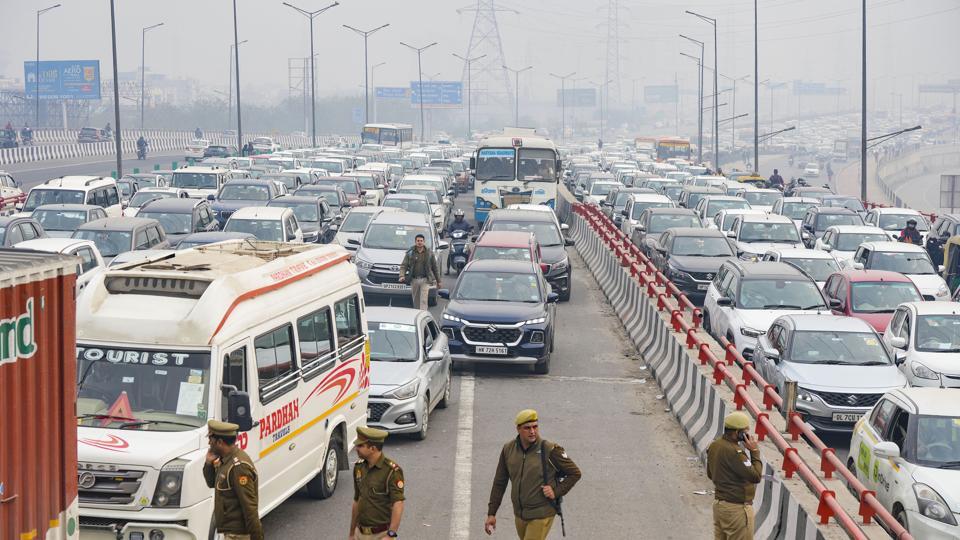
Sweeping security arrangements put in place to prevent a march of farmers from Punjab, Haryana, and Uttar Pradesh to the Capital triggered traffic chaos in Delhi on Tuesday as the authorities went on overkill, enforcing prohibitory orders to restrict movement and public gatherings.
Restrictions were imposed outside at least eight metro stations with one or multiple gates shut to control the flow of passenger movement, the Delhi Metro Rail Corporation (DMRC) said citing instructions from the Delhi Police.
Rajiv Chowk, Mandi House, Central Secretariat, Patel Chowk, Udyog Bhawan, Janpath, Khan Market, and Barakhamba Road metro stations were among those where some gates were shut.
Passengers said longer queues at stations triggered chaos, particularly during office hours. “Gate number six at the Barakhambha Metro Station has been shut down and barricades have been put there, but gate number five on the opposite side of the road was open. People are being asked to exit from there, but one has to invariably cross the road again and that is leading to traffic snarls as well,” said Jyoti Verma, who works in a private company at Barakhamba Road.
The traffic movement in parts of Delhi went into a complete tail-spin during the morning commuting hours with barricades on arterial roads. Traffic jams were reported at major border points with Noida and Gurugram.
The traffic movement also slowed down in central Delhi with pickets clogging it near Golf Links, Archbishop Makarios Marg, ITO, Barakhamba Road, Africa Avenue, and Vinay Marg among other sites.
Commuters took to social media to complain about the disproportionate measures put in place. Vinod Kabdi, a commuter posted: “If you are in Delhi NCR and stuck in Traffic, Open your Eyes and look around. You won’t see farmers blocking the road. You will see police blocking the road.”
Delhi Police installed barricades at the Singhu flyover from the Kundli side allowing one lane on both carriageways for traffic movement. “It is just enough for one vehicle to cross. As of now, the flyover is open on both carriageways for one vehicle at a time to pass but if and when the protestors reach, a decision will be taken in real time,” a traffic police officer said.
A 25-year-old man on his way from Haryana to take a postgraduate teachers examination in Delhi said he was late. “I have to reach at noon at the centre but it is 11:55am and the bus is not moving,” he said.
As many as 20 companies of security forces were deployed at the Singhu border. Commuters coming from Haryana faced up to an hour-long traffic congestion.
The farmers planned to converge at the Capital’s Singhu, Tikri, and Ghazipur border points on Tuesday afternoon. Rows of metal barricades, shipping containers, concertina wires, and trenches were placed on Delhi’s fringes ahead of the march.
Farm leaders announced the protest would continue after their meeting with Union ministers ended around midnight.
The jams spilled onto arterial stretches across the city. In a revised traffic advisory on Monday evening, the Delhi Police warned commuters that traffic diversions “may be required at Singhu, Ghazipur and Tikri borders depending on the conditions”.
An earlier advisory said that “traffic restrictions and diversions will be imposed at Singhu, Tikri, and Ghazipur borders from February 12 for commercial vehicles and from February 13 for all types of vehicles”.
Over 50 Delhi Police and paramilitary companies equipped with tear gas launchers and shells, bulletproof vests, helmets, batons, and sophisticated weapons were deployed at the borders. Drones were also deployed over the city’s fringes.
Iron barricades, jersey barriers, shipping containers, barbed wire fencing, iron nails, hydra cranes, buses, and other vehicles formed multi-layered blockades at the borders to stop the protesting farmers from entering Delhi.
An alert was sounded in all police stations across the city and police personnel were asked to intensify police pickets, patrolling, and checking of vehicles.
The police put up check-posts in central Delhi on Monday. Vehicles were checked at the Ranjit Singh flyover, Mandi House, ITO, Minto Bridge, Mathura Road, and Ring Road.
The preparations were put in place as talks in Punjab between Union ministers including Piyush Goyal and Arjun Munda with the heads of the protesting farmer bodies reached an impasse. The first meeting between the two sides on February 8 also ended in a stalemate.
Farmer leaders accused the government of trying to buy time even as authorities in Haryana and Punjab fortified the states’ borders, using concrete blocks, iron nails, and barbed wire to prevent the proposed march.
The Haryana government has imposed restrictions in 15 districts, prohibiting the assembly of five or more people and banning any demonstration or march with tractor-trolleys.
Farmers affiliated with 200 organisations and unions on Monday set off atop trucks and tractors en route to Delhi, defying curbs. Some protesters rammed down barricades with their vehicles, prompting authorities to deploy paramilitary and police forces to prevent farmers from marching to Delhi.
The farmers are seeking minimum support prices for their crops, waivers on farm loans, and jobs for relatives of those killed during the 13-month-long farmers protest between November 2020 and December 2021. They are also demanding compensation for the farmers injured in Lakhimpur Kheri and the withdrawal of cases registered against protesting farmers.
Four protesting farmers were mowed down at Lakhimpur Kheri in October 2021. Union minister Ajay Kumar Mishra Teni’s son, Ashish Mishra, is the key accused in the mowing.
The Delhi Police on Monday extended restrictions on movement and public gatherings across the national capital for a month. The prohibitory orders were in place earlier only in east, northeast, outer-north, and outer police districts.
In 2020-21, cultivators held one of the biggest demonstrations in decades and prompted the government to repeal three agricultural reform laws enacted in September 2020.
Tens of thousands of farmers opposing the laws hunkered down on highways across several states for nearly 14 months. They virtually set up protest townships at five sites including Ghazipur, Singhu, and Tikri, and choked traffic, rejecting the government’s insistence that the laws would benefit them by giving them greater access to markets. Farm unions insisted the laws would leave cultivators at the mercy of corporations.
Security forces have sought to prevent a rerun of the agitations, taking pre-emptive measures to keep the protesters from entering the Capital.


