
 E-Paper



Swraj Paul: Business icon leaves behind enduring legacy of leadership and philanthropy
Paul made the extraordinary transition from the bylanes of Jalandhar to the House of Lords in the heart of Great Britain, becoming one of UK’s richest men.

 Prefer HTon Google


British-Indian business magnate and philanthropist Lord Swraj Paul, who acted as a bridge between India and the UK for almost half a century and emblemised the sterling success story of non-resident Indians, died in London on Friday. He was 94.
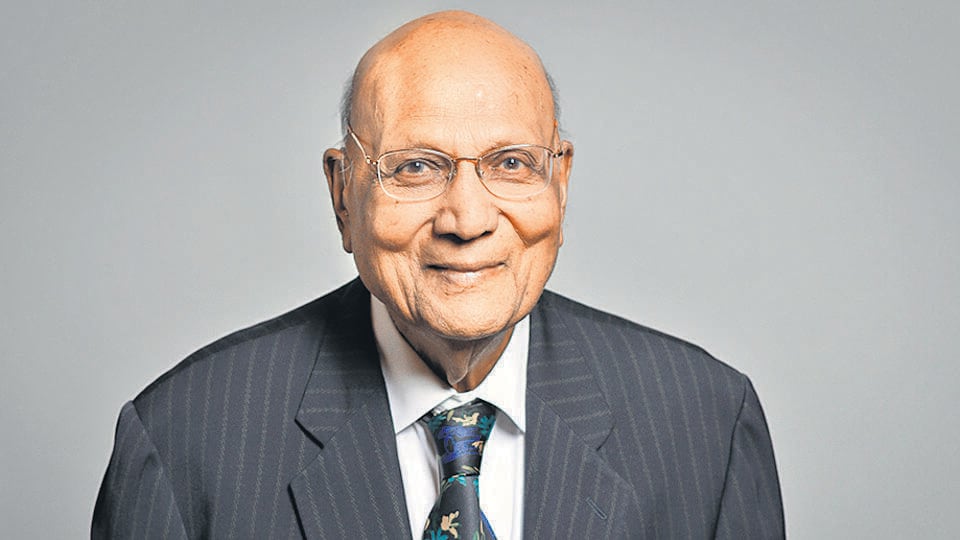
Born to Pyare Lal in erstwhile British India’s undivided Punjab on February 18, 1931, Paul made the extraordinary transition from the bylanes of Jalandhar to the House of Lords in the heart of Great Britain, becoming one of UK’s richest men.
He left behind the steel and engineering multinational Caparo Group that he built, a legacy of philanthropic and educational institutions, and a rich history of acting to advance the interests of his homeland across the world.
“Deeply saddened by the passing of Shri Swaraj Paul Ji. His contributions to industry, philanthropy and public service in the UK, and his unwavering support for closer ties with India will always be remembered. I fondly recall our many interactions. Condolences to his family and admirers. Om Shanti,” Prime Minister Narendra Modi said on X.
Congress chief Mallikarjun Kharge condoled the death. “A philanthropist, politician and Padma Bhushan recipient, he was a lifelong friend of India in the UK. His association with Former PM Smt. Indira Gandhi has been valuable,” he posted.
Paul, whose father ran a small foundry for steel goods and buckets, completed high school in Jalandhar and secured a degree in science from Punjab University in 1949. He then travelled to the US to pursue degrees in Mechanical Engineering from the Massachusetts Institute of Technology (MIT). After completing his studies, he returned to India to join the family business, Apeejay Surrendra Group —one of India’s oldest business conglomerates.
But in 1966, he was forced to relocate to the US in pursuit of treatment for his daughter Ambika who was suffering from leukaemia. Unfortunately, she died aged four.
Paul would later set up the Ambika Paul Foundation that donated millions to promote the wellbeing of children and young people through education and health initiatives. The Ambika Paul Children’s Zoo in London is one of the major beneficiaries of the foundation.
Paul grieved his daughter for a year, but was saved by meditation and reading philosophy, and slowly started making peace with himself. He began taking an interest in the UK economy, identifying a gap in the market for gas tubes, the Guardian wrote in a 2008 profile.
He founded Natural Gas Tubes Limited, before turning it to the conglomerate Caparo in 1968 with headquarters in London. It later went on to become one of the largest steel conversion and distribution businesses in the UK with operations in the UK, India, the US, Canada, and the UAE with a turnover of over $1 billion.
“So we have all come a very long way since I borrowed £5,000 in 1968 and started looking for somewhere in Britain to open a small steel tube factory…The company I launched – Natural Gas Tubes Limited – quickly became the Caparo Group,” he said in 1998, when Caparo turned 50.
Throughout this time, he was steadily rising in the British-Indian and British-Asian communities. He founded the Indo-British Association in 1975 to promote better understanding between India and Britain and served as its Chairman. He was knighted by the Queen in 1978 and became Lord Paul of Marylebone and a member of the House of Lords. He was sworn as a Privy Councilor in October 2009. He was conferred with India’s third-highest civilian honour, Padma Bhushan, in 1983.
In the Indian business landscape, Paul is also remembered for his hostile bids to take over Escorts Group and the DCM Group in the early 80s. He was a regular in the annual ‘Sunday Times Rich List’; this year he was ranked 81st with an estimated wealth of GBP 2 billion, largely derived from the Caparo Group. In his personal life, he battled tragedies. Besides the loss of daughter Ambika at a very young age, he lost his son Angad Paul, who was Caparo Group’s CEO, in 2015 and his wife Aruna in 2022.
The personal losses drove him to undertake more philanthropic endeavours in their memory. He was involved with several UK universities, gave generously to his alma mater MIT and established institutions in the UK and India. He was also involved with London’s successful bid for the 2012 Olympics.
He was appointed a Labour life peer by John Major in the 1990s, not only for his business success, but also for his philanthropic work, especially his success in helping save London Zoo. “I heard in the news that London Zoo was going to close, and I just called them and offered to help out,” he told the Guardian newspaper, adding that he used to take his daughter to the zoo between her treatments, when she was feeling better, so it held deep significance for him.
To many, he was one of the best known faces of the global Indian diaspora. He held strong views on corruption and the importance of reform and was a lifelong votary of better governance.
“Reforms alone have no meaning. Reforms without removal of corruption gave the people licence to be more corrupt and not fix the country. There was a famous Peruvian economist who long ago said that people do reforms so that their friends can make money. Reforms are only good when everybody makes money,” he said in an interview to this newspaper in 2017.
In his life and work, he was a votary of the diaspora and its importance in national growth. “For long, India had a socialist thinking and the Western world criticised it. Nor at that time did the West really see the potential of India. But, perception of India has changed a lot because of the diaspora. Indians migrated all over as workers. Now they are playing an important role in every sphere of life in the Western world, and very successfully,” he told this newspaper.
And most of all, he was a deep believer in Indian democracy and the tall strides taken by India after independence.
“It has taken a long time for the people here to accept the fact that India is even more democratic than Britain. India has demonstrated to the world what democracy is. It is something we can really be proud of. The governments change at the drop of a hat, but that happens democratically…We have made a lot of progress in the 70 years. We went astray for a while and then pulled it up,” he told this newspaper on India’s 70th anniversary of independence. “If you look at where India was and where it is now, we have come a long way.”


