
 E-Paper



‘Symbolic political critique’: Delhi court grants bail to Congress workers in AI summit protest case
Symbolic political critique: Delhi court grants bail to 9 IYC workers in AI summit protest case

 Prefer HTon Google


A Delhi court, while granting bail to nine Indian Youth Congress workers who were arrested in connection with the shirtless protest at the AI summit, said the protest constituted “symbolic political critique” and pre-trial detention could mean "pre-emptive punishment", news agency PTI reported.
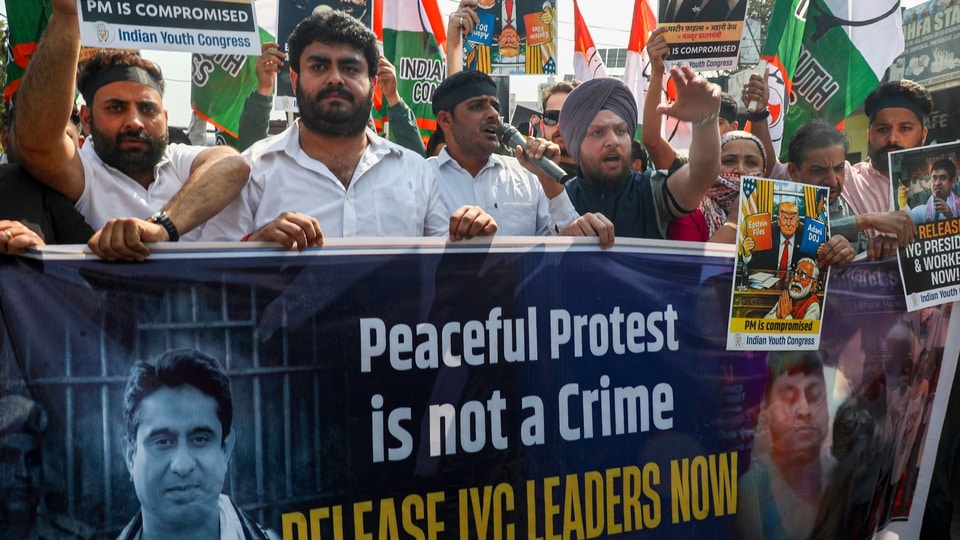
"The protest, at highest, constituted symbolic political critique during a public event: T-shirts with leadership imagery, non-inciteful slogans bereft of communal/regional taint, and transient assembly. No evidence discloses property defacement, or delegate panic; exit was orderly via escort," the court noted.
Judicial Magistrate First Class Ravi passed the order on Sunday while hearing the bail pleas of the nine accused – Krishna Hari, Narshimha Yadav, Kundan Kumar Yadav, Ajay Kumar Singh, Jitendra Singh Yadav, Raja Gurjar, Ajay Kumar Vimal alias Bantu, Saurabh Singh and Arbaz Khan.
It noted that the pre-trial detention would be “a profound aberration fundamentally at odds with the bedrock axioms of criminal jurisprudence, which exalt liberty as the governing norm and incarceration as the narrowly circumscribed exception”. Essentially, it reiterated ‘bail as norm, jail as exception’.
The Delhi police, opposing the bail pleas, submitted that the Constitution grants the right to peaceful protest, “but there are also certain conditions”.
It argued that the accused Indian Youth Congress (IYC) workers raised slogans calling the India-US trade deal a “compromise”, in the presence of international media.
When police tried to stop the accused, “they attacked the police personnel”, who sustained injuries; there is medical evidence of the same, Delhi Police said.
The court, however, did not agree with the submissions.
The IYC workers entered the AI summit venue on February 20, wearing or holding white T-shirts with images of Prime Minister Narendra Modi and US President Donald Trump printed on them, along with slogans such as "India-US Trade Deal", "Epstein Files" and "PM is compromised".
The protesters also scuffled with security personnel and police staff deployed at the venue.


