E-Paper



T20 World Cup: The main takeaways so far
Ireland have embodied this aspect of T20 cricket in the World Cup so far. In the qualifying stages, they pulled off a massive nine-wicket upset against West Indies at Hobart. Then, on Wednesday, Ireland managed an even bigger surprise when they narrowly beat England in a rain-hit match.


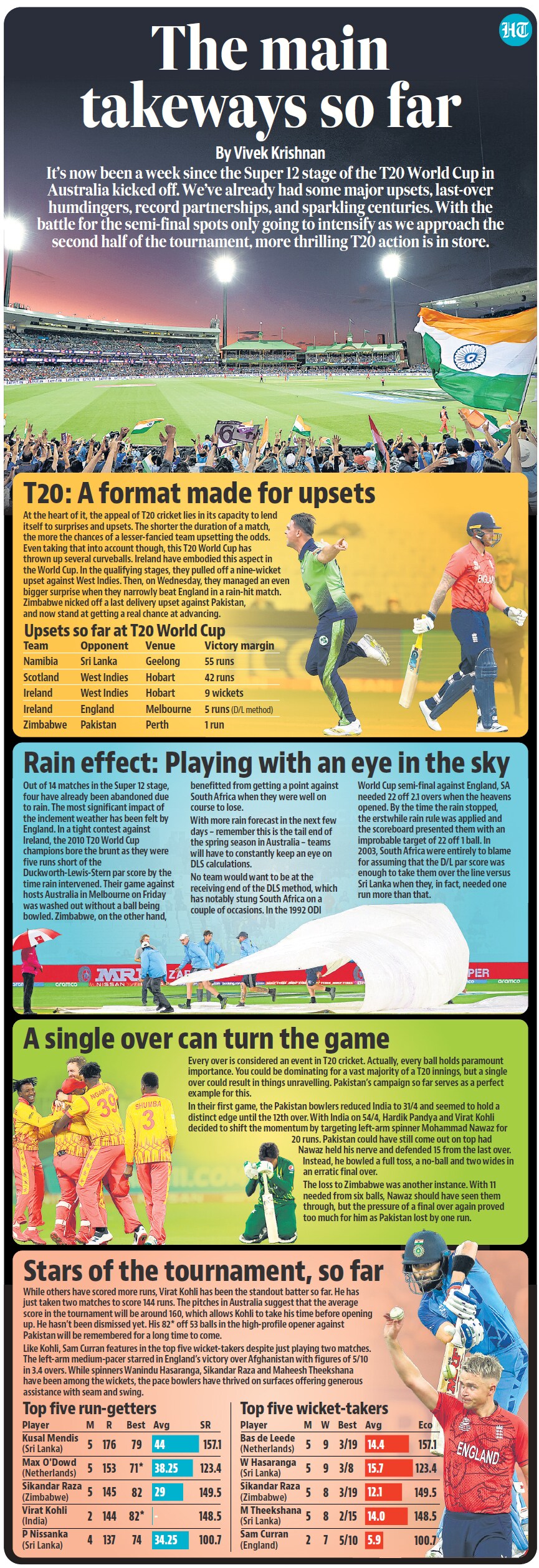
It’s now been a week since the Super 12 stage of the T20 World Cup in Australia kicked off. We’ve already had some major upsets, last-over humdingers, record partnerships, and sparkling centuries. With the battle for the semi-final spots only going to intensify as we approach the second half of the tournament, more thrilling T20 action is in store.
T20: A format made for upsets
At the heart of it, the appeal of T20 cricket lies in its capacity to lend itself to surprises and upsets. The shorter the duration of a match, the more the chances of a lesser-fancied team upsetting the odds. The T20 game illustrates this time and again. Even taking that into account though, this T20 World Cup has thrown up quite a few curveballs, keeping players and fans on tenterhooks as a result.
Ireland have embodied this aspect of T20 cricket in the World Cup so far. In the qualifying stages, they pulled off a massive nine-wicket upset against West Indies at Hobart. Then, on Wednesday, Ireland managed an even bigger surprise when they narrowly beat England in a rain-hit match.
Similarly, Zimbabwe nicked off a last delivery upset against Pakistan, and now stand at getting a real chance at advancing
The rain effect: Playing with an eye in the sky
Out of 14 matches in the Super 12 stage, four have already been abandoned due to rain. The most significant impact of the inclement weather has been felt by England. In a tight contest against Ireland, the 2010 T20 World Cup champions bore the brunt as they were five runs short of the Duckworth-Lewis-Stern par score by the time rain intervened. Their game against hosts Australia in Melbourne on Friday was washed out without a ball being bowled. Zimbabwe, on the other hand, benefitted from getting a point against South Africa when they were well on course to lose.
With more rain forecast in the next few days – remember this is the tail end of the spring season in Australia – teams will have to constantly keep an eye on DLS calculations.
No team would want to be at the receiving end of the DLS method, which has notably stung South Africa on a couple of occasions. In the 1992 ODI World Cup semi-final against England, SA needed 22 off 2.1 overs when the heavens opened. By the time the rain stopped, the erstwhile rain rule was applied and the scoreboard presented them with an improbable target of 22 off 1 ball. In 2003, South Africa were entirely to blame for assuming that the D/L par score was enough to take them over the line versus Sri Lanka when they, in fact, needed one run more than that.
A single over can turn the game
Every over is considered an event in T20 cricket. Actually, every ball holds paramount importance. You could be dominating for a vast majority of a T20 innings, but a single over could result in things unravelling. Pakistan’s campaign so far serves as a perfect example for this.
In their first game, the Pakistan bowlers reduced India to 31/4 and seemed to hold a distinct edge until the 12th over. With India on 54/4, Hardik Pandya and Virat Kohli decided to shift the momentum by targeting left-arm spinner Mohammad Nawaz for 20 runs. Pakistan could have still come out on top had Nawaz held his nerve and defended 15 from the last over. Instead, he bowled a full toss, a no-ball and two wides in an erratic final over.
The loss to Zimbabwe was another instance. With 11 needed from six balls, Nawaz should have seen them through, but the pressure of a final over again proved too much for him as Pakistan lost by one run.
The stars for the tournament, so far
While others have scored more runs, Virat Kohli has been the standout batter so far. He has just taken two matches to score 144 runs. The pitches in Australia suggest that the average score in the tournament will be around 160, which allows Kohli to take his time before opening up. He hasn’t been dismissed yet. His 82* off 53 balls in the high-profile opener against Pakistan will be remembered for a long time to come.
Like Kohli, Sam Curran features in the top five wicket-takers despite just playing two matches. The left-arm medium-pacer starred in England’s victory over Afghanistan with figures of 5/10 in 3.4 overs. While spinners Wanindu Hasaranga, Sikandar Raza and Maheesh Theekshana have been among the wickets, the pace bowlers have thrived on surfaces offering generous assistance with seam and swing.