
 E-Paper



Kargil Vijay Diwas 20th Anniversary: The battle that won the war
As thoughts raced through Thakur’s mind, his radio operator said Naik Rajender Yadav, Adhikari’s signaler, was on the line.

 Prefer HTon Google


On a freezing May night, lying flat on a windswept slope barely 200 metres from where a fierce battle was raging, Colonel Khushal Thakur whispered into the ears of his radio operator to connect him to Major Rajesh Singh Adhikari.
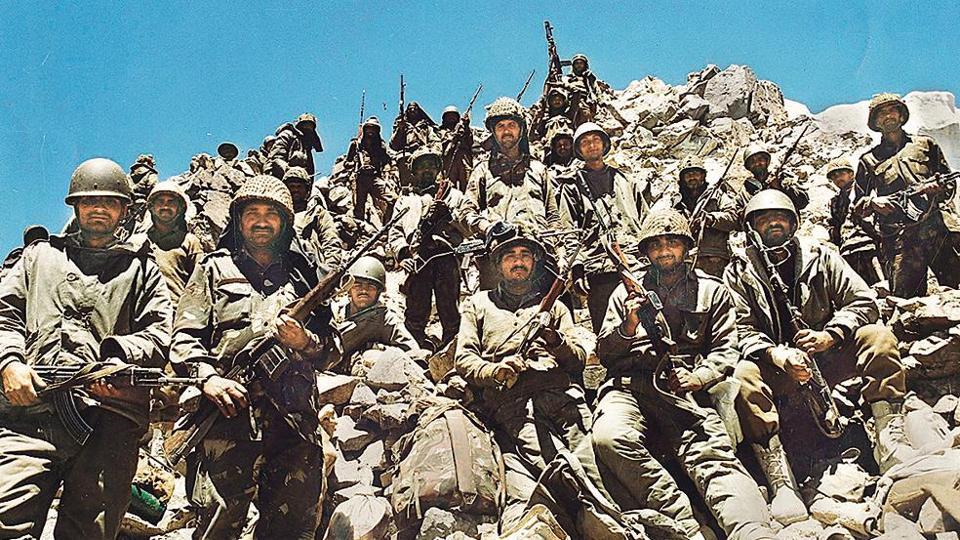
Adhikari, a young officer was atop the 15,000-ft high Tololing peak in the midst of battle, and Thakur, Commanding Officer of 18 Grenadiers, hadn’t heard from him in a while.
As thoughts raced through Thakur’s mind, his radio operator said Naik Rajender Yadav, Adhikari’s signaler, was on the line.
“Adhikari saab kahan hain (where is Adhikari?),” Thakur, then 45, whispered.
“Saab, major saab dushman ke saath hand-to-hand fight mein hain (the Major is in a hand to hand combat with the enemy),” the signaler replied.
Before Thakur could ask anything else, Singh was hit by a barrage of enemy bullets and his words, “Oh Ma!” still resound in Thakur’s ears 20 years after India won the war.
“It was the night intervening May 30 and May 31. The night we also lost Major Adhikari, who was later awarded the Maha Vir Chakra,” Thakur, who was awarded a Yudh Seva Medal and retired as a brigadier a few years ago, said.
Tololing was an eye-opener for the Indian army. It turned the war in India’s favour, but not after the army learnt some quick, bitter lessons.
Major Adhikari was among the few who died in the second attempt to capture the peak and the mission captured a crucial feature in Tololing, laying the foundation for the final ascent, and win. It was on May 31 that the then Prime Minister Atal Behari Vajpayee admitted to a “war-like situation” in Kargil.
“The battle for Tololing turned the war in India’s favour and laid the foundation for future successes, including the strategic Tiger Hill,” Thakur said.
Veterans who fought the Kargil war remember that when the initial attack on Tololing was launched on May 22, the army was under the impression that the intruders were militants and a handful at that. It emerged later that the top had been captured by a company-strength (100-plus) of Pakistani army regulars.
Intrusion reports
The first reports of infiltrators in Kargil came on May 4, after which Lieutenant Saurabh Kalia of 4 Jat regiment, led a six-man foot patrol to a forward post in Kaksar sector. Kalia and the sepoys accompanying him were captured by Pakistani troops on May 15, and brutally tortured before their mutilated bodies were returned on June 10.
The scale of intrusion however only became evident to the Indian Army by mid-May. By this time, the enemy held vantage positions in Kargil, Batalik, Mushkoh and Drass. The grim situation led the army to mobilize troops and assign different formations with the task of repelling the intruders.
By May 31, two attempts had been made to re-capture Tololing top. Another was attempted on the intervening night of June 2 and 3.
“Getting back Tololing was critical as it was the deepest incursion in the sector and closest to National Highway-1A (which connects Srinagar to Leh). It allowed the enemy to observe and dominate the key road. We had poor intelligence, inadequate artillery firepower and also limited high altitude equipment,” said Thakur.
The final assault
While 18 Grenadiers, an infantry unit, played a crucial role in the capture of Tololing, the final assault that defeated the enemy was launched by 2 Rajputana Rifles on the intervening night of June 12/13.
“Higher formations have a vital role in providing intelligence, fire support and taking on the logistic burden of the units…These aspects were ignored initially, resulting in avoidable casualties which affected the morale of troops, till 2 Rajputana Rifles captured Tololing and proved that Pakistani troops can be decisively defeated,” wrote retired Lieutenant General YM Bammi writes in his book, Kargil 1999: The Impregnable Conquered (published in 2002).
The lessons learnt from the battle of Tololing helped plan future assaults, including the recapture of Tiger Hill in June, which veterans said, broke the Pakistan Army’s back.
“After Tololing, we didn’t look back. Be it the subsequent action to capture Point 5140, Three Pimples or the taking of Tiger Hill, the prominent feature held by the Pakistanis in Drass sector,” said Brigadier Amar Aul (who retired as a Lieutenant General), then commanding 56 Mountain Brigade.
Thakur’s 18 Grenadiers was also tasked to capture Tiger Hill on June 24 along with another infantry battalion, 8 Sikh, and the final assault was to be launched on the night of July 3.
“Thanks to the lessons learnt in Tololing, we were fully prepared and equipped. We had full artillery support, we had instructors from the High Altitude Warfare School with us, there was adequate time for reconnaissance before missions, adequate clothing and no problem with logistics,” said Thakur, who lost 34 men, including his second-in-command Lieutenant Colonel R Vishwanathan, in the recapture of Tololing and Tiger Hill.
The difficult battle for Tiger Hill gave the army new heroes, such as sepoy (now Subedar Major) Yogendra Singh Yadav and Lieutenant (now Colonel) Balwan Singh, who were awarded the Param Vir Chakra and the Maha Vir Chakra, respectively. Both men led commandos during the final assault on Tiger Hill which was captured on July 4, the day the then Pakistan Prime Minister Nawaz Sharif met US President Bill Clinton in Washington. A day later, on July 5, Sharif announced the pull-out of Pakistani troops from Kargil.
Pakistan army started withdrawing a week later. The war finally ended on July 26, the day India announced complete eviction of Pakistani troops. While India lost 527 soldiers in the war, Pakistan officially admitted in 2010 that the death toll on its side was 453 (a figure that experts say is highly under-reported).
Twenty years is a long time. For perspective, the youngest officer serving the Indian Army today wasn’t even born when the war was fought in those icy heights and the treacherous terrain. But for those who fought and bled in those mountains, 1999 will remain etched in their memories.


