
 E-Paper



The importance of Amitabh Kant
Amitabh Kant got a rare third extension as the CEO of Niti Aayog, the government’s prime think tank that replaced Planning Commission in August 2014, underlining a career graph that saw him in posts as diverse as the tourism secretary in Kerala to chairman and chief executive officer, Delhi-Mumbai Industrial Corridor Corporation.


When Amitabh Kant was a student in Modern School in the heart of the national Capital, little did he imagine that his bureaucratic career will scale heights in a government office barely 3km away.
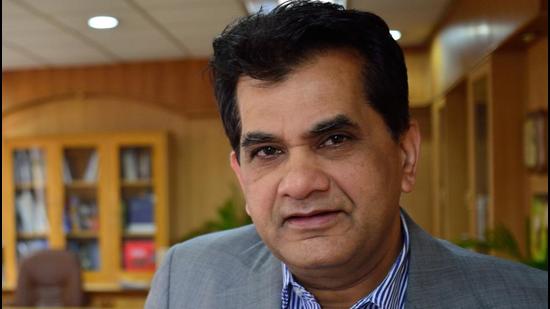
Kant got a rare third extension as the CEO of Niti Aayog, the government’s prime think tank that replaced Planning Commission in August 2014, underlining a career graph that saw him in posts as diverse as the tourism secretary in Kerala to chairman and chief executive officer, Delhi-Mumbai Industrial Corridor Corporation.
It is widely believed that this rare extension has come as Kant had been able to successfully launch Prime Minister Narendra Modi’s key projects and translate his political vision into programmes. During his stint in DPIIT, Kant had been a driving force for many of Modi’s pet schemes. Make in India, Start Up India and the Ease of Doing Business initiatives have Kant’s contributions. He started removing rules and regulations to improve ease of doing business and make India an attractive investment destination.
In 2018, India stood 77th, improving by 23 places. The next year, it climbed further up to 66th position.
Also Read | Hopefully ‘soon’: Niti Aayog’s VK Paul on WHO emergency approval for Covaxin
The programme which sealed Kant’s reputation as a bureaucrat was the Modi government’s Aspirational Districts Programme that aims to transform 112 most backward districts into economic and socially progressive habitats. A recent UNDP report described the programme as a “catalyst for expediting development” that brought about “major changes” in sectors such as healthcare, nutrition and education.
Kant also spearheads a Covid-related panel tasked with coordination with private organisations and NGOs and other social organisations. It handles the distribution of foreign aid. Niti Aayog developed a mechanism for quick dispatch of aid material to recipients and according to the latest official data, more than 99% of the 30.3 million aid items have reached the destination. Posted as tourism secretary in his cadre state of Kerala -- considered a lousy posting -- the bureaucrat saw an opportunity to showcase the potentials of God’s own country as a tourist hot spot.
His work didn’t go unnoticed as years later, he would be the joint secretary of the tourism ministry of the United Progressive Alliance government or head the government’s ailing tourism arm India Tourism Development Corporation.
But these jobs didn’t give Kant, who started his professional life as sub collector of Thalassery, the impetus to evolve as a key bureaucrat in the current regime. Especially, when Prime Minister Narendra Modi had started his innings in Delhi with an unwritten principle of no extension to retired bureaucrats in a bid to pump in fresh blood in the system.
One of his contemporary officers added, “When Modi came to power, he started interacting a lot with bureaucrats. In some of those meetings, Kant would suggest ideas that caught the attention of the Prime Minister.
It also helped that Modi’s style of management involved more dependence on bureaucrats over political representatives in key policy matters. When Covid-19 pandemic hit India, the government formed 12 empowered committees of bureaucrats to assist in Covid management. In recent times, the Pradhan Mantri Garib Kalyan Yojana, launched to help migrant workers and the poor cope with the situation, was a brainchild of a select group of bureaucrats.
“In a council of ministers’ meeting, the PM once asked a secretary in a social sector to stand up and then for almost 3 minutes, praised the bureaucrat for completing the annual targets and spending the entire budget. He is now a key part of the PMO,” said another senior official.


