
 E-Paper



The Sangh and the minority question: Will there be a reset?
A statement by RSS chief, Mohan Bhagwat, and the BJP's actions against two spokespersons for their communal rhetoric hints at a change in the Sangh Parivar's stance on minorities.


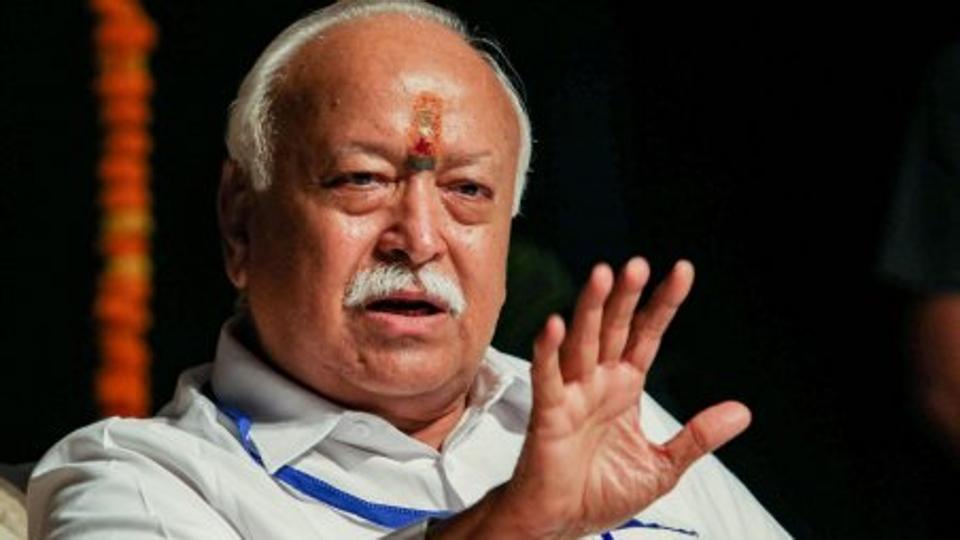
New Delhi: A statement from the Rashtriya Swayamsevak Sangh (RSS) chief Mohan Bhagwat, cautioning against escalating differences between Hindus and Muslims, and the Bharatiya Janata Party’s (BJP) action against two of its spokespersons for comments considered blasphemous by the Muslims that came with an addendum that it respects all religions, is being interpreted as the Sangh Parivar taking tentative steps to alter its stance on minorities.
The change is attributed largely to the heat that India’s diplomatic corps is facing as a coalition of countries have made public their disapproval of the treatment of Muslims and the growing Islamophobia in India.
The immediate provocation are the comments made by former spokespersons Nupur Sharma and Naveen Jindal about the Prophet Mohammad and his wife, and the US State Department’s 2021 Report on International Religious Freedom warning that attacks on individuals in houses of worship are on the rise.
On Sunday, Kuwait, Qatar and Iran summoned Indian ambassadors to protest against the remarks by Sharma and Jindal, who have now been suspended and expelled respectively by the party. This was followed by Saudi Arabia, the United Arab Emirates (UAE), Bahrain, Jordan, the Gulf Cooperation Council (GCC) and the Organisation of Islamic Cooperation (OIC) issuing statements denouncing the remarks. Indonesia, which India claims to share heritage and cultural links with, became the first Southeast Asian country to protest too.
Harried officials of the external affairs ministry were quick to denounce the statements made as the “views of fringe elements” and sought to distance the government from the remarks made on television and social media platforms.
Is there a shift in position?
The BJP and its ideological mentor, the Sangh, predictably shrugged off the actions as reiteration of their stated positions and deny there is a course correction prompted by fears of denting Prime Minister Narendra Modi’s development agenda and India’s ambitious pitch of being considered a Vishwa Guru (world leader). They also denounced the allegation of fostering an anti-minority ecosystem; of allowing the fringe to control the narrative; of sustaining campaigns for the reclamation of mosques and banishment of anyone who disagrees with their ideological point of view.
A senior RSS leader said Sangh chief Mohan Bhagwat’s statement on Friday shows no departure from the ideological position. “Everything he said on Friday has been said before…in November 2021 after the Supreme Court’s ruling on the Ram Temple issue, he made it clear that the Sangh won’t spearhead another movement and he has over the years called for finding ways to coexist peacefully. So where is the change in stance?”, the leader said.
Bhagwat’s comment the Kashi Vishwanath-Gyanvapi Mosque was a historic event that in the present day, no one can be held responsible for, was seen as setting a conciliatory tone.
“Gyanvapi has a history, which we cannot be changed now. We did not create that history. Not today’s Hindus, not Muslims. It happened then… Islam came here with the invaders. In these attacks, temples were destroyed…There are thousands of such temples,” he said.
While a section of hardline Hindutva supporters, including the Sangh offshoot, the Vishwa Hindu Parishad have drawn up a long list of temples that they want opened for the purpose of daily worship, including the historic Qutub Minar, Bhagwat’s comment to focus on “temples, which hold special significance in the hearts of Hindus” was an instruction to pick to their battles.
Unlike the movement that it nurtured for the construction of a temple at the Ramjanamabhoomi in Ayodhya, the Sangh has opted for a more temperate campaign for a Krishna Temple in Mathura’s Idgah and reclamation of the Gyanvapi Mosque in Varanasi.
However, it was Bhagwat’s caution against “raising a new issue every day” and advice to not go looking “or a Shivling in every mosque” that stole the headlines. It was perceived to be a signal to the cadre to prevent the schism between Hindus and Muslims to widen and also put an end to a litany of cases piling in courtrooms.
“There is a sense that if people continue to file cases, and demand reclamation indiscriminately, the outcome might not be what we are hoping for. So, he advised to focus on just those temples that have for long been on the agenda,” said the RSS functionary quoted above.
The BJP also attempted to downplay the change in its stance and why it has been coerced to take action. A senior party leader on Monday said the action against spokespersons was a “well-considered decision” and that the party did not bow to international pressure.
But a section of leaders does not deny the strain such comments have put on bilateral ties, and the threat that they pose to trade and economic ties.
“We have earned friends in the last eight years. The PM’s visits abroad have culminated in bringing countries including Saudi Arabia into our friends' circle so therefore, all attempts will be made to ensure that the cadre and the fringe do not derail the development agenda,” said a second BJP leader.
Outreach with riders
Even though functionaries in both the Sangh and the party assert that there is no concerted effort to woo the minorities, there is a visible change in the outreach towards the Muslims.
The BJP, which is accused of overlooking the Muslim constituency, has been criticised for not giving electoral space to the minority community. The underrepresentation of Muslims from the BJP’s quota in Parliament and state assemblies is used as a reference to draw home the hostility and distrust between the party and the community. The party is now underlining how its policies such as the outlawing of Triple Talaq, the intent to raise the age of marriage of girls and its social schemes were drafted with the purpose of improving the lot of the Muslims.
“… As far as we are concerned, we have been saying that everyone must be treated equally. Our broad outline is justice to all, appeasement of none. This is our basic principle, we are working in accordance with it," BJP president JP Nadda recently said in response to a question on the alienation of the minorities by the party.
Party leaders attributed the disengagement between the Muslims and the party to the opposition’s narrative that sowed fear among the community about the BJP’s anti-Muslim sentiment.
“The party has shown that policies are inclusive and no community or religion has been left out of schemes. The government does not believe in pandering to fears or continuing the UPA’s rhetoric about minorities having more rights on resources. We walk the talk on Sabka Saath, Sabka Vikas, Sabka Vishwas. Now it is time for the community to reciprocate,” said the first BJP leader.
The leader went on to add that there is a need for Muslim leadership to accept the BJP has been an “inclusive, nonpartisan” party.
In the Sangh too, the stress is on urging the Muslims to shun the invaders and find a way of peaceful coexistence. “Bhagwatji clearly stated that even if their prayer is from outside of this country we are not opposed to any form of worship. The Sangh is of the view that acrimony between Hindus and Muslims will serve no purpose,” the first RSS functionary quoted above said.
The functionary said the Muslims will also have to “respect” and “accommodate” the sentiments of the Hindus to put an end to recurring clashes and simmering disgruntlement.
Ajay Gudavarthi, a professor of political science at the Jawaharlal Nehru University said the Sangh and the BJP will need to revisit their overall strategy.
“This kind of global response was expected. The failure of a confrontational strategy is visible in Kashmir. BJP was also voted for development but now it has a single agenda of Hindu nationalism in lieu of everything. That is not going to work and is damaging national interests too. The RSS should also rethink its overall strategy of predatory techniques that have damaged institutions,” he said.
Preserving the core base
And while they address the issues of the minorities, the BJP and the Sangh have the task of walking the tight rope and keeping the core constituency intact. The fringe that is blamed for escalating tensions, has already slammed the Parivar for giving in to international pressure.
Social media posts by the Hindutva supporters blame the government for not looking after Sharma who faces threats from Islamists over her comments. Hashtags supporting Sharma were trending on social media sites soon after the party announced her suspension.
Can the party risk alienating the core constituency, a conglomeration of Hindu castes that it had been carefully putting together?
“There is always a danger of the fringe becoming mainstream. In all ideologies, whether it is communists or the so-called secularists, there exist ultras who take a hardline. What we need to enforce is the idea of co-existence, of accommodation and respecting rights,” said a third BJP leader and a former lawmaker.
 ABOUT THE AUTHORSmriti Kak Ramachandran
Smriti covers an intersection of politics and governance. Having spent over a decade in journalism, she combines old fashioned leg work with modern story telling tools.


