E-Paper



The top court’s push for clean politics
A series of judgements by the Supreme Court shows its intent to weeding out criminal elements from the political stream. But there’s only so far it can go

 Prefer HTon Google


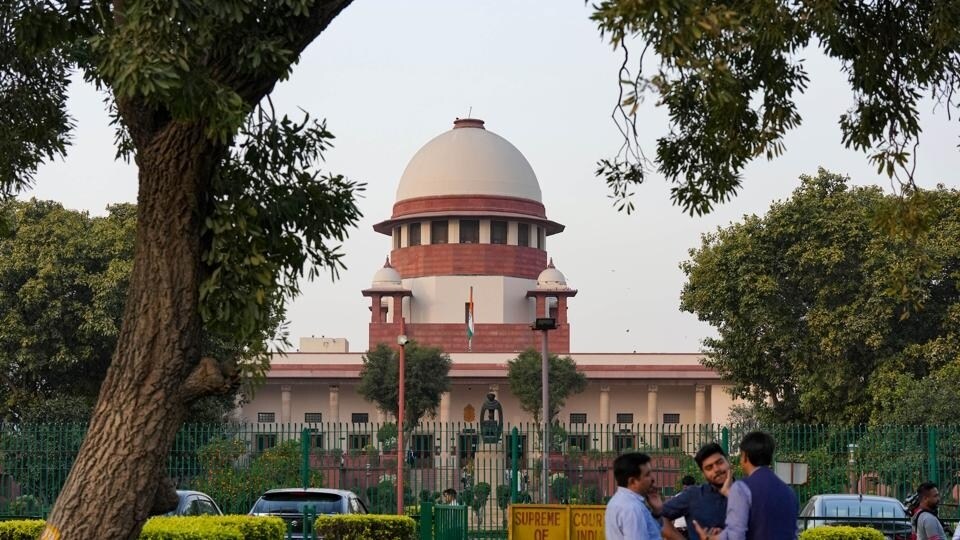
Citing the “legislative architecture” of the country, the Union government on Monday submitted in the Supreme Court that it would not be prudent or legally feasible to debar those against whom serious penal charges have been framed by trial courts from contesting elections.
Even as the Centre sought more time to bring on record its official stand through an affidavit, the government flagged that defining “serious” offences was a challenge. A law officer representing the Centre further pointed out that every order framing criminal charges could be challenged before an appellate court and potentially set aside, but the damage caused due to debarment from contesting an election would be irreparable.
The Centre’s objections against keeping criminally tainted candidates out of the electoral fray have come more than four years after the Supreme Court said that “a time has come that the Parliament must make law to ensure that persons facing serious criminal cases do not enter into the political stream.”
Two years ago, the Supreme Court again made an “appeal to the conscience of the lawmakers hoping that they will wake up soon and carry out a major surgery for weeding out the malignancy of criminalisation in politics,” which, it added, was “growing day by day.”
The top court is currently seized of a PIL by advocate Ashwini Upadhyay, who has relied on a host of reports of the Law Commission and Election Commission of India on the aspect of decriminalising politics.
In the 244th report submitted in 2014, the Law Commission recommended disqualification of people against whom charges have been framed at least one year before the date of scrutiny of nominations for an offence punishable with a sentence of five years or more.
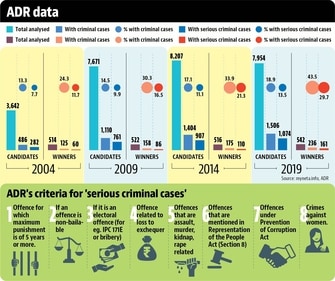
Upadhyay, in his petition, claimed that there has been an increase of 44% in the number of MPs with declared criminal cases since 2009. In the 2019 Lok Sabha elections, 159 MPs declared serious criminal cases against them, including those of rape, murder, attempt to murder, kidnapping, crimes against women. This was 29% of the 542 winners. In 2014, only 21% of MPs faced heinous crimes, he added.
The Union government has four weeks to convey its stand on an affidavit, but the larger concern, it turns out, has occupied the Supreme Court for a few decades.
Criminalisation of politics and early days
Elections are the nerve centre of democratic politics. Thus, the antecedents of candidates entering electoral politics have always remained a key consideration for the framers of the Constitution and the institutions bestowed with the duty to implement it.
Dr Rajendra Prasad, before putting the motion for passing of the Constitution on the floor of the Constituent Assembly on November 26, 1949, had said: “It requires men of strong character, men of vision, men who will not sacrifice the interests of the country at large for the sake of smaller groups and areas...We can only hope that the country will throw up such men in abundance.”
Underlining the importance of free and fair election, the Supreme Court in Mohinder Singh Gill Vs Chief Election Commissioner (1978) held that democracy is government by the people wherein “the little man, in his multitude, marking his vote at the poll does a social audit of his Parliament plus political choice of this proxy.”
The Dinesh Goswami Committee on Electoral Reforms in 1990 acknowledged the need for a crackdown on money and muscle power in polls. The Committee said: “The role of money and muscle powers at elections deflecting seriously the well accepted democratic values and ethos and corrupting the process; rapid criminalisation of politics greatly encouraging evils of booth capturing, rigging, violence etc.; misuse of official machinery, i.e. official media and ministerial; increasing menace of participation of non-serious candidates; form the core of our electoral problems."
Similarly, the Vohra Committee that was formed in the wake of the 1993 Mumbai serial blasts expressed deep concerns that over the past few years, several criminals had been elected to local bodies, state assemblies and Parliament. “The nexus between the criminal gangs, police, bureaucracy and politicians has come out clearly in various parts of the country,” stated the Committee’s report submitted to the Central government in October 1993.
The Vohra Committee report was extensively cited by the Supreme Court in its 1997 judgement in Dinesh Trivedi (MP) and others Vs Union of India and others, lamenting that the nexus between politicians, bureaucrats and criminal elements in society has been on the rise, the adverse effects of which, it said, are increasingly being felt on various aspects of social life in India.
In Anukul Chandra Pradhan, Advocate Supreme Court Vs Union of India and others (1997), the top court approved of the election laws that sought to exclude persons with criminal background from the election scene as candidates and voters, noting the object is to prevent criminalisation of politics and maintain propriety in elections.
Judgements aimed at reform since the 2000s
The first landmark judgement by the apex court to curb criminalisation of politics while fortifying the voters’ right to make informed choices came in 2002 in Union of India Vs Association for Democratic Reforms and Another. The Supreme Court, by this judgement, made it compulsory for the candidates to declare assets, educational qualifications and criminal antecedents in the form of an affidavit to the Election Commission. “Voter's (little man- citizen's) right to know antecedents including criminal past of his candidate contesting election for MP or MLA is much more fundamental and basic for survival of democracy. The little man may think over before making his choice of electing law-breakers as law-makers,” noted the judgement.
The 2002 verdict prompted the Parliament to amend the 1951 Representation of the People Act (RPA). Section 33A was introduced in the Act to make it obligatory for a candidate to furnish records relating to her or his conviction as well as details of pending criminal cases. But the section did not mention anything about a candidate’s assets and educational qualifications. In fact, the Parliament brought in Section 33B to take away the jurisdiction of courts to require a candidate to furnish any information apart from what was prescribed in Section 33A.
But the Centre’s attempt to restrict judicial intervention was emphatically rejected by the Supreme Court in People's Union for Civil Liberties (PUCL) Vs Union of India and Another (2003). The court struck down Section 33B, holding the provision was on the face of it beyond the legislative competence. “This court has held that the voter has a fundamental right under Article 19(1)(a) to know the antecedents of a candidate for various reasons recorded in the earlier judgement as well as in this judgement,” it stated.
“Those who break the law should not make the law. Generally speaking, the purpose sought to be achieved by enacting disqualification on conviction for certain offences is to prevent persons with criminal background from entering into politics and the house — a powerful wing of governance,” the Supreme Court held in Prabhakaran Vs P Jayarajan (2005) in the context of enacting disqualification under Section 8(3) of the RPA.
Sections 8(3), inserted in the RPA in 1989, provided that a person will be disqualified from the electoral process if a court hands down a sentence of at least two years in prison. However, Section 8(4), introduced in the same year, made a distinction between sitting legislators and pre-elected candidates. This provision laid down that disqualification of a sitting MP and MLA “shall not” take effect until his appeal, moved against the first conviction within three months, is finally decided by the appellate court.