
 E-Paper



Three seats in the Valley take INDIA allies to opposite sides
As the INDIA bloc falls into trouble in Jammu and Kashmir, it's important to remember that the NC and PDP share a longer history of rivalry than camaraderie

 Prefer HTon Google


Anyone will be forgiven for thinking that the events of this week alone are enough to understand the mistrust between the National Conference (NC) and the People’s Democratic Party (PDP), the two significant regional parties of Jammu and Kashmir.
Here’s a quick recap.
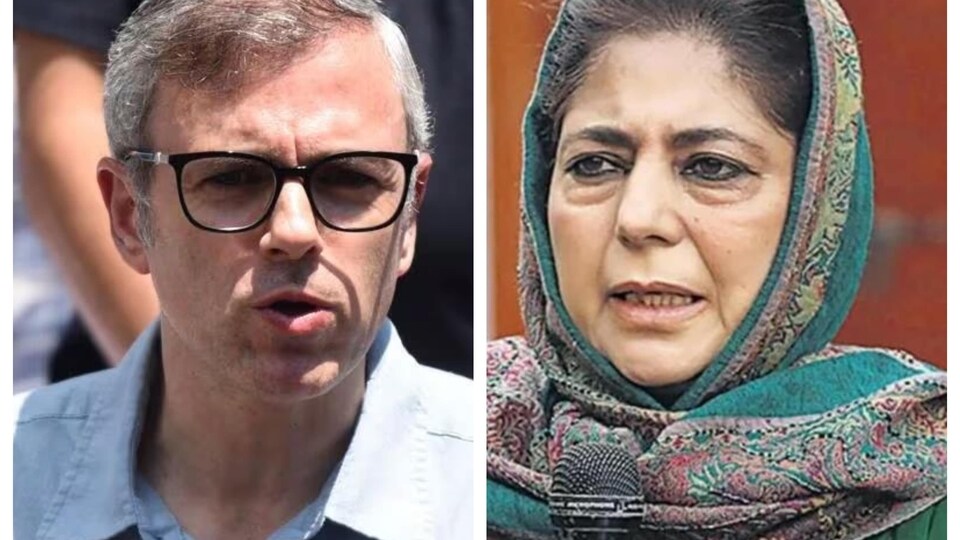
On Monday, National Conference vice president and former J&K chief minister Omar Abdullah announced that veteran Gujjar leader, Mian Altaf Ahmed Larvi (whose great grandfather was a renowned saint) was the party candidate from Anantnag Poonch Rajouri Lok Sabha seat. This was a jolt for the Indian National Developmental Inclusive Alliance (INDIA) partners, in particular, the PDP, whose president and former J&K chief minister Mehbooba Mufti is contesting from the same seat.
By Wednesday, the INDIA bloc’s agreement had collapsed in Kashmir, after Mufti announced that her party would field candidates from all three Lok Sabha seats in the Valley and accused the C of high-handedness, just two weeks ahead of general elections.
Despite losing the seat in the 2019 Lok Sabha polls, south Kashmir is still considered a strong bastion of the PDP. For most party leaders, NC’s announcement was a shock especially since it came a day after Abdullah and Mufti put up a united show at the INDIA bloc’s Loktantra Bachao Rally in New Delhi. Mehbooba has represented Anantnag in 2004 and 2014.
“Mehbooba ji said in Delhi that Farooq Saheb and we are together and we will not break the INDIA alliance. Why are you people trying to make us fight here? You should expose the A team, B team and C team,” Omar Abdullah told reporters in South Kashmir’s Pahalgam.
"If NC and PDP go solo then it's going to be a big advantage to their opponents in Kashmir and will also be the end of both the Indis and the PAGD alliance in J&K," said Ishfaq Ahmad, a political columnist for vernacular dailies.
While the NC and the PDP are part of the INDIA bloc, they did not field candidates in Jammu and Udhampur seats; the Congress of the INDIA alliance has put up candidates from there. “If they (PDP and NC) have some issues, they can have a friendly contest on three Kashmir seats,” Congress general secretary Mir Iqbal said. It would’ve been better if the National Conference and the PDP had jointly contested polls, he said.
A historical rivalry
The PDP, which was formed by former Union home minister Mufti Mohammad Sayeed in 1999, is the main rival of NC, a regional party that ruled J&K for years. Soon after its formation, Sayeed took oath as J&K chief minister in 2002 with the help of the Congress despite the fact that the PDP had won just 16 seats in the assembly elections and the NC in fact had emerged as the single largest party.
The National Conference was formed before partition in 1939 by Sheikh Mohammad Abdullah when J&K was ruled by the erstwhile Maharaja, Hari Singh. Sheikh Mohammad Abdullah, the grandfather of Omar Abdullah, was considered a staunch nationalist and one of the tallest leaders the J&K has produced, his mass following extended to all regions of the state.
NC governed Kashmir since Partition, losing power a couple of times when the Congress and a breakaway faction of the NC won in the 1960s and mid-80s. In the late ’80s, the NC and Congress came together and formed a coalition government after defeating the Muslim United Front (MUF) candidates in elections, which the opposition claimed was heavily rigged. This was one of the triggers of militancy in the now-Union territory.
Between 2002 and 2008, the NC was the main opposition party; and then from 2015 to 2018, when the PDP and Congress and, later the PDP and BJP, ran coalition governments.
Till 1999, after which the BJP started making inroads in J&K, especially in Jammu, the Congress and small regional parties like the People’s Conference and the Jammu and Kashmir National Panthers Party acted as the main opposition.
The rivalry between PDP and NC dates back to the early 1990s, when Sayeed, as Union home minister (he held the post for a year), and J&K was brought under the Governor’s rule. This was also the time when militancy was starting to affect the Valley, and when Sayeed appointed Jagmohan as Governor for the second time, Farooq Abdullah resigned in protest.
In 1996, NC won a landslide victory in the assembly elections. The rivalry passed to the second generation till both parties came together under the banner of the People’s Alliance for Gupkar Declaration (PAGD) in 2020, however, on the ground the mistrust between the cadres and leaders remained.
Senior political analyst and former dean of social sciences department, Kashmir University, professor Noor Ahmad Baba said that the NC has had a longer history in the Valley and it draws support from that. “Ideologically there is no fundamental difference between the parties. Both stand for autonomy though with different names. NC talked about autonomy and Article 370 while PDP talked of self-rule and tried to bring additional elements in that narrative. PDP was born at a time when the peace process between India and Pakistan was on. They built them into their own proposals like cross LoC activities."
There are people who question the timing of PDP’s creation and how it divided power. Till then Kashmir’s role in government was predominant. Mehbooba’s party had to build itself out of nothing. It empathised with the suffering of people but separatist politics was never their agenda," he said adding that historically the people who formed PDP have been closer to Indian politics than others. "NC leadership was always regionally based. Mufti Sayeed was part of larger national politics."
Sayeed passed away in 2016.
Also read: All you need to know about Mufti Mohammad Sayeed
Necessity brings them together
With the abrogation of Article 370 and bifurcation of J&K into two Union Territories, the leaders of both parties came together in August 2019 stating that they will fight for a broader cause to safeguard the interests of the people of J&K and strive hard for reinstatement of statehood.
In 2020, more than two decades after its formation, the PDP along with the NC contested the joint District Development Council polls and the NC won the highest number of the DDC seats.
For the past several months, NC leadership, especially Omar Abdullah, has insisted on contesting all three Lok Sabha seats of Kashmir on the basis that the party had won all three seats in the 2019 elections. Senior PDP leaders were hopeful NC would finally leave the seat, which didn’t happen.
"We can't leave seats for NC especially when the vice president, Omar Abdullah has shown arrogance without taking members of the INDIA bloc or PAGD into confidence. The party (PDP) leaders are of the strong opinion that we should have candidates on all three seats of Kashmir," a senior PDP leader.


