E-Paper



‘Told PM there is work that we need to do’: Justin Trudeau on brief exchange with PM Modi
India continues to expect that Canada won’t allow “anti-India Khalistani activities” on its soil and take “firm action" against those advocating violence

 Prefer HTon Google


NEW DELHI: Canada’s Prime Minister Justin Trudeau said on Friday he had a “brief exchange” with his Indian counterpart Narendra Modi on the margins of the Asean Summit in Laos though people familiar with the matter made it clear there was no substantive discussion between the two leaders.
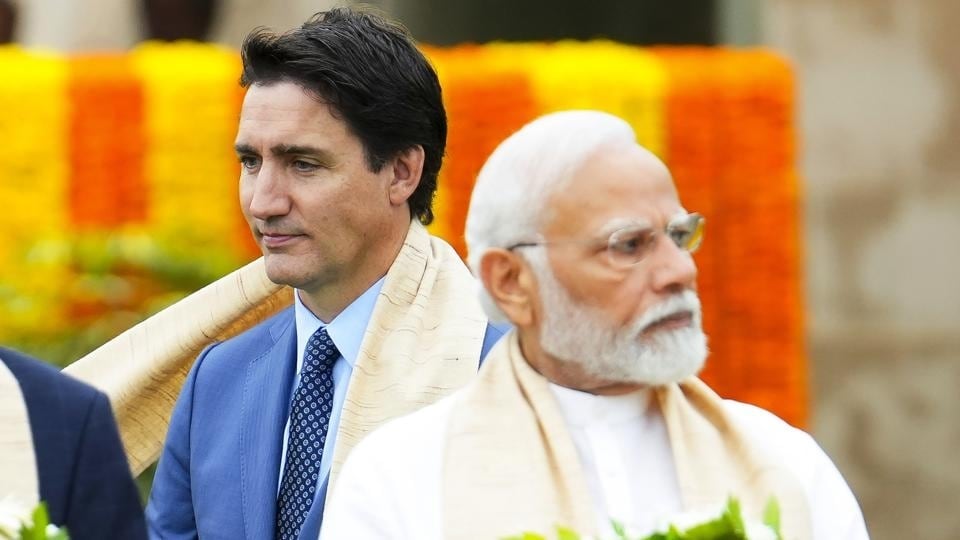
This was the second such encounter between the two leaders since Trudeau alleged in September 2023 that Indian government agents were linked to the killing of pro-Khalistan activist Hardeep Singh Nijjar. The accusation, which India dismissed as absurd, sent bilateral ties into a tailspin from which they are yet to recover.
“I had a brief exchange with Prime Minister Modi in which I emphasised that there is work that we need to do,” Trudeau told the media in the Lao capital of Vientiane.
He declined to give details about the conversation but said there are real issues that India and Canada need to solve. He said that the “safety of Canadians and upholding the rule of law is one of the fundamental responsibilities of any Canadian government, and that’s what I’ll stay focused on”.
Trudeau added: “Yes, we need to continue to develop our trade ties and our people-to-people ties but there are real issues that we need to solve and we’re going to stay focused on that.”
The people cited above said on condition of anonymity that there was no substantive discussion between Modi and Trudeau. The Indian side continues to expect that Canada won’t allow “anti-India Khalistani activities” on its soil and that “firm action, which is lacking thus far, will be taken against those advocating violence, extremism and terrorism against India from Canadian territory”, one of the people said.
“The growing nexus of such forces with organised crime, drug syndicates and human trafficking should be a concern for Canada as well,” the person said.
India attaches importance to relations with Canada but “these cannot be repaired unless the Canadian government takes strict and verifiable action” against those pursuing anti-India activities and conspiring to promote hate, disinformation, communal disharmony and violence in India and Canada, the person added.
Modi and Trudeau last had a brief encounter on the margins of the G7 Summit in Italy in June. They also met on the margins of the G20 Summit in New Delhi last September, just days before Trudeau made the allegations about Nijjar’s killing in the Canadian Parliament.
Nijjar was gunned down by masked men outside a gurdwara in Surrey in June 2023. Four Indian nationals have been arrested by Canadian authorities and accused of first-degree murder and conspiracy. The Indian side has raised the issue of Khalistani elements issuing threats to Indian missions and diplomats.
Canada’s foreign minister Mélanie Joly on Thursday described her country’s relations with India as “tense” and “very difficult” while testifying at the Public Inquiry into Foreign Interference. She also said there is still a threat of more killings like Nijjar’s on Canadian soil.
Asked by a reporter about Joly’s remarks, Trudeau said: “We are seeing troubling patterns of violence affecting Indo-Canadians right across the country over the past number of months and this is an issue that I can assure you that we will continue to be very, very seized with and we will ensure that our responsible authorities continue to do the right work.”
Trudeau said his accusation about Nijjar’s killing “continues to stand” and that he made the allegations public because keeping “Canadians safe is one of the fundamental jobs of any Canadian government”. He added: “I won’t go into anything further now, but Canadians can know and can be confident that this is an issue that has remained at the forefront of my mind...”