
 E-Paper



Top court goes live in push for transparency
History was created on Tuesday with the Supreme Court live-streaming its Constitution bench proceedings in a landmark first, with the highest court in the country pushing for public access and transparency.


History was created on Tuesday with the Supreme Court live-streaming its Constitution bench proceedings in a landmark first, with the highest court in the country pushing for public access and transparency.

Marking a watershed moment in the judicial history of the country, three courtrooms beamed crucial proceedings that involved intricate issues of constitutional and legal significance, having far-reaching ramifications.
Across the three five-judge benches, more than 800,000 people tuned in on the first day to watch. While 732,000 viewers used YouTube to access the proceedings, others used the NIC Webcast portal to watch the feeds of the first three courts of the country, according to official data.
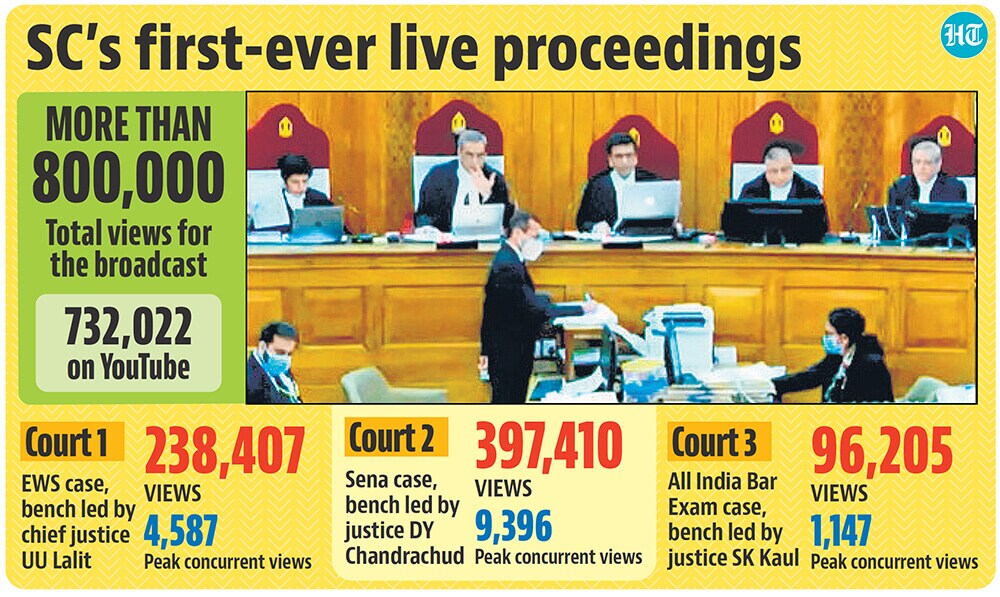
The Constitution bench headed by Chief Justice of India Uday Umesh Lalit, was hearing a challenge to the central law on 10% quota to the economically weaker sections (EWS), which was heard in court hall 1 for three hours. More than 238,000 viewers tuned in on YouTube to watch the EWS case. The average viewing time for this court was three minutes, 33 seconds.
In court hall 2, another five-judge bench, led by justice Dhananjaya Y Chandrachud, heard the politically sensitive matter relating to the Maharashtra political crisis on several petitions filed by both the factions of the Shiv Sena — led by Uddhav Thackeray and state chief minister Eknath Shinde. The proceedings ran for almost five hours, beyond the normal working hours of the court. Around 400,00 people accessed the proceedings. The average length of time a viewer watched the proceedings before this bench was just over six minutes.
Justice Sanjay Kishan Kaul headed the third Constitution bench, which was adjudicating a challenge to All India Bar Association (AIBE) in so far as it imposes preconditions to advocates’ enrolments. The proceedings in court hall 3 had over 100,000 views. People watched the proceedings for two minutes, 34 seconds on average.
While arguing a constitution bench case before justice Kaul-led bench, attorney general KK Venugopal lauded the move as he pointed out that law interns will be able to watch and participate in the court proceedings. As the AG said that the live-streaming, however, is confined to constitution bench cases, justice Kaul quipped: “It is just the beginning.”
All the three courtrooms used a Cisco video-conferencing platform, and were equipped with eight microphones and three cameras each — one camera focused on the bench, and two on the advocates’ sides. A digital sound system was also put in place with wireless and wired microphones, digital amplifiers and receivers, and speakers.
“Truly, a historic day. This step will go a long way in overcoming the barriers of distance and provide citizens from every nook and corner of the country an opportunity to watch the Supreme Court proceedings. This is a humble beginning and attempts will now be made to live stream proceedings in all important matters,” stated an official communication from the Supreme Court administration.
Senior advocate and former additional solicitor general KV Viswanathan welcomed the move: “It will reinforce the confidence of litigants and other people in the judiciary. It would prove to be a great source of education for legal scholars throughout the country,” he said. Viswanathan added that the fear of ‘playing to the gallery’ because of live-streaming may not be justified since once engrossed in the proceedings, lawyers actually forget that they are going live.
Senior advocate Gopal Sankaranarayanan asserted that live-streaming will defog the entire judicial process, especially for the common man who cannot have access to the apex court otherwise. “There will perhaps be a course correction among the judges and the lawyers, and it will eventually be in the best interest of the institution. Concerns over irresponsible use of content or disinformation cannot defeat the access of open courts to public,” he added.
As reported by HT last week, a full court, comprising all judges of the top court, had on September 20 decided to live-stream constitutional bench proceedings from the following week. At the meeting, which was presided over by CJI Lalit, all the judges were unanimous in their decision that live-streaming, on a regular basis, should commence with broadcasting Constitution bench cases.
In the last week of August the Supreme Court live-streamed its first proceedings, more than three years after a top court ruling recommended live-streaming its hearings. The move was, however, confined to the proceedings of a ceremonial bench that bid adieu to then CJI NV Ramana.
By a judgment in September 2018, the Supreme Court declared the live telecast of court proceedings part of the right to access justice under Article 21 of the Constitution, stating that it is necessary for the judiciary to move apace with technology in order to promote a greater degree of confidence in the judicial process.
Subsequently, Supreme Court’s e-Committee, headed by justice Chandrachud, came out with model guidelines to regulate live-streaming of court proceedings in India.
The e-Committee has also been working on a proposal to launch an exclusive platform for live-streaming court proceedings. The proposition to have an exclusive platform to live-stream apex court proceedings was part of the third phase of the e-courts project, which is an ambitious initiative to implement the use of information and technology in India’s judiciary. On Monday, CJI Lalit also said the top court will soon have its own “platform” to live-stream its proceedings instead of having to use YouTube.
Currently, six high courts in the country, Gujarat, Orissa, Karnataka, Jharkhand, Patna, and Madhya Pradesh, live-stream their proceedings through their own channels on YouTube.


