E-Paper



Toy sector seen as global player amid self-reliance push
The study, commissioned by the Department for Promotion of Industry and Internal Trade, was released by DPIIT secretary Rajesh Kumar Singh on Thursday

 Prefer HTon Google


New Delhi:
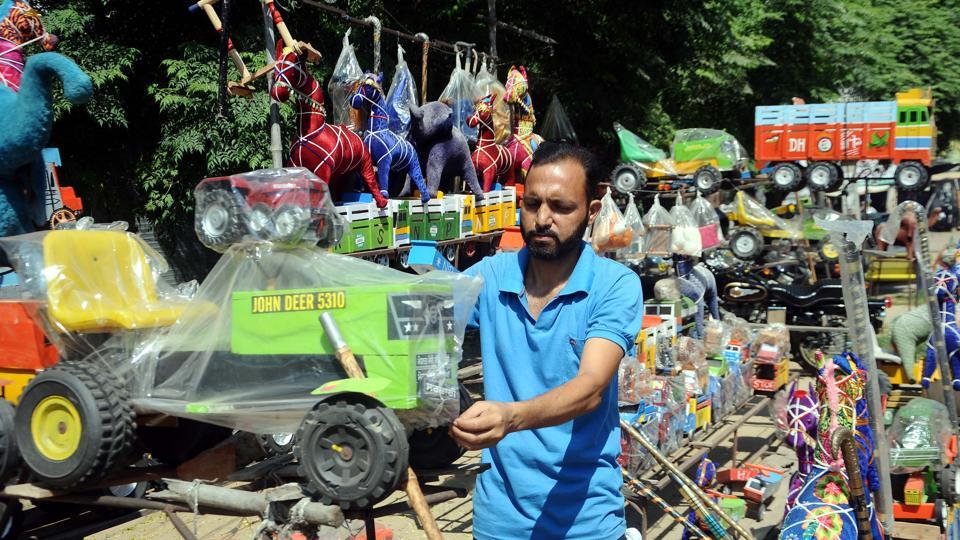
Prime Minister Narendra Modi’s government’s self-reliance push for the toys sector has seen India emerge as a strong contender in the global market in which it was a net importer eight years ago but has since had global retail giant Walmart developing about 100 local manufacturing points for its global sourcing.
The information was disclosed by two government officials who cited a study by the Indian Institute of Management (IIM), Lucknow. In the period between 2013-14, when Modi took over as PM, and the last financial year 2022-23, imports of toys fell by 48% to $159 million while exports jumped 293% to $326 million, according to the IIM’s case study -- Success Story of Made in India Toys.
The study, commissioned by the Department for Promotion of Industry and Internal Trade, was released by DPIIT secretary Rajesh Kumar Singh on Thursday.
The success of toys could act as a template for other sectors while keeping their specific sectoral requirements in mind, Singh said. Due to several tariff and non-tariff measures, India has been able to reduce the dumping of low-quality, cheaper Chinese products in its toy market. China’s share in India’s toy imports fell $39 million in 2022-23 as compared to $260 million in 2014-15, the study showed.
The government took multiple steps to reduce dependence on imports and increase India’s exports, such as raising basic customs duty (BCD) from 20% to 60% in February 2020, and to 70% in March 2023. It brought the sector under quality control order (QCOs) in 2020, making Bureau of Indian Standards (BIS) compulsory for both domestic manufacturing as well as imports.
“This helped in two ways – checking dumping of low-quality imports from one geographic region and nudging domestic manufacturing to produce quality products for both, local consumption and exports,” Singh said. BIS has already granted over 1,200 licences to domestic manufacturers and more than 30 licences to foreign manufacturers.
Sanjiv, a joint secretary in DPIIT, said the policy measures led to transformation of the Indian toy sector and domestic producers are now getting integrated into the global supply chains. Walmart, which plans to source Indian products worth about $10 billion for its various global markets, is training nearly 100 local units in manufacturing quality toys.
Indian toys are now going to various markets including the US, the United Arab Emirates (UAE) and Australia.
India’s policy focus on the sector started after Modi expressed his desire to establish India as a global toy manufacturing hub in his ‘Mann ki Baat’ in August 2020, Singh said. On that August 30 episode, the Modi said: “To my start-up friends, to our new entrepreneurs I say - team up for toys… let us make toys together. For everybody it is the time to get vocal for local toys… Toys should be such that in their presence childhood blooms and smiles. Let us make toys which are favourable to the environment too.”
To fulfil the vision, the government undertook a series of initiatives including formulation of the National Action Plan for Toys (NAPT) to promote designing of toys, using toys as a learning resource, monitoring quality of toys and promoting indigenous toy clusters, Singh said.
The IIM report said that focus must continue to position India as a viable alternative to current toy hubs of the world -- China and Vietnam. The Ministry of micro, small and medium enterprises (MSMEs) is supporting 19 toy clusters under the Scheme of Funds for the Regeneration of Traditional Industries (SFURTI), and the Ministry of Textiles is providing designing and tooling support to 13 toy clusters, Sanjiv said.