E-Paper



Trudeau triggers diplomatic firestorm with India remark
India has rejected Canadian Prime Minister Justin Trudeau's claim of a "potential link" between Indian government agents and the killing of Khalistani leader Hardeep Singh Nijjar in June. Trudeau's claim has further damaged bilateral relations, which are already strained over the activities of pro-Khalistan elements in Canada. As a consequence, both countries have expelled senior diplomats. India maintains that Canada has provided shelter to Khalistani terrorists and extremists who threaten India's sovereignty and territorial integrity.

 Prefer HTon Google


India on Tuesday dismissed as “absurd and motivated” Canadian Prime Minister Justin Trudeau’s claim of a “potential link” between Indian government agents and the killing of Khalistani leader Hardeep Singh Nijjar in June, as the two countries carried out tit-for-tat expulsions of senior diplomats.
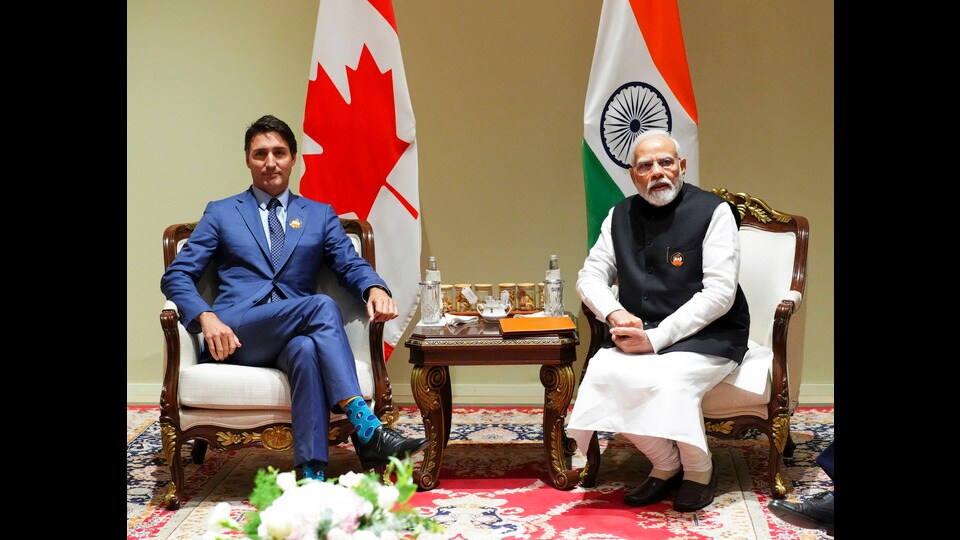
Trudeau later on Tuesday told reporters Ottawa was not looking to “provoke or escalate”.
“India and the government of India need to take this matter with the utmost seriousness,” Trudeau said. “We are doing that. We are not looking to provoke or escalate. We are simply laying out the facts as we understand them and we want to work with the government of India to lay everything clear and to ensure there are proper processes.”
Trudeau’s claim will further damage bilateral relations, which are already at an all-time low over the activities of pro-Khalistan elements in Canada, including holding a so-called referendum on a separate homeland for Sikhs, targeting of Indian diplomatic premises, and incitement of violence against top Indian officials.
Soon after Trudeau on Monday made the claim in Canada’s Parliament, foreign minister Mélanie Joly announced the expulsion of a “top Indian diplomat” as a consequence. Joly’s office identified the diplomat as Pavan Kumar Rai, the head of the Research and Analysis Wing (RAW) in Canada, according to public broadcaster CBC.
Hours later, Canadian envoy Cameron MacKay was summoned to the external affairs ministry and informed of the government’s decision to expel a senior Canadian diplomat. The diplomat was asked to leave within five days, the ministry said in a brief statement. The decision reflects the Indian government’s “growing concern at the interference of Canadian diplomats in our internal matters and their involvement in anti-India activities”, the statement added.
The statement didn’t name the Canadian diplomat, but people familiar with the matter said Olivier Sylvestere, the Canadian intelligence agency’s station chief in New Delhi, had been asked to leave the country.
The external affairs ministry said in a separate statement that Trudeau made similar allegations to Prime Minister Narendra Modi at a meeting on September 10, on the margins of the G20 Summit, and these “were completely rejected”.
“Such unsubstantiated allegations seek to shift the focus from Khalistani terrorists and extremists, who have been provided shelter in Canada and continue to threaten India’s sovereignty and territorial integrity. The inaction of the Canadian government on this matter has been a long-standing and continuing concern,” the ministry said.
The development came a little more than a week after Modi told Trudeau at their meeting that New Delhi expects Ottawa to cooperate in tackling pro-Khalistani elements in Canada who are “promoting secessionism and inciting violence against Indian diplomats”.
Nijjar, a Canadian citizen, was shot dead in the parking lot of Guru Nanak Sikh Gurdwara in the town of Surrey in British Columbia on June 18. Nijjar was earlier designated a terrorist by the Indian government for his involvement in pro-Khalistan activities.
In a speech to Canada’s House of Commons on Monday, Trudeau said he wished to inform the House of an “extremely serious matter” that he had discussed with opposition leaders.
“Over the past number of weeks, Canadian security agencies have been actively pursuing credible allegations of a potential link between agents of the government of India and the killing of a Canadian citizen, Hardeep Singh Nijjar. Canada is a rule of law country. The protection of our citizens and defence of our sovereignty are fundamental,” he said.
He added: “Canada has declared its deep concerns to the top intelligence and security officials of the Indian government. Last week, at the G20, I brought them, personally and directly, to Prime Minister Modi in no uncertain terms. Any involvement of a foreign government in a killing of a Canadian citizen on Canadian soil is an unacceptable violation of our sovereignty.”
Trudeau said some Indo-Canadians are feeling “angry” and “perhaps frightened right now”.
Trudeau’s speech in Parliament followed weeks of behind-the-scenes contacts with allied nations, especially the Five Eyes intelligence alliance that groups Australia, Canada, New Zealand, the UK and the US, to raise Nijjar’s killing with India and to “issue a joint statement condemning the act”, The Washington Post cited an unnamed Western official as saying.
Several countries, including the US, demurred as they feared a diplomatic backlash from the Indian government that was focused on hosting the G20 Summit, the Post reported. Instead, the killing was “privately raised by several senior officials” from the Five Eyes states before the summit, the report added.
Soon after his speech, Joly told the media the “allegations that a representative of a foreign government may have been involved in the killing of a Canadian citizen... on Canadian soil is not only troubling but it is completely unacceptable”. She added: “As of today and as a consequence, we’ve expelled a top Indian diplomat from Canada.”
While it is not unusual for countries to expel operatives of a foreign intelligence agency, it is rare for them to identify the expelled official.
Joly also said she conveyed Canada’s principles regarding seeking the truth, protecting Canadians at all times and protecting Canada’s sovereignty to her Indian counterpart and sought “India’s full collaboration to get to the bottom” of the matter. She added Canada wouldn’t “tolerate any form of foreign interference”.
Responding to the Canadian government’s allegations, the external affairs ministry rejected Trudeau’s statement in Parliament and Joly’s comments.
“Allegations of government of India’s involvement in any act of violence in Canada are absurd and motivated,” the ministry said in its statement. “We are a democratic polity with a strong commitment to rule of law.”
The statement pointed out that “Canadian political figures have openly expressed sympathy for such elements” and this remains a deep concern for India. “The space given in Canada to a range of illegal activities including murders, human trafficking and organised crime, is not new,” it added.
While rejecting attempts to connect the Indian government to such developments, New Delhi urged the Canadian government to take “prompt and effective legal action against all anti-India elements operating from their soil”.
CBC News quoted a senior Canadian government source as saying that Trudeau had briefed the leaders of the country’s closest allies about the case, including UK Prime Minister Rishi Sunak, French President Emmanuel Macron and US President Joe Biden.
While addressing the Canadian media on the margins of the G20 Summit in New Delhi, Trudeau had said he had raised the issue of “foreign interference” in Canada’s internal affairs with his Indian counterpart.
Asked at the same news conference about India’s concerns over the activities of pro-Khalistan elements, Trudeau said Canada will always defend freedom of peaceful protest but simultaneously asserted it will prevent violence.
A tersely worded readout issued by the external affairs ministry on the bilateral meeting on September 10 said that Modi had conveyed to Trudeau India’s “strong concerns about continuing anti-India activities of extremist elements in Canada”, who are “promoting secessionism and inciting violence against Indian diplomats, damaging diplomatic premises, and threatening the Indian community... and their places of worship”.
Modi further said the “nexus of such forces with organised crime, drug syndicates and human trafficking should be a concern for Canada” and that it is “essential for the two countries to cooperate in dealing with such threats”.
The people cited above said the external affairs minister is likely to make a statement on the matter during the ongoing special session of Parliament.
India-Canada relations are in tatters over the activities of pro-Khalistan elements on Canadian soil. In recent months, the extremist elements have organised pro-Khalistan rallies and protests in several cities and targeted Indian diplomatic facilities and officials. They have also held a so-called referendum on Khalistan in Surrey, Brampton and other cities with sizeable Sikh populations. One referendum was held on the same day that Modi met Trudeau in New Delhi.
The Indian side was particularly angered when a float at a recent rally depicted the assassination of former prime minister Indira Gandhi in a gory manner and eulogised her killers.
The troubled bilateral ties have also affected negotiations on a free trade agreement, with officials from both sides saying the talks have been paused. Two-way trade in goods in 2022 was worth US$10.5 billion, including Indian exports of US$6.4 billion, while bilateral trade in services in 2021 was worth US$5.88 billion. Canadian pension funds have invested more than US$55 billion in India.
Canadians of Indian origin account for about 4% of the country’s population. With nearly 1.6 million people of Indian origin and another 700,000 non-resident Indians (NRIs), Canada hosts one of the largest Indian diasporas. The current House of Commons has 19 MPs of Indian origin, including three cabinet ministers.
The opposition New Democratic Party, led by Jagmeet Singh, has helped keep Trudeau’s minority government in power. Singh, who has often spoken in favour of Khalistan, said on Tuesday he would ensure all links to Nijjar’s killing are pursued and justice is done.