
 E-Paper



True history is not based on govt facts but real events: Shah
Contending that several rulers were overlooked by historians who chronicled India’s past, he said, “History is based on true events and not governments…it is like a shining lamp in a dark night.”


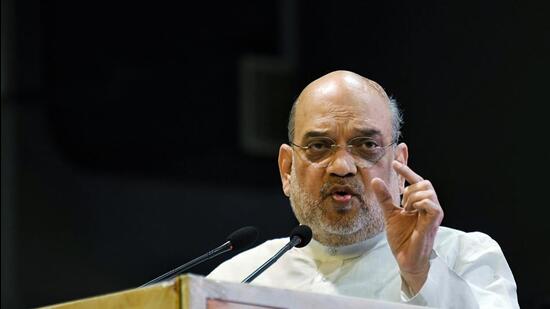
New Delhi: True history is not based on facts presented by the governments, but on real events unearthed and documented by people, Union home minister Amit Shah on Friday said at the launch of a book, Maharanas, based on the Mewar rulers.
Contending that several rulers were overlooked by historians who chronicled India’s past, he said, “History is based on true events and not governments…it is like a shining lamp in a dark night.”
Shah added that when governments write history, there can be problems, but when people unearth details and write about historic facts, the truth emerges. “Those who had to distort history have already done so …but who can stop us now; we are free and not dependent on anyone, we can write our own history,” he said, urging scholars to dig into the past and present the history of the country that has not been documented.
He said that had VD Savarkar not been around, the truth about the uprising of 1857 would have also been buried. Savarkar, a writer and revolutionary considered one of the pioneers on Hindutva ideology, wrote The Indian War of Independence, which was first published in 1909.
Referring to himself as a “student of history”, Shah said to ensure a bright future, one must be inspired by the past, learn lessons, and decide the way forward. “There are some who wrote history in a way that led to nirasha (disappointment), but in the end, the truth wins and it has won,” he said.
The Bharatiya Janata Party (BJP) and its ideological fount, the Rashtriya Swyamsevak Sangh (RSS), have been pushing to write history from an Indian perceptive, which includes documenting the lesser-known kingdoms and events not included in education curriculums. The RSS has also been pushing the government to revisit the history documented in textbooks -- a contentious process that has sparked criticism from some historians.
This thinking has also been visible in decisions such as changing the names of towns or streets from names either acknowledging Mughal rulers or those that originated during Mughal rule.
Earlier this month, at the screening of a film Prithviraj Samrat, based on the life of Prithviraj Chauhan, which was also attended by Shah, RSS chief Mohan Bhagwat said, “…We used to read our history written by others. Now, we are looking at history from India’s perspective.”
Shah also pitched for re-examining history from an Indian perspective. “We need to start writing it from our point of view...We need to bring our history out; we need to remove the dust of time and unravel history,” he said. “To those who write history, I want to tell them, they overlooked our own kingdoms for the Mughals. The Ahom kings ruled for over 650 years and kept Assam independent… the Chalukyas went on for 600 years … but all these did not merit writing tomes or being included in the history that was written.”
The author of the book, Omendra Ratnu, said, “Usually it is said the victor writes history, our history was written by the losers. And for a few pennies, some intellectuals sold off their conscience and doctored history.” He said there should be a probe by independent experts to see if the history that has been written is correct or not.
Professor of contemporary history at Jawaharlal Nehru University, Aditya Mukherjee said, “Jawaharlal Nehru in his discovery of India talked in glowing terms about the Rig veda, Upanishads, Ramayana, Mahabharat, Budha, the Gupta Empire etc., long before any Muslim ruler emerged in India. Questions about what has been included or left out should be raised by historians not politicians.”
Mukherjee said a recent film on Prithviraj Chauhan claimed he was the last Hindu ruler. “…this shows the complete lack of awareness about dynasties in Southern India, for instance the Vijaynagar Empire.”


