
 E-Paper



UCC a contentious point among Opposition parties
Opposition leaders believe this issue will not affect the unity achieved in their recent meeting.

 Prefer HTon Google


New Delhi: The government’s push for a Uniform Civil Code, seen by many analysts as a sharply polarising issue, seems to have already polarised the opposition parties, with some openly supporting the move, albeit with caveats, and others strongly opposed to it.
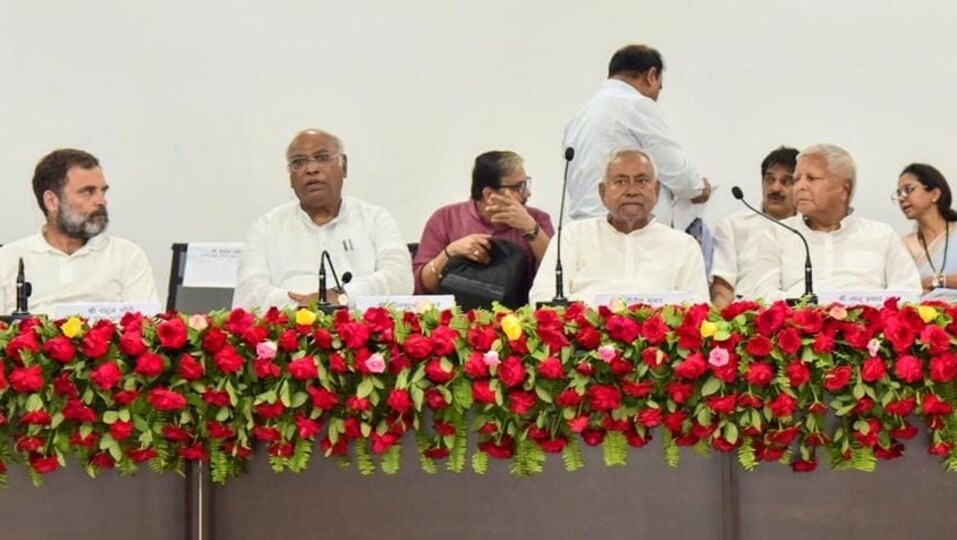
One constituent of the Opposition group, the Aam Aadmi Party has supported the government’s push for Uniform Civil Code (UCC), another, the Shiv Sena (UBT) wants to see the fine print, but most have opposed it. Still, some opposition leaders are confident that the positions of individual parties on UCC will not adversely affect the unity achieved in their Patna meeting on June 23.
Also Read | Ex-Himachal CM's son deviates from Cong line, offers ‘full support’ to UCC
Senior leaders of the Congress and Trinamool argued that they are not expecting all 15 constituents to ftake similar positions on various political issues. But as in the Patna meeting, the upcoming Opposition meeting in Bengaluru in mid-July will focus on common issues such as federalism, jobs, economic woes and the Centre’s alleged interference in Opposition-ruled states.
“All 15 parties are not photocopies of each other,” said Trinamool’s Rajya Sabha leader Derek O’Brien.
“After the Patna summit, the second summit will consolidate on those issues that we have a 100% agreement on. We are aware that on some issues, all parties will not be on the same page. This is not unusual. There is total agreement at the macro level on the way ahead” he added.
A senior Congress strategist pointed out that in the Patna meeting, 14 of 15 Opposition parties agreed that there would be unity on a common agenda and that the Opposition parties will fight unitedly against the BJP.
Also Read | Kapil Sibal's swipe on PM Modi over UCC remarks: ‘Why now after 9 years’
“In the Patna meeting itself, we showed how we can overcome issues of individual parties. (AAP’s) Arvind Kejriwal was focused on the Delhi ordinance and wanted Congress’ assurance but both West Bengal chief minister Mamata Banerjee and former J&K CM Omar Abdullah intervened . Abdullah had told Kejriwal that there are “bigger issues” to be discussed”, this person added
O’Brien claimed that UCC is BJP’s attempt to divert the attention. “When you cannot deliver on jobs. When you cannot control price rise. When you rip the social fabric. When you fail to keep every promise made. All you can do, in your desperation, is to fan the flame with your deeply divisive politics before 2024,” he said.
UCC refers to a common set of laws that will subsume customary laws across faiths and tribes and govern issues such as marriage, divorce, inheritance and maintenance. In the Constitution, it is a part of the non-justiciable directive principles of state policy. In a 2018 consultation paper, the law commission said UCC was “neither necessary nor desirable at this stage”. Earlier this month, the law commission again sought views and suggestions on UCC from the public and recognised religious organisations. Moreover, some states such as Uttarakhand have set up panels to explore implementation of UCC.
The issue got a fresh fillip on June 27, when Prime Minister Narendra Modi spoke to BJP booth workers and made a strong case for UCC. “These days, people are being provoked by the UCC. You tell me, if there is one law for one person in a home, and another law for another person, can that house function?” Modi asked. As the crowd roared in denial, Modi said, “Then how can a country work with such a hypocritical system? We have to remember that even the Constitution of India talks of common rights.”
Also Read | What the UCC debate entails
Another senior Opposition leader said that in the Bengaluru summit, the issue of UCC might be raised by individual leaders but that the summit will remain focused on the strategy for 2024 election. “The key agenda is to discuss the electoral strategy, fielding common candidates backed by all parties in maximum seats, and a common agenda for protests and the upcoming monsoon session,” the Congress leader cited abovea dded.
The AAP, which has governments in Delhi and Punjab, supported the UCC and said, “In principle, we support Uniform Civil Code (UCC) as Article 44 also says that there should be UCC in the country. However, it should be implemented after wider consultation with everyone. We feel that there should be wide consultation with all religions, political parties and organisations and a consensus should be built.”
Shiv Sena (UBT) party president Uddhav Thackeray on Wednesday told members of the Muslim Personal Law Board (MPLB) that his party supported the UCC but needed clarification from the central government on the possible impact of the law on various communities.
NC leader Farooq Abdullah has slammed the government over UCC. “Our country is diverse and so they should rethink the implementation of UCC. People of different religions live here. Muslims have their own Shariat law and if they (Union government) implement UCC, there could be backlash or possible storm.”


