
 E-Paper



Uddhav Thackeray opposes Maharashtra's move to make Hindi compulsory in schools
Uddhav Thackeray said that his party has no issue with the Hindi language but questioned why it is being ‘imposed’ in the state.

 Prefer HTon Google


Shiv Sena (UBT) chief Uddhav Thackeray on Saturday said that his party will oppose making Hindi compulsory in Maharashtra, after the state government decided to introduce Hindi as a mandatory third language for students in classes 1 to 5.
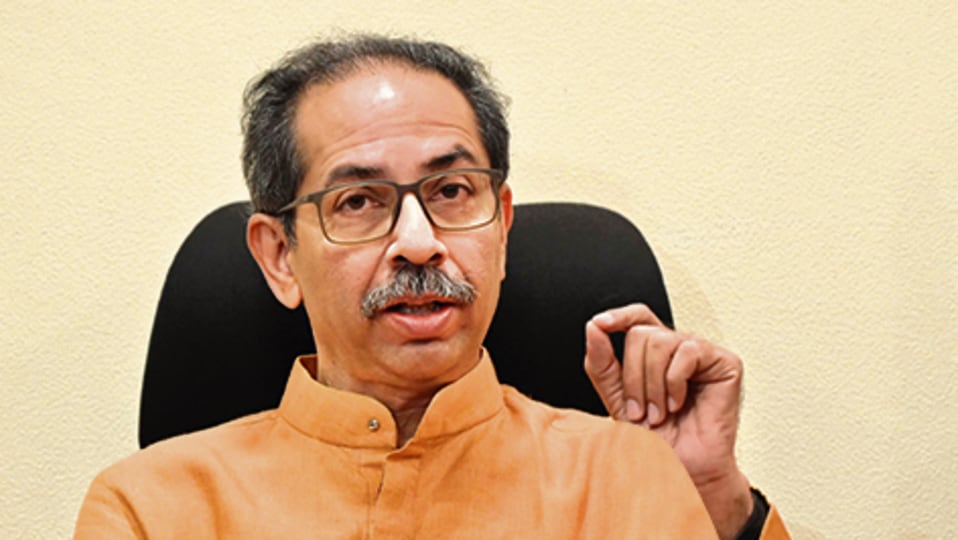
Speaking at a Bharatiya Kamgar Sena event, the workers' wing of Shiv Sena (UBT), Thackeray said that his party has no issue with the Hindi language but questioned why it is being imposed.
Thackeray's response came amid opposition criticism of the Maharashtra government's decision to make Hindi a mandatory third language for students in Classes 1 to 5 in both Marathi and English-medium schools, replacing the previous system of studying two languages.
Earlier, on Friday, Maharashtra state Congress president Harshvardhan Sapkal accused the BJP-led government of “imposing Hindi” on Marathi-speaking students, warning that the move threatens to erase regional languages and cultural identity.
Hindi to be mandatory from academic year 2025–26
The Maharashtra government announced that Hindi will become a mandatory third language for students in Classes 1 to 5, starting from the academic year 2025–26.
This decision is part of the phased implementation of the National Education Policy (NEP) 2020 at the school level, as per a government resolution (GR) issued by the school education department on Wednesday.
The three-language formula, which currently applies only to secondary education, will now be extended to the primary level. This change will bring notable adjustments to the language curriculum, particularly in Marathi-medium and English-medium schools.
Under the state curriculum framework, students in Marathi- and English-medium schools will now be required to learn Hindi starting from Class 1.
In schools with other mediums of instruction, Marathi and English will be mandatory subjects, with the language of instruction serving as the third language.
According to the GR, the NEP will be implemented in four phases, starting with Class 1 in the 2025–26 academic year. The new structure replaces the existing 10+2+3 model with a 5+3+3+4 model, dividing schooling into four stages: Foundation (ages 3 to 8), Preparatory (Classes 3 to 5), Pre-Secondary (Classes 6 to 8), and Secondary (Classes 9 to 12).
With PTI inputs


