
 E-Paper



Unfortunate that Aadhaar Act was challenged in court: PM Modi
In 2018, the apex court upheld the constitutionality of the Aadhaar Targeted Delivery of Financial and other Subsidies, Benefits and Services Act, 2016 (Aadhaar Act) and the 12-digit unique identity scheme.


Prime Minister Narendra Modi used the Aadhaar scheme to target the opposition parties while replying to motion of thanks on the President's address in Lok Sabha on Wednesday. PM Modi said that schemes like Jan Dhan accounts and Aadhaar were very useful for the poor during Covid-19 but the opposition moved court against such programmes.
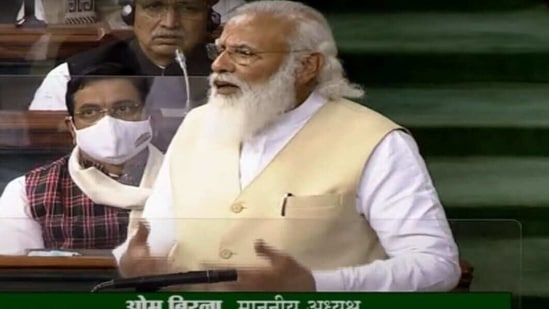
He said, “Our Jan Dhan-Aadhaar-Mobile trinity made a positive difference in people's lives. It helped the poor and the marginalised. Unfortunately, people went to court against Aadhaar.” The Prime Minister was talking about how through Aadhaar, the government was able to send essential items and transfer cash over the past few years.
The Aadhaar scheme was first challenged in court in 2012 on grounds that it invaded privacy and lacked statutory backing. Later in 2018, the apex court upheld the constitutionality of the Aadhaar Targeted Delivery of Financial and other Subsidies, Benefits and Services Act, 2016 (Aadhaar Act) and the 12-digit unique identity scheme.
The court had then said that Aadhaar would be needed for accessing social welfare schemes but citizens cannot be forced to present Aadhaar while opening bank accounts and for getting mobile and internet connections.
The government in 2016 introduced the Aadhaar Act in Parliament. The validity of the act was challenged once more in the Supreme Court on grounds that it was passed as a money bill and it had circumvented the Rajya Sabha.
The Article 110 of the Constitution says that a money bill is a bill which includes provisions relating to taxation, borrowing of money by the government, appropriation of money out of the Consolidated Fund of India and expenditure from or to the Consolidated Fund of India. A money bill originates in Lok Sabha and once passed by the house with a simple majority in the Lok Sabha, it is then sent to the Rajya Sabha for its recommendations. The recommendations of the Rajya Sabha are not binding on the Lok Sabha.
In 2018, former Chief Justice of India Dipak Misra declared privacy a fundamental right while upholding the validity of Aadhaar saying it involved “parting with minimal information” to fulfil the “larger public interest” of the marginalised and the poor, who can use it to obtain government benefits and subsidies, an argument which was strongly put forward by the central government in defence of the 12-digit unique identity number.


